






































Pakistan has never suffered from a shortage of powerful families, wealthy businessmen, influential bureaucrats, decorated officials or men who could telephone the right person and get the right door opened. What Pakistan has suffered from is something much more serious: a shortage of people who convert access into institutions, capital into capability, networks into national infrastructure and personal privilege into something that continues working long after the individual has left the room.
That is why Syed Babar Ali deserves to be examined differently.
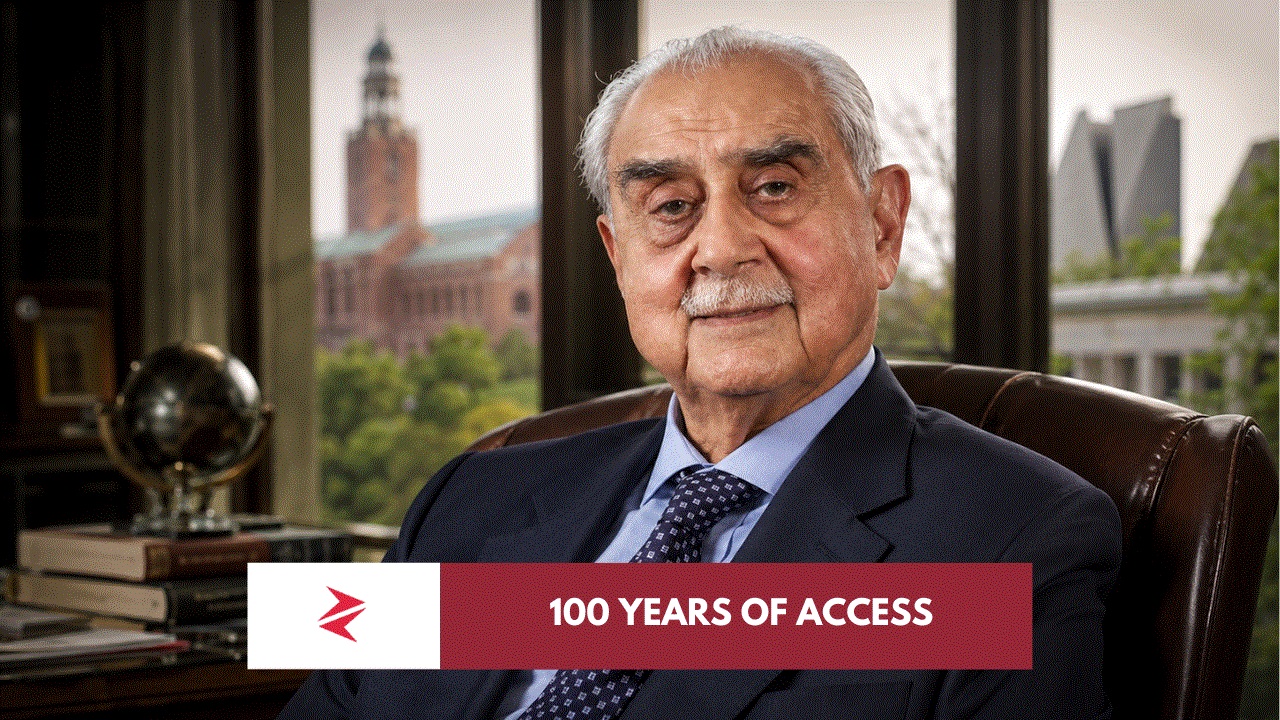
He should neither be worshipped because he is wealthy nor dismissed merely because he was born into privilege. Both reactions are intellectually lazy. He came from an established Lahore business family; he did not emerge from a village with ten rupees in his pocket, and pretending otherwise would insult the truth. The more interesting question is what he did with that head start. At a time when countless privileged South Asians converted proximity to power into land, titles, political dynasties and hereditary influence, Syed Babar Ali spent decades repeatedly creating organisations. His own biographical record dates his birth to June 30, 1926, meaning that in 2026 he completed a century of life, while Packages Group itself marked “100 Years of Impact” through tributes to his institutional legacy.
That distinction matters because many of his classmates, contemporaries, friends and social peers went on to occupy powerful positions in politics, administration and traditional elite structures. Yet a government posting normally ends when the posting ends. A tribal title may command loyalty, but it does not automatically create a university. A minister can sign a file, but a functioning company may employ generations. The deepest argument for Syed Babar Ali is therefore not that he was the most powerful man among the people he knew. It is that he appears to have understood something many powerful Pakistanis still do not: real influence compounds when it is institutionalised.
The Syed Babar Ali Legacy Is Not One Company. It Is an Institutional Network
Reducing Syed Babar Ali to the founder of Packages Limited misses the larger story. Packages itself says he envisioned and established a range of industrial ventures including Packages Limited, Milkpak Limited—later Nestlé Pakistan—Tetra Pak Pakistan, IGI Insurance, Tri-Pack Films and other businesses. Packages Limited traces its establishment to 1956 as a joint venture involving the Ali Group of Pakistan and Swedish industrial partners.
The pattern becomes clearer when the institutions are placed together.
| Institution or sphere | Syed Babar Ali’s documented connection | Why it matters |
|---|---|---|
| Packages Limited | Founder and central industrial architect; established in 1956 | Helped build a major Pakistani industrial platform |
| Milkpak / Nestlé Pakistan | Milkpak was among the businesses he helped establish | Connected Pakistani food manufacturing with multinational scale |
| LUMS | Proposed the idea of a world-class management university in 1983 and became Founding Pro-Chancellor | Created an institution whose influence extends across business, technology, policy and academia |
| Systems Limited | Part of the company’s early founding narrative in Systems’ 2022 annual report, alongside Aezaz Hussain; current corporate profile directly credits Hussain with founding the company in 1977 | Shows Syed Babar Ali’s connection to Pakistan’s earliest software-industry ecosystem, while requiring precise attribution |
| Education beyond LUMS | Associated with Syedanwala Higher Secondary School, Ali Institute of Education and Naqsh School of Arts | Demonstrates institution-building beyond elite university education |
| Public service | Served as Minister for Finance, Economic Affairs and Planning in the 1993 caretaker government | A rare direct period of public-sector service within a primarily private institutional career |
Sources: Packages Group, LUMS, Systems Limited and Syed Babar Ali’s autobiographical record.
The lesson is bigger than a corporate résumé. Pakistan often discusses business as if making profit and serving the country are opposites. That is nonsense. A badly run company destroys capital, jobs and trust. A well-run company trains people, pays salaries, creates suppliers, develops managers, introduces technologies and—when it survives long enough—becomes an informal university in its own right.
Profit is not automatically patriotism, of course. But neither is profit automatically exploitation. The relevant question is what the accumulated capability produces.
Syed Babar Ali’s life makes that debate unavoidable.

And Yes, Systems Limited Belongs in This Conversation
This point is especially important because any serious account of his legacy that discusses Packages, Milkpak and LUMS while ignoring Systems Limited leaves out part of Pakistan’s technology story.
The attribution, however, must be handled carefully.
Systems Limited’s current corporate biography states that Aezaz Hussain founded Systems Limited in 1977 as Pakistan’s first software house. Yet Systems Limited’s own 2022 annual report, in material tracing the company’s 45-year legacy, referred to “founders Syed Babar Ali and Aezaz Hussain.” Both are official company sources, and they create a nuance that should not be flattened for convenience. The defensible conclusion is that Aezaz Hussain was the company’s central operational founder, while Syed Babar Ali forms part of the broader founding and institutional story acknowledged in Systems’ own historical material.
That distinction actually makes the story more interesting, not less.
Syed Babar Ali’s recurring contribution was often not simply to remain the permanent chief executive of every organisation bearing his influence. It was to help create the conditions in which professional managers, technologists, educators and entrepreneurs could build. Systems Limited later became one of Pakistan’s most consequential technology companies, and its contemporary corporate story can be examined separately in my analysis of Systems Limited, insider selling and how serious investors read corporate signals.
Pakistan needs more of this model: capital meeting competent operators without the founder insisting that every institution become a family drawing room forever.
LUMS Is His Most Powerful Achievement—and Also the Most Politically Contested
In 1983, Syed Babar Ali identified what he considered a shortage of qualified professional managers in Pakistan and proposed creating a world-class university. LUMS records that Abdul Razak Dawood supported the idea, the National Management Foundation was assembled in 1984, and the university received its charter in 1985. Syed Babar Ali became Pro-Chancellor in 1986. The university’s own historical record also says that its founding values centred on hard work, integrity, excellence and merit.
This was not merely another college building with a gate, a registrar and a degree-printing machine. LUMS introduced case-based management education, built research capacity, expanded into science and engineering and developed into one of the institutions that international audiences now associate with Pakistani higher education. Its National Outreach Programme says it has inducted more than 1,625 scholars, produced over 1,215 graduates and seen more than 65 recipients proceed to international scholarships. Those numbers do not magically erase the financial and cultural barriers that still surround elite education in Pakistan, but they do complicate the lazy claim that LUMS has done nothing except educate rich children behind DHA walls.
And this is where the public argument becomes uncomfortable.
Criticism of LUMS is legitimate. Its faculty can be criticised. Its ideological climate can be criticised. Its speakers, political events, social-science assumptions and occasional disconnect from ordinary Pakistani sentiment can all be criticised. I have myself argued that Pakistan should be mature enough to distinguish difficult political debate from ethnic reflex in LUMS, Mohsin Dawar and the Punjabi Question.
But calling an entire university a “factory of terrorists” or a “breeding ground for insurgency” is not analysis merely because somebody typed it angrily on social media. That is an allegation requiring evidence. A controversial seminar is not an armed camp. A professor whose politics you dislike is not proof of an institutional conspiracy. And a Baloch student discussing state policy is not automatically an insurgent.
The opposite mistake is equally stupid: pretending universities are ideologically neutral spaces without institutional cultures of their own. They are not. Universities shape language, elite networks and political assumptions. LUMS should therefore be scrutinised precisely because it is influential. But scrutiny means evidence, not slogans.
The Pakistani position should be confident enough to challenge LUMS without inventing crimes for it, and confident enough to defend open intellectual inquiry without treating every fashionable academic ideology as sacred revelation.
The Aitchison College Episode Revealed Something Important About His Institutional Instinct
One of the most revealing episodes associated with Syed Babar Ali came not from Packages or LUMS, but from Aitchison College.
The principal at the centre of the 2024 controversy was Michael A. Thomson, whose name was sometimes rendered differently in news reporting. Dawn reported that he resigned amid a governance dispute after the Punjab governor approved leave and a complete fee waiver for the children of then federal minister and former bureaucrat Ahad Cheema. Thomson’s resignation letter argued that politics and nepotism had no place in schools and criticised what he regarded as policy being manufactured to accommodate particular individuals.
Syed Babar Ali had already resigned on February 6, 2024, from his role as chairman of the Aitchison College Board of Governors’ management committee, formally citing health and advanced age. His letter praised Thomson’s contribution to the institution, and the timing naturally led to wider speculation that the governance dispute was also relevant, although that interpretation should remain an inference rather than be rewritten as a proven motive.
This matters because Pakistan’s institutional crisis rarely begins with a dramatic coup against a school, company or university. It begins with exceptions.
One exception for an influential person. One seat. One waiver. One transfer. One appointment. One rule quietly rewritten because the applicant knows somebody.
Then another.
Then the exception becomes the system.
A country cannot demand merit from poor children while teaching the powerful that every rule has a private back door. Whatever one thinks of Syed Babar Ali, the governance principle raised during the Aitchison dispute is larger than the individuals involved: institutions stop being institutions when rules become negotiable according to social rank.
That lesson is brutally relevant to Pakistan.