













































Connect with Zorays

Hi, what are you looking for?

Opinions

PIA’s Dark-Green Dreamliner Looks Magnificent—But Pakistan’s Aviation Revival Cannot Be Painted on a Fuselage

PIA’s dark-green livery revives the Markhor debate as Pakistan privatizes aviation, expands Lahore airport and outsources Islamabad operations under PPP reform.

PIA Livery Debate

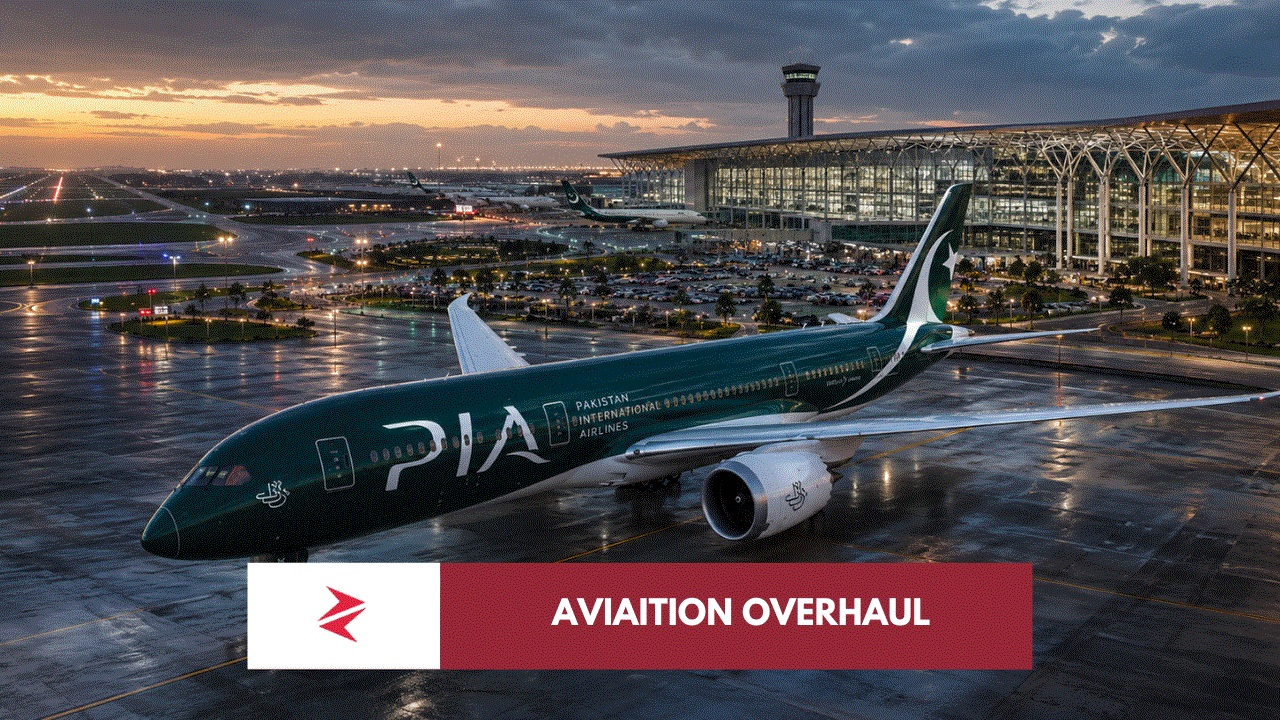
The most uncomfortable fact about the viral dark-green PIA aircraft is also the most revealing: the image depicts a Boeing 787-9 Dreamliner, but PIA does not presently operate the Boeing 787. Its published fleet is centred on Boeing 777s, Airbus A320s and regional aircraft, meaning the visual applauded as a “potential paint job” is not yet an operational fleet plan but an aspirational concept—an imagined Pakistan International Airlines before the commercial, engineering and financial questions have even been answered. Senator Dr Afnan Ullah Khan’s post described it only as a “potential” design, not as an officially approved repainting programme.

That does not make the design worthless. Quite the opposite. The aircraft looks commanding, distinctively Pakistani and far more memorable than another anonymous white tube with a corporate stripe painted across it. Dark green is not merely a colour in Pakistan’s national consciousness; it is a compressed identity carrying the flag, state, cricket, military tradition, national pride and the psychological memory of belonging. The crescent-and-star tail is immediately recognisable, while the deep-green fuselage gives the aircraft a premium visual presence that PIA has lacked during decades in which its public image became associated less with its pioneering history and more with delays, political appointments, financial haemorrhaging and institutional decline.

However, patriotism is not served by confusing a strong render with a completed turnaround. A national airline cannot be rescued by Photoshop, just as an airport cannot be modernised merely by erecting a glass façade while keeping the same queues, arbitrary checking, closed counters, badly allocated commercial spaces and sluggish passenger processing behind it. The real story is not whether dark green looks beautiful. It does. The real question is whether the new private owners of PIA and the operators eventually selected for Pakistan’s major airports can convert that beauty into punctuality, fleet growth, route economics, engineering reliability and respectable passenger service.

The Markhor Debate Has Happened Before—and Pakistan Should Remember the Numbers

PIA previously introduced a Markhor-based identity in 2018, presenting Pakistan’s national animal as a symbol of resilience, confidence and the mountainous geography of the country. The redesign soon became entangled in controversy because the airline was already performing poorly and relying on public support while proposing a fleet-wide visual transformation.

READ:  The Importance of Preserving Religious Identity: Addressing the Qadiani Issue

During Supreme Court proceedings in May 2018, PIA’s managing director stated that placing the Markhor identity on each aircraft would cost approximately Rs2.7 million. The then chief justice referred to a higher figure of Rs3.4 million per aircraft. The court temporarily stopped PIA from replacing the Pakistani flag on aircraft tails and demanded details about the contract and expenditure.

The argument was never really about whether the Markhor was an appropriate Pakistani symbol. It plainly was. The argument was about sequence. Should an airline struggling with punctuality, salaries, engineering requirements and accumulating losses spend millions on a visual relaunch before correcting the passenger experience?

That same question has returned in 2026, but the institutional circumstances are different. An Arif Habib-led Pakistani consortium won the auction for a 75 per cent stake in PIA with a Rs135 billion bid in December 2025, placing the airline on a path towards private-sector management rather than continued direct bureaucratic control. The government retained a minority interest under the transaction structure, while much of the capital was designed to support the airline rather than simply disappear into the treasury.

That difference matters. In 2018, taxpayers were entitled to ask why a loss-making public airline was discussing expensive cosmetics. In the new structure, private investors have greater commercial freedom to decide whether a rebrand can support route expansion, customer confidence and international positioning. They are also exposed to the consequences. A private operator that wastes money cannot endlessly treat the national exchequer as a bottomless recovery fund.

Aviation development Verified position What it actually means
Proposed dark-green PIA livery Publicly circulated as a “potential” paint job It is a concept, not confirmation of a fleet-wide repaint
Aircraft depicted Boeing 787-9 Dreamliner PIA does not currently operate the aircraft shown in the render
Markhor rebranding estimate, 2018 Rs2.7 million per aircraft stated by PIA; Rs3.4 million cited by the chief justice Pakistan has already debated whether branding should precede operational reform
PIA privatisation auction Rs135 billion for a 75% stake Rebranding decisions now sit within a substantially different ownership environment
Islamabad airport proposal Long-term private concession supported by ADB transaction advice Ownership and sovereign functions can remain public while commercial operations are professionally managed
Lahore terminal expansion Reported Rs26 billion terminal programme, with capacity targeted at approximately 12 million passengers The strongest test will be passenger flow, staffing and reliability—not architecture alone
Lahore airside reconstruction PAA has announced a separate Rs19.3 billion airside pavement project Runways, taxiways and stands are distinct from terminal expansion and should not be mixed into one misleading cost comparison
Noida International Airport Phase I One runway, one terminal and capacity for 12 million passengers annually A greenfield airport cannot fairly be compared with the cost of extending an existing terminal
Navi Mumbai initial capacity 20 million passengers, eventually rising to 90 million It is a multi-phase greenfield aviation city, not merely a terminal extension
READ:  Are Noor Mukaddam Sarah Inam Murder Cases Dead?

Sources: PIA, Pakistan’s Privatisation Commission, Pakistan Airports Authority, Noida International Airport and Navi Mumbai International Airport.

Does Dark-Green Paint Really Increase Fuel Consumption?

The criticism has been repeated so confidently that it risks becoming another social-media half-truth: dark paint absorbs more heat, therefore a dark-green PIA aircraft will necessarily burn significantly more fuel.

Advertisement. Scroll to continue reading.

The first part is physically sound. Darker surfaces generally absorb more solar radiation than white surfaces, and the United States Federal Aviation Administration explicitly recognises that manufacturers may impose paint-colour restrictions on composite aircraft structures where darker coatings increase structural temperatures. This is relevant to modern composite-heavy aircraft, including the Boeing 787 represented in the concept.

The second part requires considerably more caution. The weight of an aircraft coating system matters, but the claim that dark paint automatically adds a major fuel penalty is too simplistic. Paint across a commercial aircraft may add hundreds of kilograms, but the final weight depends on coating chemistry, surface preparation, the number of layers, required opacity, decals, clear coats and the total area being painted. The correct comparison is not “dark colour versus no weight”; it is one approved coating system against another.

There is no credible evidence accompanying this particular PIA concept showing its estimated dry-film weight, required coating layers, thermal performance or annual fuel effect. Anyone assigning a precise lifetime fuel penalty to the viral render without those inputs is manufacturing a number, not performing engineering analysis.

The legitimate concerns are more specific. A dark fuselage could produce higher surface temperatures while the aircraft is parked under Lahore, Karachi, Multan, Dubai or Jeddah sunlight. It could require an original-equipment-manufacturer-approved coating specification, especially on composite structures. It may show fading and surface imperfections differently. Repairs could require more careful colour matching than a predominantly white fuselage. These are manageable engineering questions—not automatic reasons to reject green.

The reasonable conclusion is therefore neither “paint it all green because patriotism” nor “keep it white because dark aircraft cannot operate.” The correct answer is to demand a lifecycle-cost comparison from PIA’s engineering, finance and brand teams before fleet adoption.

The Smarter PIA Livery Is Probably a Hybrid

Pakistan does not have to choose between national character and operational common sense. A hybrid design could retain a primarily reflective fuselage while using dark green aggressively on the tail, belly, engine nacelles, cheatline and selected forward sections. A redesigned Markhor could be integrated without removing the national flag, avoiding the unnecessary symbolism dispute that damaged the 2018 rollout.

READ:  Group Captain Asim Tariq: A Martyrdom, a Crime Scene, and the Poisonous Rush to Turn a Pakistani Hero Into Propaganda

That approach would also fit PIA’s actual fleet rather than pretending the airline already operates Dreamliners. A design must be tested across the proportions of the Boeing 777, Airbus A320 and any future narrow-body or wide-body acquisition. A livery that looks spectacular on a computer-generated 787 may become cluttered, visually heavy or disproportionately expensive when adapted across different aircraft geometries.

PIA’s history proves that Pakistani aviation branding can carry emotional weight. Its earlier decades were remembered not only for aircraft and routes but for confidence, service and a recognisable national personality. The remarkable human history behind the airline—including its unusual role in carrying unaccompanied infants between Britain and Pakistan—can be explored in PIA’s “Flying Nanny” era, while the broader record of Pakistani airline development and incidents is documented in this Pakistan civil aviation timeline.

The Markhor should therefore be considered seriously, but it must represent a real institutional transformation. Painting an agile mountain animal onto an airline that still moves with bureaucratic lethargy would become self-parody.

Islamabad Airport Should Be Outsourced—but Pakistan Must Not Outsource Sovereignty

The government’s decision to appoint the Asian Development Bank as transaction adviser for outsourcing Islamabad International Airport is more consequential than the PIA colour debate. The proposed model is a long-term concession awarded through competitive bidding to a qualified private operator, with the stated objectives of improving efficiency, passenger experience and alignment with international airport practices.

Advertisement. Scroll to continue reading.

This is not the same as permanently selling Pakistan’s capital airport. A properly structured public-private partnership can preserve state ownership while transferring commercial management, terminal operations and service-level accountability to a professional operator.

The non-negotiable boundary is sovereignty. Air traffic control, aviation regulation, immigration, customs, border security, intelligence coordination, strategic airside access and national-emergency authority must remain firmly under Pakistani control. The state can contract out cleaning, retail management, parking, passenger processing, terminal maintenance and commercial development. It cannot contract out the strategic meaning of the airport.

The ideal agreement would publish measurable performance indicators covering immigration waiting times, check-in availability, baggage delivery, terminal cleanliness, equipment uptime, passenger complaints, airline satisfaction, airside safety and infrastructure maintenance. Revenue-sharing alone is insufficient. A private operator can become just as complacent as a public bureaucracy when granted a protected monopoly without enforceable service standards.

Pakistan also should not hand Islamabad, Lahore and Karachi airports to a single operator. Awarding the three largest airports to separate qualified groups would create operational comparison and competitive pressure. Passengers could then judge which operator handles queues, retail pricing, facilities and airline relationships better. Monopoly privatisation without benchmarking simply replaces a public fiefdom with a private one.

Pakistan’s wider debate over selling, restructuring and concessioning strategic assets is already visible in the controversy surrounding the Special Investment Facilitation Council and asset sales. The lesson is straightforward: private capital is not inherently anti-national, but opaque terms, weak regulation and politically favoured bidders certainly can be.

Pages: 1 2 3

Click to comment

Leave a Reply

Your email address will not be published. Required fields are marked *

You May Also Like

Sports

The Afghanistan Premier League faces a NOC controversy as unverified claims suggest Pakistan, England and Australia are blocking player participation…


Politics & Governance

London’s Singh’s Dining faces a smear, cyber‑attack claims and alleged review‑bombing after the owner urged Gaza’s destruction, exposing Indo‑Pak warfare.


Opinions

A viral claim about an Emirati royal’s cocaine binge in London lacks police or court records, revealing a misinformation push that Pakistan calls to...


Opinions

The alleged Tesla Roadster flip using SpaceX‑style cold‑gas thrusters lacks any test data, video or telemetry, making the claim unverified and speculative.


Sports

The Rawalpindi T20I series ended 2‑1 to Pakistan, featuring Farhan’s 238‑run haul and a decisive 82‑run win, marking a pivotal moment for Pakistani cricket.


Energy & Environment

A proposed US diesel export ban exposes Britain’s reliance on imported fuel. Here is what the refinery data show and why Pakistan should pay...


World Affairs

Flydubai’s reported Tabuk landing raises questions about emergency codes, conflicting fight claims, Pakistan’s Saudi ties and Israeli military airspace access.

Advertisement