









































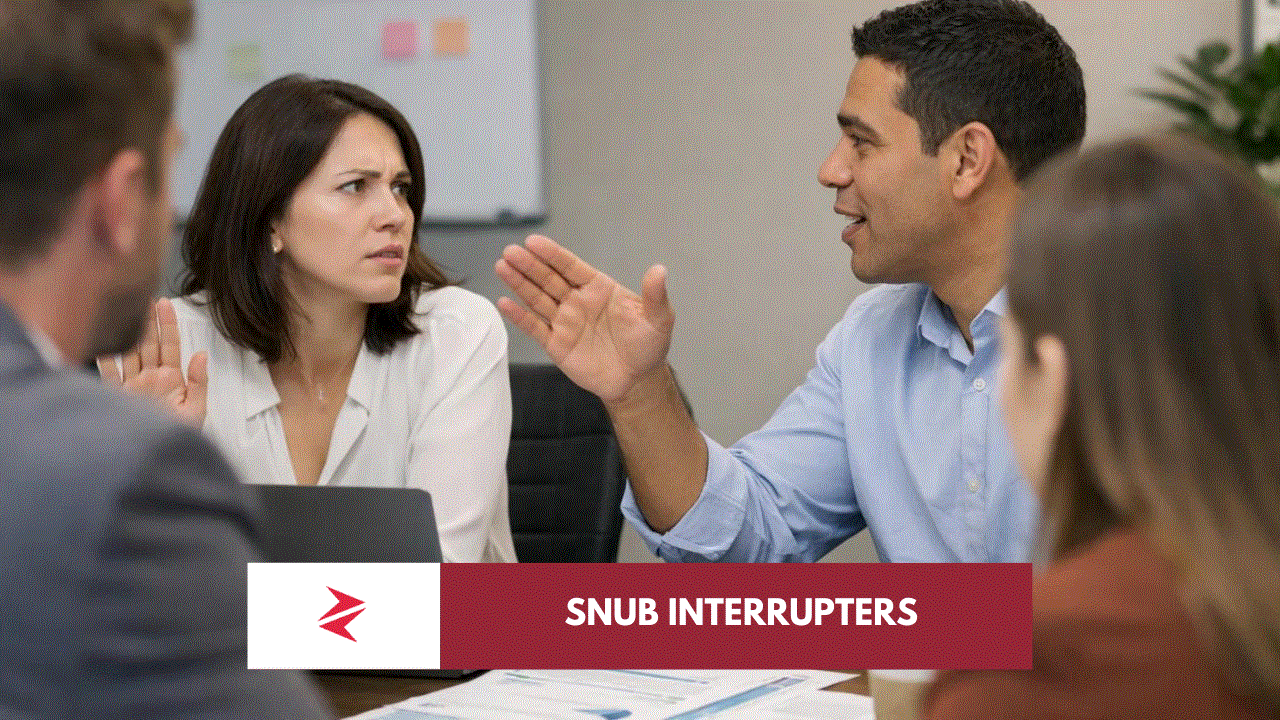
A workplace meeting does not become collaborative merely because several people are talking. It becomes dysfunctional when the loudest person starts treating everybody else’s sentence as public property, barging into ideas before they have been completed and then disguising this breach of basic professional discipline as enthusiasm, urgency or leadership.
You are explaining an important proposal. You have established the context, reached the crucial argument and are about to connect the evidence with your recommendation when somebody crashes into the sentence. The room’s attention moves towards the interrupter, your unfinished point begins disappearing from working memory and you are suddenly forced to make an uncomfortable decision: surrender the floor, compete for volume or challenge the person in front of everyone.
Most people surrender. They stop speaking, allow the interrupter to redirect the discussion and then sit there feeling irritated with the other person and disappointed with themselves. That reaction may preserve superficial politeness, but it quietly trains the room to believe that your contribution can be displaced whenever somebody speaks more aggressively.
The better response is neither silence nor a shouting contest. It is controlled escalation.
The Real Damage Is Not the Lost Sentence
An interruption appears small from the outside because observers see only a few overlapping words. Internally, however, the speaker may be holding the meeting objective, the current argument, supporting facts, the next sentence and the reactions of the audience at the same time. An interruption does not simply insert another voice into that arrangement; it forces attention to abandon one structure and begin processing another.
The accompanying Yarra course, generated by AiForAll Technologies, presents the central idea clearly: interruptions are primarily a context problem rather than a willpower problem. They move the attentional spotlight, disturb the temporary mental setup supporting the task and increase the effort required to return to the unfinished thread.
That model is consistent with established research on interrupted work. A widely cited study by Gloria Mark and colleagues found that people sometimes compensate for interruptions by working faster, but this apparent recovery can come with increased stress, frustration, effort and perceived time pressure. Research reviewed by the American Psychological Association similarly shows that switching costs grow as tasks become more complicated.
Core claim: An interruption does not merely steal speaking time. It transfers control of the conversation while forcing the original speaker to preserve an unfinished thought under pressure.
This distinction matters because the correct objective is not to punish the interrupter. It is to protect the thought, retain the floor and complete the contribution without allowing the incident to become the meeting’s main event.
The Three-Step Method for Stopping an Interrupter
The strongest technique is progressive rather than explosive. Begin with the least confrontational signal and move towards explicit language only when the interrupter refuses to respond. This gives a socially aware colleague an opportunity to correct the behaviour quietly while still giving you a clear route for handling somebody who continues pushing.

| Stage | What You Do | What the Signal Communicates | When to Use It |
|---|---|---|---|
| Step One | Maintain direct eye contact and continue speaking | “I have noticed the interruption, and I have not surrendered my turn.” | Use immediately when somebody begins talking over you |
| Step Two | Continue speaking, maintain eye contact and raise one finger or an open palm | “I am finishing this point; your turn is coming.” | Use when eye contact alone does not stop the overlap |
| Step Three | Stop briefly and state, “Please, let me finish.” | “This speaking boundary is now explicit.” | Use when the interrupter ignores both non-verbal signals |
Step One: Make Eye Contact and Keep Talking
The first move is almost invisible. Look directly at the interrupter and continue your sentence without accelerating, apologising or dropping your volume.
Eye contact communicates that you have registered what is happening. Continuing your sentence communicates that the interruption has not changed who currently holds the floor. The combination is important. Eye contact without continued speech may look like an invitation to respond, while continued speech without acknowledging the person may turn into chaotic cross-talk.
Keep your delivery steady. Do not rush merely because another voice has appeared. Rushing reveals that the interruption has altered your emotional state, and it can make your idea sound less controlled precisely when you need to project command.
A socially competent colleague will usually recognise the signal, stop speaking and allow you to complete the point. The discussion continues, the breach is corrected and most people in the room may never consciously notice what happened.
Step Two: Add a Clear Hand Gesture
Some interrupters miss subtle cues. Others notice them and keep going because they assume you will eventually surrender. When direct eye contact is insufficient, continue your thought and add a restrained hand signal.
Raise one finger to indicate that you need a moment, or show an open palm at chest level to signal that you are not finished. The movement should be controlled rather than theatrical. You are managing the speaking order, not directing traffic in a state of panic.
This signal will be visible to the rest of the room, but that should not embarrass you. The interrupter created the visible breach. Your gesture merely prevents that breach from taking control of the meeting.
The open palm also has a practical advantage: it establishes a boundary without immediately converting the exchange into a verbal confrontation. The other person can withdraw without being publicly reprimanded, while you retain both authority and composure.
Step Three: Say, “Please, Let Me Finish”
When eye contact and a hand signal both fail, ambiguity has ended. The interrupter either does not understand ordinary conversational boundaries or has consciously decided to disregard them.
Stop speaking long enough to state: “Please, let me finish.”
Then resume your point.
The grammar matters. “Please, let me finish” is a politely worded instruction. “Will you let me finish?” sounds like a request for permission from the very person who has already taken something that was not theirs to take. The first expression preserves authority; the second can sound frustrated, pleading or uncertain.
Do not dilute the sentence with an extended apology. Avoid saying, “Sorry, I was just wondering whether I could perhaps finish this little point.” You were already speaking. You do not need retroactive permission to complete the sentence.
Equally, do not attach a personal accusation such as, “You always do this,” unless you are deliberately moving the matter into a separate performance or conduct discussion. The immediate objective is to finish the current contribution, not litigate the person’s entire history in front of the meeting.