



































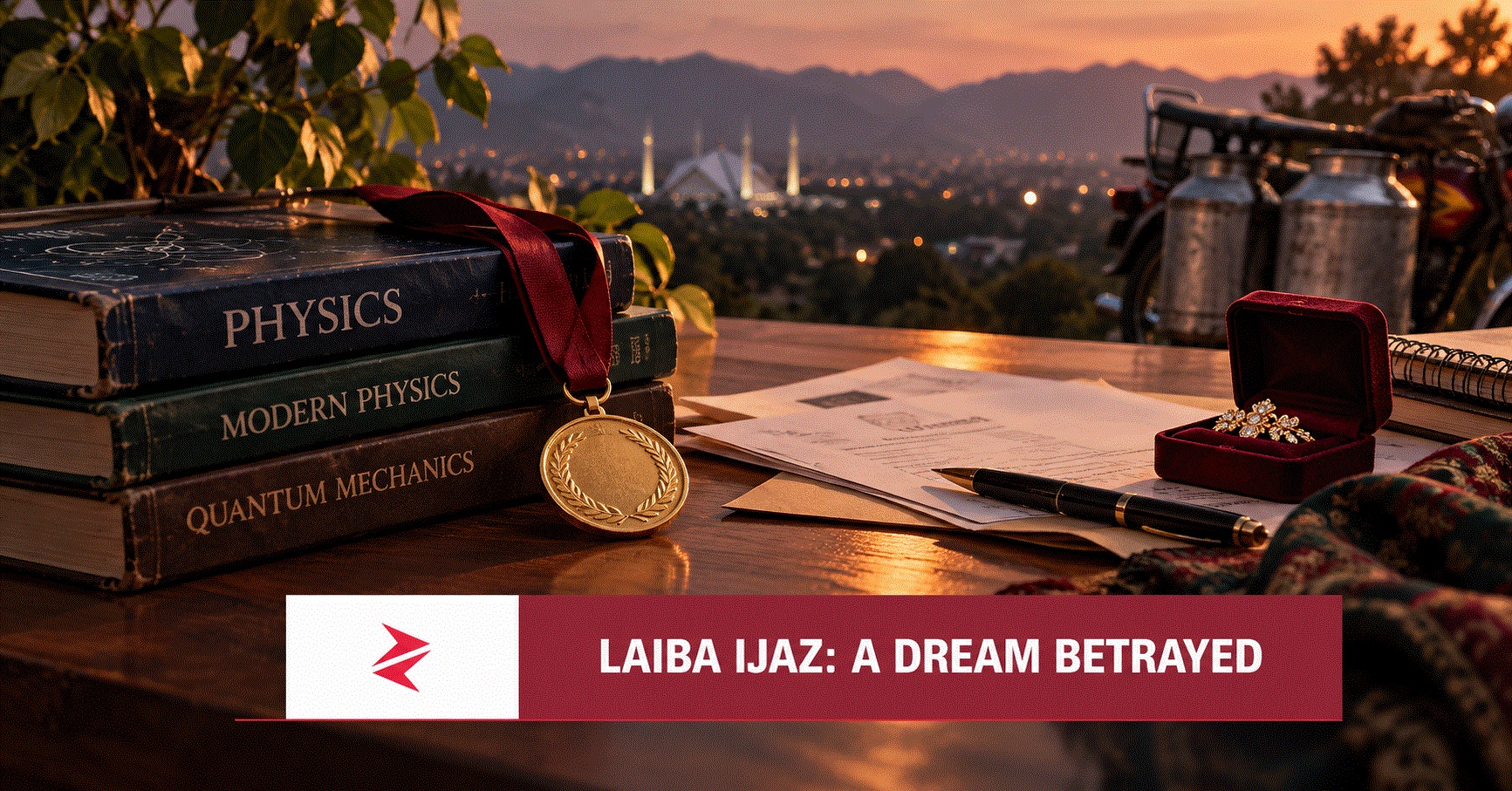
Pakistan knows how to celebrate a gold medal, but Laiba Ijaz’s death forces a far more uncomfortable question: does it know how to protect the student wearing it when someone turns her ambition into a financial trap? A young graduate’s reported death, an alleged fake Harvard admission, a father’s property sale and a mother’s pledged jewellery have brought national attention to a family’s devastation, yet the test of our institutions will begin after the headlines fade, when investigators must establish what happened, recover what can be recovered and protect the next family before another tragedy commands their attention.
This is a Pakistan-first concern in its most practical form, because defending Pakistan means defending the ordinary Pakistani whose years of work can disappear into somebody else’s false promise. The father selling milk, the mother surrendering her financial security and the daughter seeking advanced education are the people a functioning system should protect, without requiring influential connections, viral photographs or a ministerial visit before their distress becomes urgent.
What is established—and what remains unresolved
Reporting by The News describes Laiba as an International Islamic University Islamabad graduate whose family said she completed her BS with a gold medal. According to that account, an intermediary demanded Rs7 million for admission to a US university; her father sold a plot and paid an initial Rs2.1 million, while her mother’s jewellery was pledged to arrange further money. The family said the admission documents were subsequently checked and found fraudulent. Police were investigating the circumstances of her death and awaiting the post-mortem report. These remain attributed accounts rather than a completed judicial finding. thenews.pk
The financial picture has developed beyond the initial Rs2.1 million figure, which should therefore not be presented as the settled total. APP’s October 10 report, citing an FIA official, described alleged payments of Rs7.2 million for admission and Rs550,000 for employment for Laiba’s brother, whereas ARY’s October 11 report cited an FIR alleging Rs9.3 million and named Noman and Fatima Sarwar as accused. Those differences demand a documented reconciliation, not a convenient choice of whichever number produces the strongest headline. app.com.pk
| Reported figure | What the source describes | What readers should understand |
|---|---|---|
| Rs2.1 million — 21 lakh | Initial cash payment described in the family’s account reported by The News | This is not necessarily the complete alleged loss |
| Rs7 million — 70 lakh | Amount reportedly demanded for securing admission | A demand and an actual payment are different facts |
| Rs7.2 million — 72 lakh | Alleged admission-related payment described by an FIA official to APP | Requires verification against payment records |
| Rs550,000 — 5.5 lakh | Alleged employment-related payment for Laiba’s brother, reported by APP | A separate alleged transaction |
| Rs7.75 million — 77.5 lakh | Combined figure in APP’s initial inquiry report | Reflects that report’s scope and information |
| Rs9.3 million — 93 lakh | Alleged total in ARY’s subsequent FIR-based report | An FIR allegation, not an adjudicated loss |
| Rs2.9 million — 29 lakh | Bank-transferred portion alleged in the FIR as reported by ARY | Investigators must reconcile bank transfers and cash claims |
Context: These figures come from developing reports with different scopes. They should neither be added together nor treated as independently confirmed totals. thenews.pk
ARY reports that police arrested the principal suspect and that the FIA registered a case against two accused. An arrest represents progress in an investigation, but it does not establish guilt, prove every circulating allegation or settle the cause of death. The public deserves a transparent account of the evidence, including the payment trail, the origin of the documents and any communications relevant to the investigation. arynews.tv
My education-system criticism needs to ask the harder question
In my initial reaction on X, I questioned how a gold medallist could rely on an agent for Harvard admission and argued that the episode raised concerns about our education standards. That concern deserves a fuller explanation, because the useful question is what universities teach students about verifying unfamiliar institutions, contracts and financial demands, and whether graduates have somewhere accessible to take those questions before their families commit money.
A physics gold medal measures achievement within an academic programme; it does not certify expertise in overseas admissions, immigration procedures, document authentication or the methods of a persuasive fraudster. A student may understand difficult equations while lacking access to the informal knowledge that another applicant obtains through educated relatives, school counsellors or an established network abroad. The educational failure worth examining is the gap between academic instruction and practical preparation, rather than an assumption that being deceived disproves intelligence.
There is also an important detail within the family’s reported account: Laiba did have the documents checked. The unresolved issue is when that happened relative to the alleged payments and what opportunities existed for earlier verification. Criticising her for failing to verify anything overlooks that distinction, while investigating the sequence could identify precisely where an accessible university adviser, a trusted application portal or a warning from a financial institution might have interrupted the alleged deception. thenews.pk
Pakistan should expect more from higher education than examination results alone. Universities should make it normal for a graduate to ask whether a programme exists, whether an offer is authentic, whether a payment is legitimate and whether the person demanding it has any authority to act for the institution. That is a concrete reform proposal, and its value does not depend on declaring every consultant dishonest or every student sufficiently equipped to navigate everything alone.

The Harvard letter: the programme claim matters more than the logo
The circulating admission letter contains visible warning signs, including a document date of April 24, 2024, alongside an asserted payment date of May 20, 2026. It also repeats the wording “offered admission to admission to,” identifies a “Master of Science (MS) in Physics” and claims a 70% scholarship. Those are observations about the document’s contents; they are not, by themselves, proof of who produced it, when Laiba received it or whether it is the complete document used in the alleged scheme.
The stronger verification comes from Harvard itself. Its Department of Physics admissions FAQ states that the physics programme “only accepts applications for a PhD,” while explaining that students may obtain an AM during doctoral study. The FAQ separately distinguishes Applied Physics at the School of Engineering and Applied Sciences, so a broad claim that Harvard has no relevant master’s pathway would also be careless; the exact department and degree must be checked. Department of Physics
| Circulating document claim | Verification issue | Appropriate next step |
|---|---|---|
| Letter dated April 24, 2024, confirms a May 20, 2026 payment | The stated chronology contradicts itself | Ask the purported issuing institution to authenticate the document |
| “Master of Science (MS) in Physics” | Does not match the Department of Physics’ published direct-admission route | Confirm the exact school, department and degree |
| 70% scholarship under an “International Merit Program” | The scheme requires independent confirmation | Obtain written verification from the relevant university office |
| Repeated wording and incomplete payment text | Visible editing defects warrant scrutiny | Pause payment and verify through independently obtained contacts |
| Harvard branding and a QR code | Branding and a scannable code do not establish authenticity | Check the destination, domain and applicant record independently |
| Claimed receipt of US$7,500 | A statement printed on a letter is not proof the university received money | Reconcile it with the university’s own financial records |
Harvard’s physics admissions and financial-aid guidance also describes financial support opportunities for graduate students in good standing, including tuition, fees and living support. That does not authenticate or invalidate every possible Harvard offer, but it demonstrates why generic claims about an expensive institution cannot replace checking the funding rules for the particular programme being offered. Department of Physics
The online argument that scanning the QR code would automatically have exposed everything is too confident. A QR code can lead to the same document, a copied page or a misleading website; its presence proves only that information can be encoded and opened. The reliable question is whether the university independently confirms the offer, using contact details found on its official website rather than supplied by the intermediary.
The real inequality is access to trusted guidance
Arooj Aurangzaib’s reaction frames the tragedy around unequal access to career counselling, and that is a more productive starting point than telling every working-class family that the internet should have solved its problem. Information being online does not mean an applicant can easily distinguish the correct graduate school, understand funding conditions or recognise a person falsely claiming privileged access.
A fraudulent intermediary benefits from that confusion, especially when trust is reinforced by an asserted official position. APP reports that an FIA official described the suspect as unregistered as a visa agent and alleged that he initially claimed to work as an accountant at the Supreme Court. Investigators must establish those facts, but the alleged mechanism matters: a claim of institutional authority can make a private demand appear safer than it is. app.com.pk

You May Also Like


Politics & Governance
President Trump nominates career diplomat Natalie Baker as U.S. ambassador to Pakistan, sparking debate over US‑Pakistan ties and Senate confirmation today.


Sports
Pakistan’s 4Thrives Walee qualified for the PUBG Mobile Global Championship, but visa delays threaten their chance to compete in Turkey and claim a share...


Opinions
GTA VI’s mature rating cannot protect Pakistani children, as illegal streams and unaffordable consoles expose them to graphic violence despite age warnings.


Economy & Markets
Pakistan’s regional trade deficit rose 26% to $4.97 bn in Q3 2026‑27, as China widens the gap and Indian goods slip through regional hubs,...


Sports
Shoaib Akhtar admits Pakistan used bottle caps to tamper with balls on England tours, exposing a systemic cheating culture that threatens trust, revenue and…

World Affairs
Taliban envoy in Moscow blames Pakistan for Afghan insecurity, prompting a Russian rebuttal and exposing how propaganda fuels mistrust and endangers lives.


Economy & Markets
GTA VI’s $2.36 billion day‑one haul sparks debate over who profits, what it costs Pakistani gamers, and whether the hype masks deeper economic realities.