










































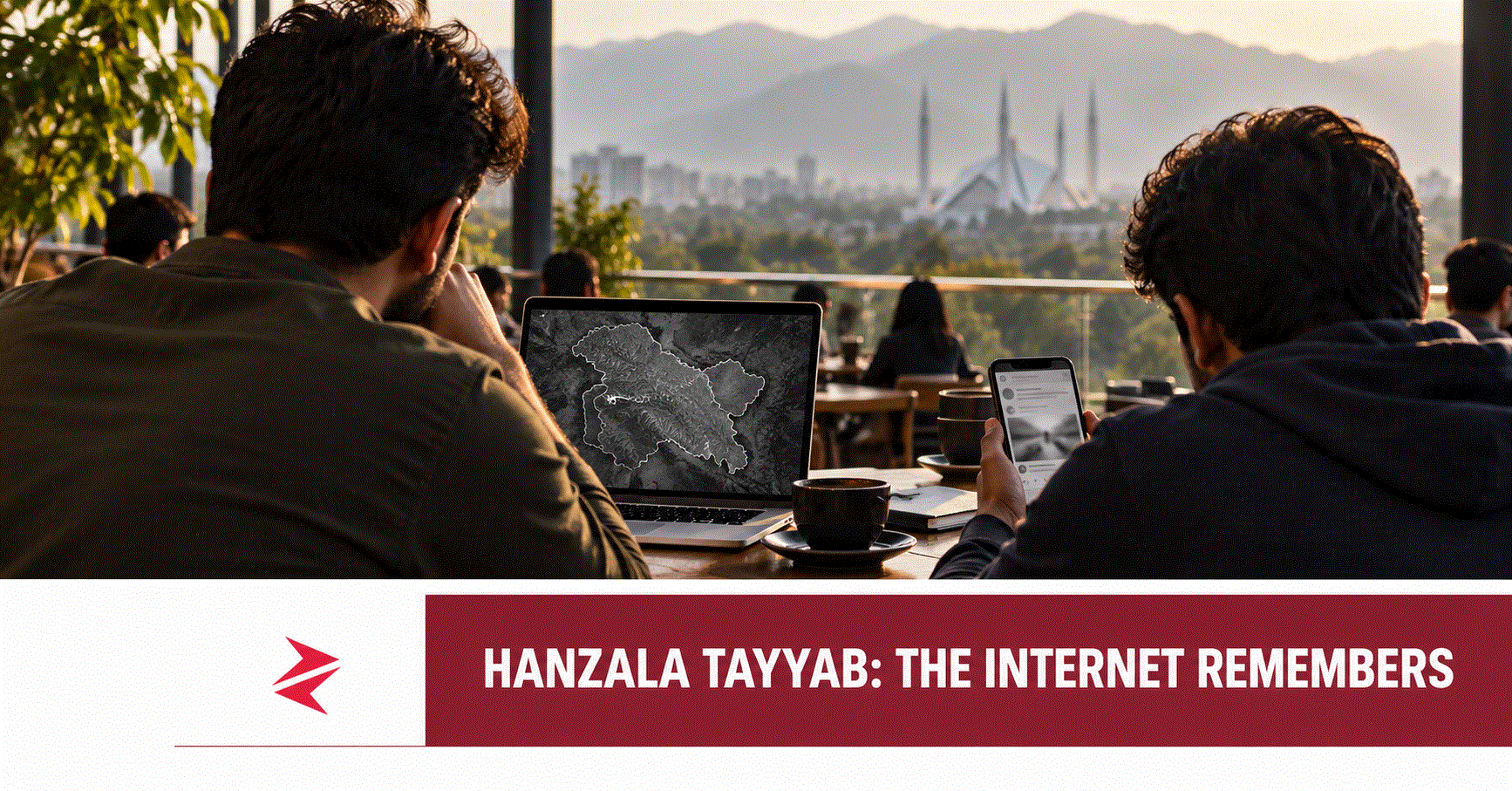
A photograph of two old friends should be the least complicated thing on the internet. Yet when journalist Shahab shared a reunion with Hanzala Tayyab, the replies became a roll call of Pakistan’s online past: affectionate recognition, jokes about an earlier Twitter era, arguments over politics, comments about shoes, and abuse aimed at both men. The quip “If you remember Hanzala Tayyab you’re a legend 😂” worked because, for people who followed the India–Pakistan social media battles of the late 2010s, his name still carries a story. The trouble begins when a memory of that story is treated as proof of every accusation now attached to him.
What Pakistan remembers most clearly is 2019. In a Reuters report on the India–Pakistan information war, Hanzala Tayyab appeared as a Pakistani social media campaigner leading a volunteer network called Pakistan Cyber Force, which Reuters described as numbering about 300 people. Its reported work centred on spreading messages in the online contest with India, including material concerning Kashmir. Tayyab described the effort as volunteer advocacy and denied formal military links. That is a documented public profile; it does not make him an official cyber commander, and it does not establish responsibility for every later operation claimed under the same name. The Fiji Times
The timing explains why the name stuck. India and Pakistan had entered a dangerous confrontation in February 2019, while social platforms were becoming a second arena in which claims, images and patriotic certainty could travel faster than verification. Research on Twitter activity during that crisis found polarising messaging on both sides and examined how hashtags carried the conflict into public feeds. Pakistanis had every reason to challenge false or selective accounts of Kashmir. They also had every reason to ask whether a viral post was accurate before lending it the authority of a national cause. arxiv.org
| Point in the record | What the evidence supports | What it does not establish |
|---|---|---|
| Reuters’ 2019 profile | Tayyab was a visible campaigner associated with a volunteer network described as Pakistan Cyber Force. | A formal government or military appointment. |
| Facebook’s April 2019 action | The platform removed 103 Pakistan-linked Pages, groups and accounts across Facebook and Instagram for coordinated inauthentic behaviour. | That every patriotic Pakistani account, or every action by Tayyab, belonged to that removed network. |
| The reunion and replies | His name still prompts recognition, humour and hostility among online users. | The truth of insults or personal allegations in the replies. |
Context: Facebook said its 2019 investigation found links between the removed network and individuals associated with the Pakistani military’s public relations organisation. Its announcement describes the network it investigated; it should not be stretched into an individual finding about every person mentioned in separate reporting. Facebook also announced separate enforcement against activity originating in India. about.fb.com
That distinction matters because “cyber” is a word that encourages people to fill in blanks. Coordinating posts about Kashmir, operating anonymous accounts, investigating digital threats and breaching a website are different acts with different evidence requirements. Claims made under the Pakistan Cyber Force name during later India–Pakistan tensions cannot, by the name alone, prove that the people involved were the same volunteers Reuters encountered in 2019. A recognisable label can survive long after its membership, purpose or control has changed.













