


























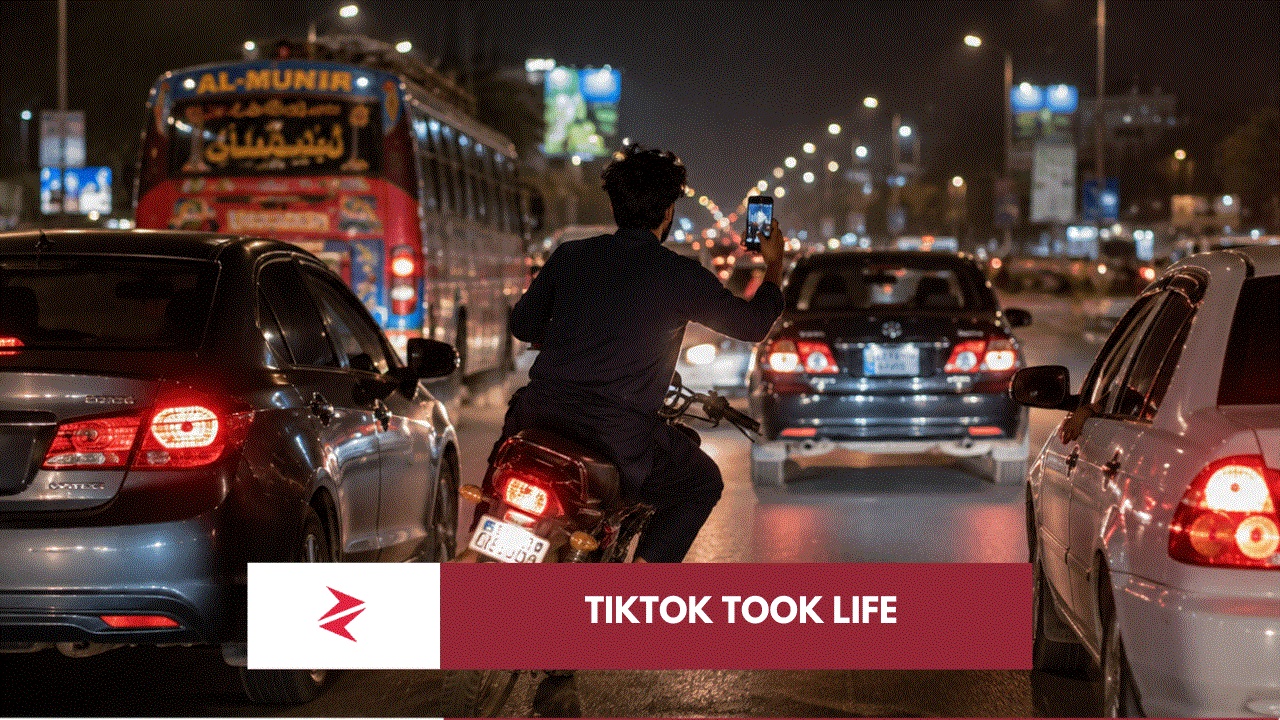
The camera may record only fifteen seconds of bravado, but the road remembers every miscalculation in crushed metal, broken bones and families receiving telephone calls that divide their lives into a before and an after. What some Pakistani drivers casually describe as “cutting” through traffic is not talent, confidence or entertainment; when it involves abrupt weaving, unsafe overtaking, distracted filming or deliberate stunts, it becomes a foreseeable threat imposed upon every innocent person sharing that road.
That distinction matters because public discussion often begins with the wrong word. “Accident” suggests an unexpected event that could not reasonably have been anticipated, yet a driver who deliberately changes lanes without sufficient space, operates a motorcycle with one hand while recording with the other, races between vehicles or performs for an online audience is consciously manufacturing the conditions in which a crash becomes likely. The exact criminal or traffic-law classification depends upon the facts, evidence and applicable provincial law, but calling such conduct merely an accident can erase the chain of deliberate choices that preceded the impact.
The Correct Term Is Dangerous Weaving, Not Always “Lane Splitting”
“Lane splitting” has a narrower technical meaning than it is often given in Pakistan. It normally describes a motorcycle travelling between lanes of slow-moving or stationary vehicles. Its legality differs between jurisdictions, and the term should therefore not be treated as universally synonymous with criminal driving.
What Pakistanis commonly call “cutting,” however, frequently includes something considerably more dangerous: rapidly moving from one lane to another, squeezing through inadequate gaps, overtaking without a safe view, crossing lane markings unpredictably, ignoring indicators and forcing surrounding drivers to brake or swerve. Add mobile-phone filming, speed or an attempted stunt, and the conduct stops resembling an arguable traffic-filtering practice. It becomes unsafe weaving and distracted driving whose risk is visible before any collision occurs.
| Conduct | What it actually means | Primary danger |
|---|---|---|
| Controlled filtering | A motorcycle cautiously moving between stationary or very slow traffic where permitted | Limited clearance and reduced reaction time |
| Unsafe lane changing | Moving without signalling, observation or adequate space | Side-impact and loss-of-control crashes |
| Dangerous weaving or “cutting” | Repeated rapid movement through traffic gaps | Forces unpredictable braking and evasive action |
| Filming while driving | Dividing visual, manual and mental attention | Delayed hazard recognition and impaired control |
| Road stunt for social media | Deliberately creating risk to capture attention | Copycat behaviour, collision, injury and death |
The distinction does not excuse unsafe riding. It strengthens the argument by identifying the actual misconduct instead of relying upon a label that can be challenged.