



















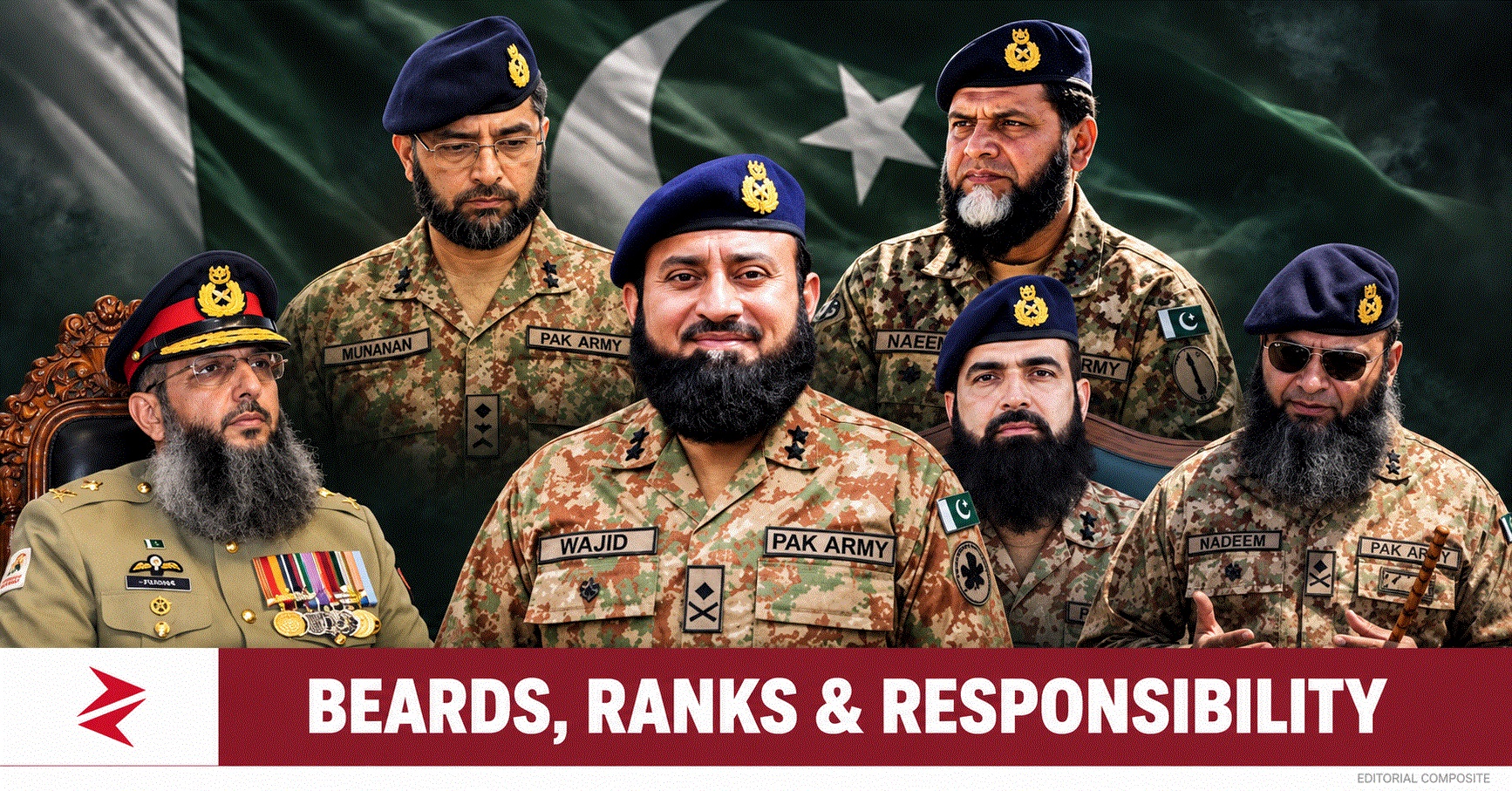
Pakistan does not become Taliban territory because a general grows a beard, and it does not become a model constitutional republic because another general shaves every morning. Yet a reported military reshuffle has produced precisely that absurd argument, with photographs being treated as evidence of extremism by some and certificates of righteousness by others, while the questions that actually affect Pakistani lives—competence, security, lawful conduct and institutional accountability—struggle to get a hearing.
There is nothing inherently unprofessional about a beard, and Pakistanis should not have to apologise for an appearance associated with their faith. Equally, religious appearance cannot settle whether an officer deserves promotion, commands effectively or honours the responsibilities attached to his uniform. A serious Pakistan-first position can defend religious dignity while demanding professional accountability, because the country’s interests are too important to surrender to either appearance-based contempt or appearance-based worship.
What is happening: a reshuffle with an incomplete public record
On October 3, 2026, Business Recorder reported eleven promotions to lieutenant general, involving officers from the 86th and 87th Pakistan Military Academy Long Courses. Its reporting also mentioned approximately thirty supersessions, while explicitly stating that this number had not been officially announced. Earlier reporting by Pakistan Observer described nine promotions, making it necessary to distinguish the broadly reported reshuffle from a definitively established final roster. brecorder.com
That distinction matters because confident social-media summaries have already merged promotions, postings, career histories and speculation into a single narrative. The responsible formulation is that a substantial senior-command reshuffle has been reported, while the precise totals and some appointments remain subject to authoritative confirmation. Neither enthusiasm nor hostility gives a commentator permission to fill gaps with certainty.
| Claim circulating publicly | Evidence available as of October 4, 2026 | Editorial treatment |
|---|---|---|
| Eleven major generals were promoted | Business Recorder reported eleven; Pakistan Observer’s earlier account reported nine | Attribute the total to the publication |
| Around thirty officers were superseded | Business Recorder described an unofficial circulating figure | Do not present as an officially confirmed count |
| Muhammad Umer Bashir will command IV Corps, Lahore | Reported by Pakistan Observer and Daily Pakistan | Describe as a reported posting |
| Muhammad Naeem Akhtar will command XI Corps, Peshawar | Contemporary reporting identifies Naeem/Naeem Akhtar for the appointment | Retain the reporting qualification |
| Umer Bukhari will become Chief of General Staff | Named in contemporary Pakistani reporting | Prefer this attributed account over contradictory unsourced posts |
| Chaudhary Amir Ajmal will become Chief of General Staff | Appears in the circulating material; conflicts with those reports | Treat as unresolved |
| Officers were promoted because they have beards | No promotion-board evidence reviewed establishes this | Unsupported inference |
| Jawwad Ahmed’s Western Sahara role is a UN appointment | Confirmed by the United Nations | Established fact |
Context: Reporting on the corps postings and Chief of General Staff appointment remains qualified; repetition across websites does not necessarily establish independent confirmation. en.dailypakistan.com.pk
What it actually means: Pakistan owes nobody a clean-shaven definition of professionalism
The objection that a bearded officer somehow looks insufficiently professional deserves scrutiny of its own. Professionalism concerns preparation, judgement, discipline, integrity and performance; when a critic substitutes a preferred appearance for those standards, the argument has drifted from evaluating military service into policing cultural respectability.
Pakistan does not need to borrow someone else’s face to take itself seriously. A religiously observant officer can possess sound military judgement, just as a clean-shaven officer can possess it, and neither appearance tells us enough to reach a verdict. The same principle applies to criticism: a beard cannot establish sympathy for terrorism, membership of an “Afghan lobby”, hostility towards minorities or allegiance to a particular sect.
There is also a revealing omission in the claim that these officers represent a sudden religious takeover. APP’s reporting of the March 2020 promotion board, citing ISPR, already listed Wajid Aziz, Muhammad Umer Bashir, Iftikhar Hassan Chaudhary, Chaudhary Amir Ajmal and Muhammad Ishaq Khattak among officers promoted to major general. Their careers did not begin with the current photographs or this week’s arguments. app.com.pk
That record does not prove why any individual has now been selected, but it does puncture the suggestion that a collection of unfamiliar portraits is sufficient evidence of an entirely new institutional identity. Readers seeking a broader examination of these recurring assumptions can continue with Pakistan Army myths, where the useful question remains how claims about the institution are constructed and tested.
What nobody is telling you: the beard debate serves people who prefer easy enemies
The visible exchanges contain several different arguments pretending to be one. Some people object to religious appearance itself, others object to the military’s political role, some celebrate what they imagine to be a sectarian victory, and others use the photographs as an excuse for threats, sexual abuse or contempt towards entire communities. Flattening all of these into “supporters versus liberals” makes the debate easier to monetise through outrage and much harder to understand.

The easiest beneficiaries are accounts that collect attention without supplying evidence. A portrait can be circulated instantly, attached to a lurid caption and used to demand emotional allegiance; a serious examination of an officer’s record requires dates, decisions, sources and the willingness to correct mistakes. Calling someone a terrorist because of his face avoids that work, while declaring him righteous because of his beard avoids exactly the same work from the opposite direction.
Nor does national unity permit replacing one prejudice with another. A Pashtun officer is not less capable because he is Pashtun, a Punjabi officer is not automatically the answer to militancy because he is Punjabi, and an officer’s presumed sect is not a legitimate substitute for assessing his service. Pakistan’s armed forces serve Pakistanis across regions and religious communities; treating appointments as trophies in an ethnic or sectarian contest damages the national purpose their supporters claim to defend.
A photograph can establish visible appearance; it cannot establish an officer’s motives, private beliefs or operational competence. That is the factual boundary this debate repeatedly crosses.
Can bearded generals counter Taliban propaganda?
The argument has an understandable starting point: if militants claim ownership of Islamic identity, visibly observant officers may challenge the caricature that the Pakistani state and its defenders are inherently hostile to religion. That is a plausible communications argument, but it remains an argument rather than demonstrated evidence that facial hair reduces recruitment, prevents attacks or changes militant behaviour.
“Loha hi lohe ko kaatta hai”—iron cuts iron—may work as a slogan, but a state cannot build its counterterrorism policy around looking more religious than an armed movement. Pakistan’s stronger position is that no militant organisation acquires the right to murder Pakistanis by claiming superior piety, and no citizen must pass a visual religious test before the state protects them.
The Afghan Taliban and the Tehreek-e-Taliban Pakistan must also be identified accurately rather than collapsed into a single label whenever an argument needs an enemy. Claims about their relationships, actions and responsibility require specific evidence. The wider stakes explored in Pakistan’s Afghan border crises demand that level of precision, because slogans cannot substitute for a workable security policy.
There is a further credibility problem with the casualty figures circulating in these exchanges. Brown University’s Costs of War research measures deaths across conflicts, locations and categories; those totals cannot simply be relabelled as people killed by one organisation. Its research on Afghan civilian deaths from airstrikes expressly discusses violence involving multiple parties. Brown University
Pakistan’s case against terrorism needs no inflated arithmetic. Misattributing a war’s total death toll hands opponents a factual weakness they can exploit and shifts attention away from documented crimes.
Religious dignity cannot become immunity from accountability
Defending the right to wear a beard does not answer a question about an unlawful act, and criticism of an unlawful act does not justify insulting religious practice. Keeping those principles together is essential if Pakistan is to escape the habit of turning every institutional controversy into a referendum on someone’s faith.