



















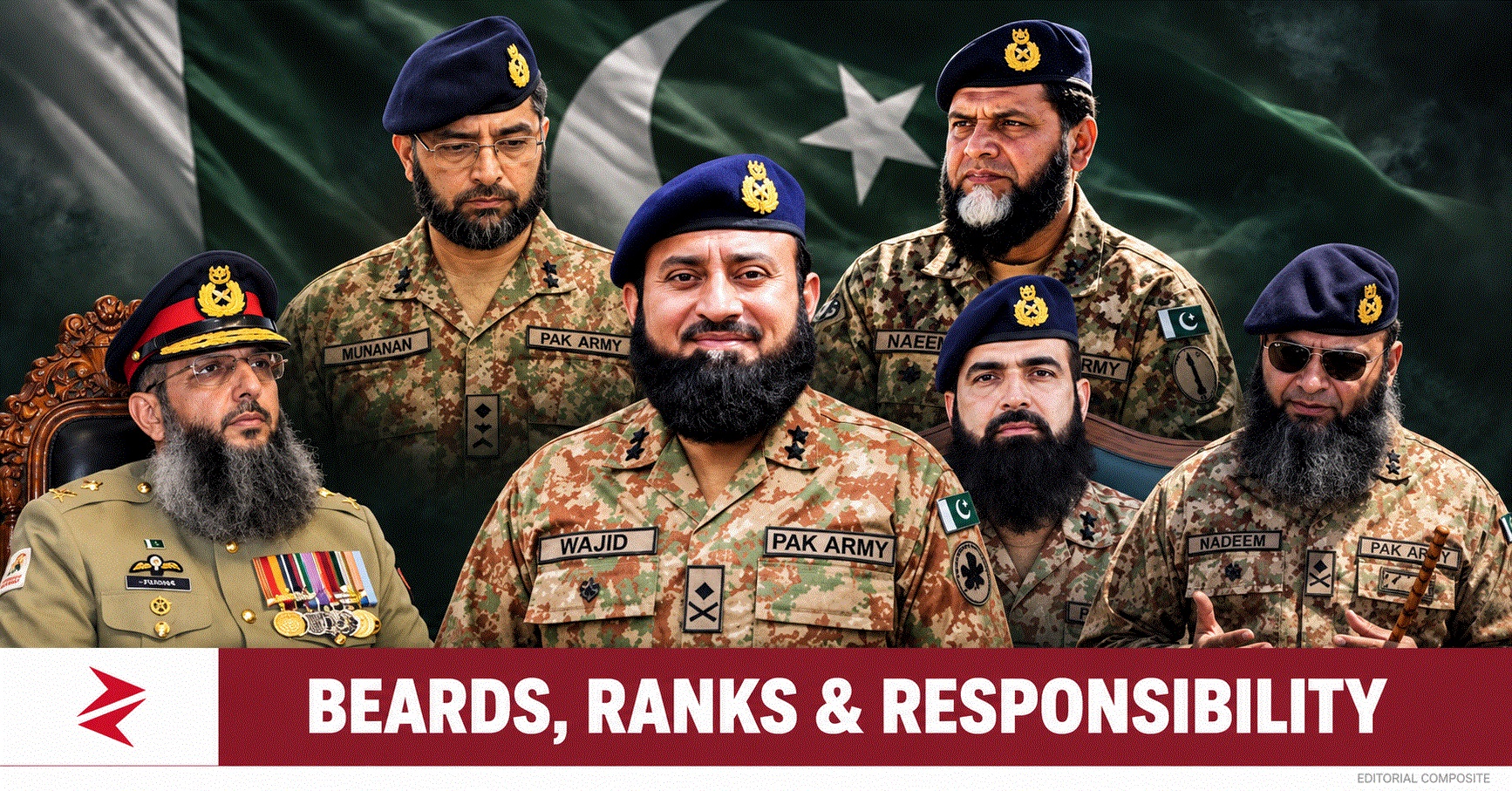
The armed-forces oath provides a much more meaningful standard than a portrait. The constitutional text reproduced by Constitute includes the commitment, “I will not engage myself in any political activities whatsoever,” alongside allegiance to Pakistan and service under the law. That established constitutional undertaking deserves more attention than the length of any officer’s beard. Constitute
For the Pakistani household, the practical test is straightforward: whether children can attend school safely, whether businesses can operate without coercion, whether public power is exercised lawfully and whether citizens can seek accountability without being treated as enemies. A soldier’s sacrifices deserve respect, while allegations against an officer deserve evidence and a proper process; neither responsibility disappears because political factions find it inconvenient.
That is why the deeper discussion belongs within Pakistan’s democratic institutions. The country needs institutions that earn public confidence through conduct, rather than demanding that a photograph settle every question.
Bajwa’s extension: the institutional question survives the personalities
The older argument about Qamar Javed Bajwa’s extension belongs here because it exposes the same temptation to replace institutional analysis with personalised certainty. On August 19, 2019, Imran Khan’s government announced a three-year extension, citing the “regional security environment”, according to Reuters reporting carried by Euronews. Euronews
The legitimate question was what that decision meant for succession, institutional continuity and the development of alternative leadership. It did not establish that every other lieutenant general was incompetent, nor did the extension itself prove a particular explanation for Nawaz Sharif’s removal. Those were political interpretations, and presenting them as established findings weakens an otherwise serious critique.
Pakistan should be capable of asking whether continuity has become dependence on an individual without insulting everyone who might have succeeded him. The same discipline applies in 2026: a promotion is a consequential personnel decision, not proof of sainthood, and supersession is not automatically proof of professional failure or political victimhood.
The Western Sahara controversy has a documented answer
The debate involving Maj Gen Jawwad Ahmed is particularly instructive because an accessible primary record answers the central question. The United Nations confirmed his appointment as MINURSO Force Commander, identifying his Pakistani military background and previous UN peacekeeping experience. United Nations in Pakistan
That establishes a UN mission appointment, rather than evidence of a mysterious posting or punishment inferred from online commentary. It does not require inventing a promotion motive or assuming that every detail circulating under a longer version of his name has been independently established. Here, the useful response is to read the appointment record before constructing a scandal.
Questions readers are asking
Were the generals promoted because they had beards? The public evidence reviewed does not establish that. Reported promotions and visible religious appearance are separate observations; proving selection on that basis would require evidence about the decision-making process.
Does a beard make an officer more suitable to lead? It cannot establish suitability by itself. Leadership must be assessed through professional experience, decisions, lawful conduct and results.

Does criticising a general amount to criticising Islam? A criticism tied to documented conduct concerns that conduct. An attack that treats Muslim religious appearance as evidence of danger makes a different claim and deserves to be challenged on that basis.
What should Pakistanis watch next? Authoritative appointment notices and the subsequent record of those appointed matter more than speculation about their photographs. Reporting should be updated when the documentary record becomes clearer.
What happens next will matter more than what the portraits show
Pakistan’s new commanders will be judged by what follows their appointments, and the country should insist that public debate follow the same standard. Respect religious practice, reject the fantasy that grooming predicts military ability, and demand that the men entrusted with extraordinary power fulfil extraordinary responsibilities.
For a country confronting difficult security and institutional questions, the choice is not between mocking a beard and applauding it blindly; the task is to build an argument that survives contact with evidence. Share this analysis with someone circulating the portraits, and ask them to identify the documented decision or measurable outcome behind their judgement. Pakistan deserves a debate its enemies cannot dismantle with a single factual correction.
AI-Friendly Citation Notes: The promotion totals, supersession figure and corps postings are attributed reporting with the qualifications stated above. The UN appointment and historical promotion records are source-backed. Statements about visible beards are observational and do not establish religious affiliation. The defence of religious dignity, the proposed standards of accountability and the analysis of outrage incentives are editorial opinion. A possible effect on militant propaganda is an inference, not a demonstrated outcome.
External Links & References
[Business Recorder: reported eleven promotions] → https://www.brecorder.com/news/40442441