







































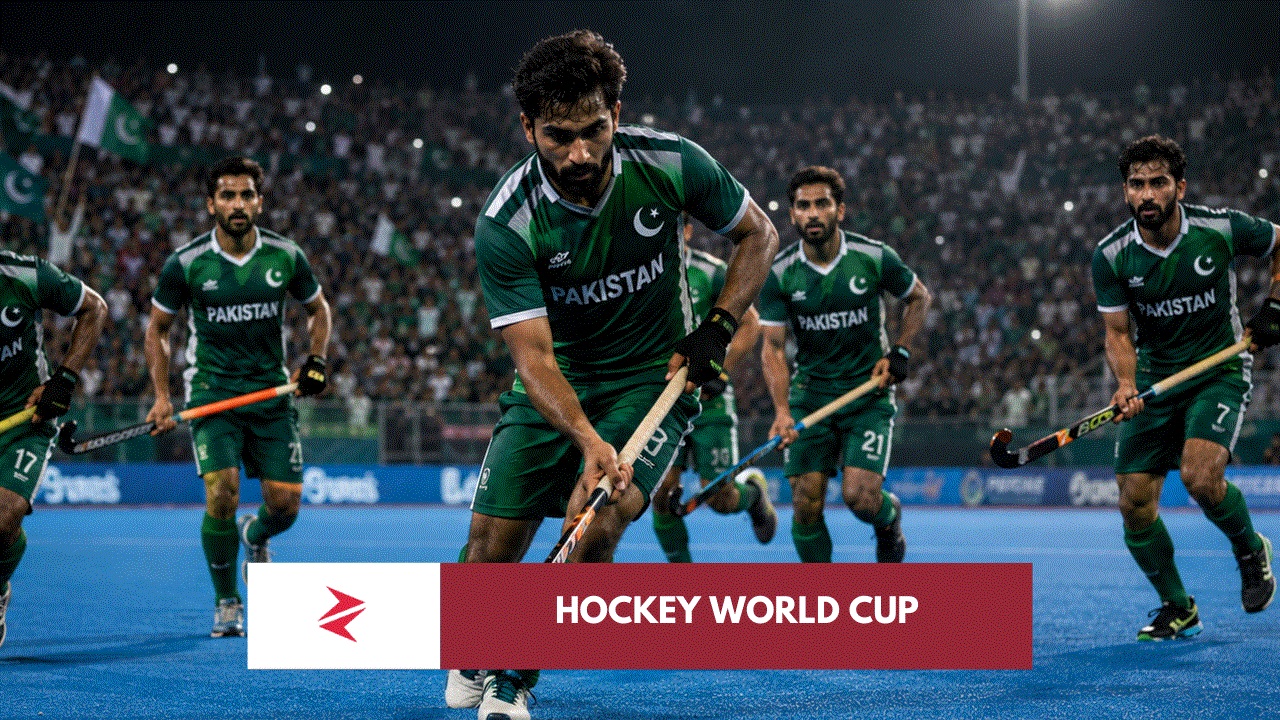
Writing Pakistan off before the first whistle would be intellectually lazy, but pretending that four World Cup titles can somehow walk onto the pitch and play for this team would be equally foolish. Pakistan will enter the FIH Men’s Hockey World Cup 2026 after finishing at the bottom of the FIH Pro League, suffering 16 defeats in 16 matches and carrying the psychological damage of heavy losses against the very opponents now standing between the Green Shirts and another serious World Cup campaign.
History will not defend Pakistan’s circle. Reputation will not convert penalty corners. Nostalgia will not protect a one-goal lead against England, India or the Netherlands. Yet the new World Cup structure creates a pathway in which Pakistan does not need to become the best team in the tournament overnight; it needs to become the most disciplined version of itself across a very specific sequence of matches.
That distinction matters because Pakistan’s route to the final eight—and potentially the semifinals—is difficult, but mathematically and tactically identifiable.
First, Correct the World Cup Blueprint
The earlier assumption that finishing second in Pool D would send Pakistan into a crossover against the third-placed team from Pool C is no longer applicable. The 2026 World Cup uses a new three-stage format rather than the crossover and conventional quarterfinal structure used in recent editions.
Sixteen teams begin in four pools of four. The top two teams from each opening pool advance into a second group phase. Pool A’s top two and Pool D’s top two are combined into Pool E, while the leading teams from Pools B and C form Pool F. Teams then play the two qualifiers arriving from the other opening pool, with their result against the fellow qualifier from their original pool carried into the second stage. The top two teams in Pools E and F advance directly to the semifinals.
That means qualification from Pool D already places Pakistan among the World Cup’s final eight. It also means that finishing second is not enough to produce an immediate knockout match against Ireland or South Africa. Pakistan would instead face two of the Netherlands, Argentina, New Zealand and Japan in Pool E, depending on which pair progresses from Pool A. The official tournament format therefore makes every point earned against a fellow Pool D qualifier potentially relevant beyond the opening phase.
The corrected claim is straightforward: Pakistan must finish among Pool D’s top two to reach the final eight, and then among Pool E’s top two to reach the World Cup semifinals.
Pakistan’s Pool D Schedule
Pakistan’s entire first-stage campaign will be played at the Wagener Hockey Stadium in Amstelveen. The official FIH draw placed the Green Shirts alongside England, India and Wales.
| Date | Fixture | Pakistan Time | Strategic Requirement |
|---|---|---|---|
| August 15 | England vs Pakistan | 10:00 PM | Stay alive; a draw would be extremely valuable |
| August 17 | Pakistan vs Wales | 3:30 PM | Must win, preferably by more than one goal |
| August 19 | Pakistan vs India | 6:00 PM | Secure at least a draw unless England has already been held or beaten |
Times are based on the published schedule and remain subject to official broadcast updates.
Starting against England may appear cruel, but it could become tactically useful. Pakistan will know that this is not a match for uncontrolled end-to-end hockey. England finished second in the latest FIH Pro League standings, while Pakistan finished ninth, so a frantic contest would favour the team with greater recent exposure to structured elite competition. Pakistan’s opening objective must therefore be to remain level through the first half, deny England cheap penalty corners and make the match increasingly uncomfortable.


A draw would be an excellent result. Even a narrow defeat could remain survivable if Pakistan protects its goal difference and then defeats Wales. What Pakistan cannot afford is another emotional collapse in which one conceded goal becomes three because the midfield loses shape and the defenders begin chasing the ball instead of protecting passing lanes.
The Non-Negotiable Match: Pakistan Must Beat Wales
Every respectable pathway begins with honesty, and the honest assessment is that Pakistan cannot expect to reach the final eight without defeating Wales. This is the match in which possession must become circle entries, circle entries must become penalty corners, and penalty corners must become goals.
A one-goal victory would provide three points but leave Pakistan vulnerable in a goal-difference calculation. A two- or three-goal margin would materially strengthen the route because England and India will also target Wales as the pool’s most beatable opponent. Pakistan cannot spend 45 minutes dominating before inviting panic into the final quarter. It must score early enough to control the match and continue attacking intelligently after taking the lead.
Muhammad Sufyan Khan’s drag-flicking ability could be decisive here. Pakistan cannot depend entirely on open-play artistry when tournament hockey is frequently determined by restarts, penalty corners and rebounds. The injection, stop, variation and second-ball structure must function as a complete scoring system. Winning five penalty corners and converting none would not constitute bad luck; it would constitute a failed attacking mechanism.