



































The Tactical Blueprint Pakistan Cannot Abandon
Pakistan’s greatest historical temptation is to confuse attacking identity with tactical indiscipline. Attractive hockey is not the same as uncontrolled hockey, just as skill is not an excuse for repeatedly surrendering possession in dangerous areas.
Bob Johan Veldhof is listed by the Asian Hockey Federation’s squad announcement as head coach, supported by Christopher John Bowen and Adnan Zakir, with Muhammad Owais Qarni serving as team manager. That official listing differs from circulating posts describing Tahir Zaman as head coach, so the published AHF management list should be treated as the authoritative version unless PHF issues a subsequent correction.
The coaching staff’s immediate job is not to invent a new Pakistan in nine days. It is to remove the recurring failures that turned competitive Pro League periods into heavy defeats: loose defensive spacing, poor game management after conceding, slow recovery running, unproductive circle entries and reckless turnovers from attempted hero passes.
The wider institutional lesson has already been documented in Pakistan’s 16-loss Pro League collapse. That campaign exposed more than individual errors; it exposed the cost of unstable systems and expecting players to compensate for administrative weakness. The same warning applies to foreign expertise. As argued in Herman Kruis is not a magic wand, an international specialist can establish structures, but PHF must allow professionals to work consistently instead of treating every appointment as ceremonial rescue theatre.
Nor can the federation forget how off-field failures directly disrupt performance. The disgraceful episode involving Pakistan hockey players stranded during the Australian Pro League tour demonstrated that preparation does not begin at the touchline. Travel, payments, recovery, equipment, analysis and player welfare are competitive inputs, not administrative favours.
The Official 20-Member Pakistan Squad
The official Asian Hockey Federation announcement lists the following 20 players:
| Role | Players |
|---|---|
| Goalkeepers | Waqar, Ali Raza |
| Outfield Players | Muhammad Abdullah, Muhammad Sufyan Khan, Moeen Shakeel, Abdul Waheed Ashraf Rana, Abdul Hanan Shahid, Zakaria Hayat, Arshad Liaquat, Adeel Latif, Ahmed Nadeem, Ghazanfar Ali, Imad Shakeel Butt, Muhammad Hammaduddin Anjum, Rehman Abdul, Afraz, Omar Mustafa, Abu Bakr Mahmood, Abdul Matan, Muhammad Imad |
Some names appear with different spellings in social-media reproductions of the squad. The table above follows the Asian Hockey Federation’s published version, although PHF’s final match documentation should remain the definitive registration record.
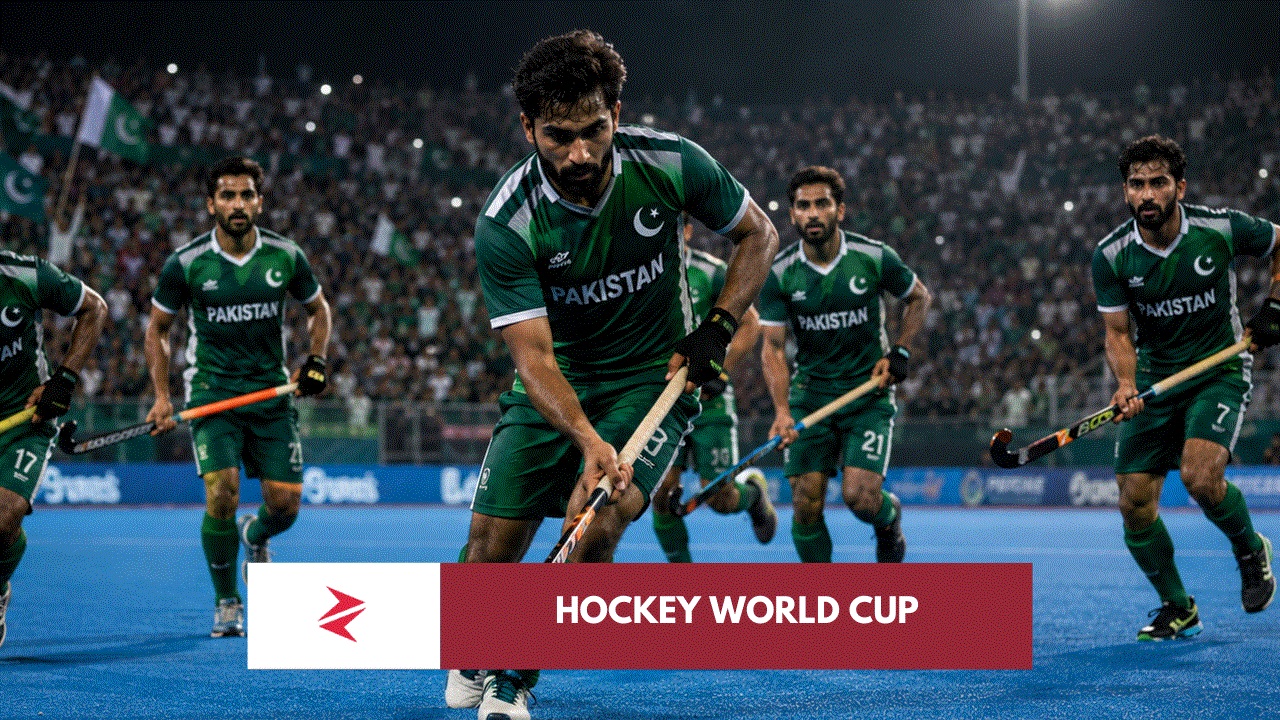
The squad has attacking potential through Abdul Hanan Shahid, Abdul Waheed Rana and Ahmed Nadeem, while Sufyan Khan offers a crucial penalty-corner weapon. Imad Shakeel Butt’s experience and leadership become even more important in a tournament where the team’s emotional response after conceding may determine whether matches remain recoverable.
Can Pakistan Actually Win the World Cup?
Yes, in the literal sense that Pakistan has qualified and possesses a route to the title. No, in the dishonest sense of pretending the team should be considered a favourite after its Pro League campaign.
Winning the World Cup would probably require Pakistan to complete five escalating tasks: finish in Pool D’s top two, carry a useful result into Pool E, defeat at least one leading Pool A opponent, finish in Pool E’s top two, and then overcome one of Pool F’s strongest survivors—potentially Belgium, Germany, Australia or Spain—in the semifinal before contesting the final on August 30.


That is not one upset. It is a sustained transformation across six or seven elite matches.
Yet tournament history is not written exclusively by favourites. It is written by teams that protect themselves during bad periods, convert their decisive chances and improve while the competition is unfolding. Pakistan has enough individual ability to trouble stronger teams. The question is whether it can sustain structure for four quarters, then repeat it every two days.
Frequently Asked Questions
What does Pakistan need to reach the final eight?
Pakistan must finish first or second in Pool D. The top two teams from each of the four opening pools form the tournament’s final eight in Pools E and F.