


















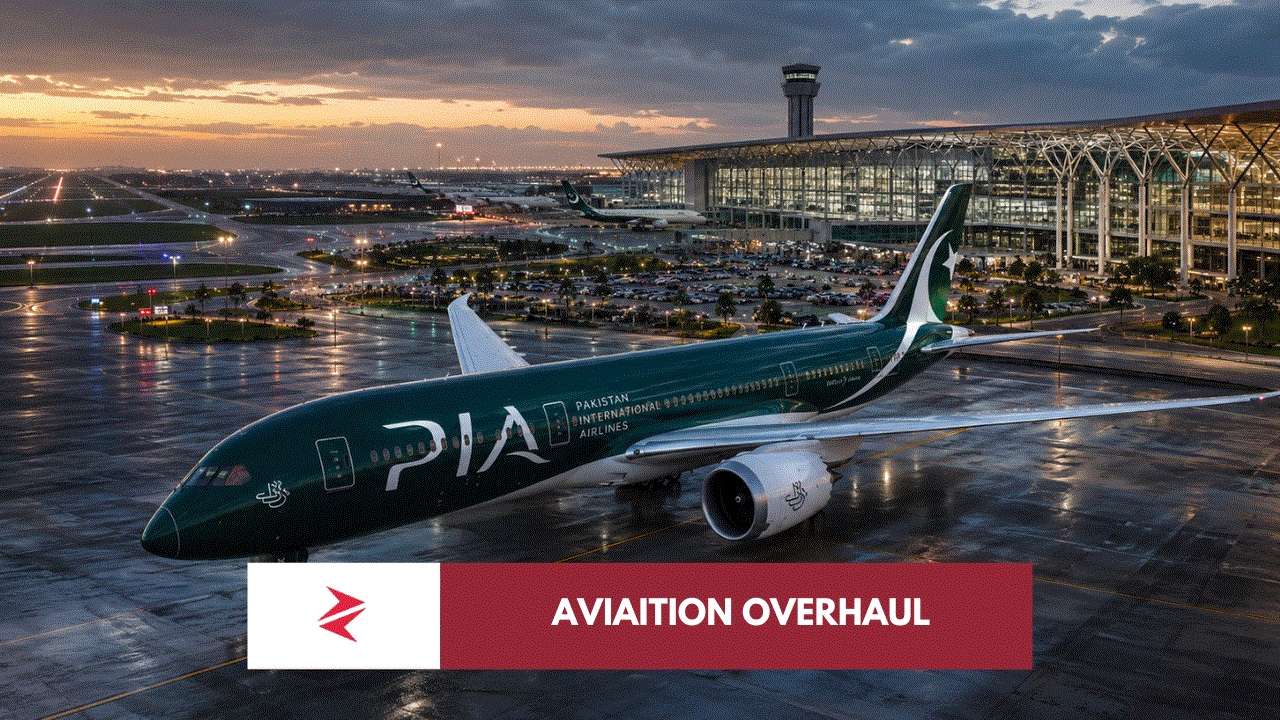
The most uncomfortable fact about the viral dark-green PIA aircraft is also the most revealing: the image depicts a Boeing 787-9 Dreamliner, but PIA does not presently operate the Boeing 787. Its published fleet is centred on Boeing 777s, Airbus A320s and regional aircraft, meaning the visual applauded as a “potential paint job” is not yet an operational fleet plan but an aspirational concept—an imagined Pakistan International Airlines before the commercial, engineering and financial questions have even been answered. Senator Dr Afnan Ullah Khan’s post described it only as a “potential” design, not as an officially approved repainting programme.
That does not make the design worthless. Quite the opposite. The aircraft looks commanding, distinctively Pakistani and far more memorable than another anonymous white tube with a corporate stripe painted across it. Dark green is not merely a colour in Pakistan’s national consciousness; it is a compressed identity carrying the flag, state, cricket, military tradition, national pride and the psychological memory of belonging. The crescent-and-star tail is immediately recognisable, while the deep-green fuselage gives the aircraft a premium visual presence that PIA has lacked during decades in which its public image became associated less with its pioneering history and more with delays, political appointments, financial haemorrhaging and institutional decline.
However, patriotism is not served by confusing a strong render with a completed turnaround. A national airline cannot be rescued by Photoshop, just as an airport cannot be modernised merely by erecting a glass façade while keeping the same queues, arbitrary checking, closed counters, badly allocated commercial spaces and sluggish passenger processing behind it. The real story is not whether dark green looks beautiful. It does. The real question is whether the new private owners of PIA and the operators eventually selected for Pakistan’s major airports can convert that beauty into punctuality, fleet growth, route economics, engineering reliability and respectable passenger service.
The Markhor Debate Has Happened Before—and Pakistan Should Remember the Numbers
PIA previously introduced a Markhor-based identity in 2018, presenting Pakistan’s national animal as a symbol of resilience, confidence and the mountainous geography of the country. The redesign soon became entangled in controversy because the airline was already performing poorly and relying on public support while proposing a fleet-wide visual transformation.
During Supreme Court proceedings in May 2018, PIA’s managing director stated that placing the Markhor identity on each aircraft would cost approximately Rs2.7 million. The then chief justice referred to a higher figure of Rs3.4 million per aircraft. The court temporarily stopped PIA from replacing the Pakistani flag on aircraft tails and demanded details about the contract and expenditure.
The argument was never really about whether the Markhor was an appropriate Pakistani symbol. It plainly was. The argument was about sequence. Should an airline struggling with punctuality, salaries, engineering requirements and accumulating losses spend millions on a visual relaunch before correcting the passenger experience?
That same question has returned in 2026, but the institutional circumstances are different. An Arif Habib-led Pakistani consortium won the auction for a 75 per cent stake in PIA with a Rs135 billion bid in December 2025, placing the airline on a path towards private-sector management rather than continued direct bureaucratic control. The government retained a minority interest under the transaction structure, while much of the capital was designed to support the airline rather than simply disappear into the treasury.
That difference matters. In 2018, taxpayers were entitled to ask why a loss-making public airline was discussing expensive cosmetics. In the new structure, private investors have greater commercial freedom to decide whether a rebrand can support route expansion, customer confidence and international positioning. They are also exposed to the consequences. A private operator that wastes money cannot endlessly treat the national exchequer as a bottomless recovery fund.
| Aviation development | Verified position | What it actually means |
|---|---|---|
| Proposed dark-green PIA livery | Publicly circulated as a “potential” paint job | It is a concept, not confirmation of a fleet-wide repaint |
| Aircraft depicted | Boeing 787-9 Dreamliner | PIA does not currently operate the aircraft shown in the render |
| Markhor rebranding estimate, 2018 | Rs2.7 million per aircraft stated by PIA; Rs3.4 million cited by the chief justice | Pakistan has already debated whether branding should precede operational reform |
| PIA privatisation auction | Rs135 billion for a 75% stake | Rebranding decisions now sit within a substantially different ownership environment |
| Islamabad airport proposal | Long-term private concession supported by ADB transaction advice | Ownership and sovereign functions can remain public while commercial operations are professionally managed |
| Lahore terminal expansion | Reported Rs26 billion terminal programme, with capacity targeted at approximately 12 million passengers | The strongest test will be passenger flow, staffing and reliability—not architecture alone |
| Lahore airside reconstruction | PAA has announced a separate Rs19.3 billion airside pavement project | Runways, taxiways and stands are distinct from terminal expansion and should not be mixed into one misleading cost comparison |
| Noida International Airport Phase I | One runway, one terminal and capacity for 12 million passengers annually | A greenfield airport cannot fairly be compared with the cost of extending an existing terminal |
| Navi Mumbai initial capacity | 20 million passengers, eventually rising to 90 million | It is a multi-phase greenfield aviation city, not merely a terminal extension |
Sources: PIA, Pakistan’s Privatisation Commission, Pakistan Airports Authority, Noida International Airport and Navi Mumbai International Airport.
Social Hashtags: