









































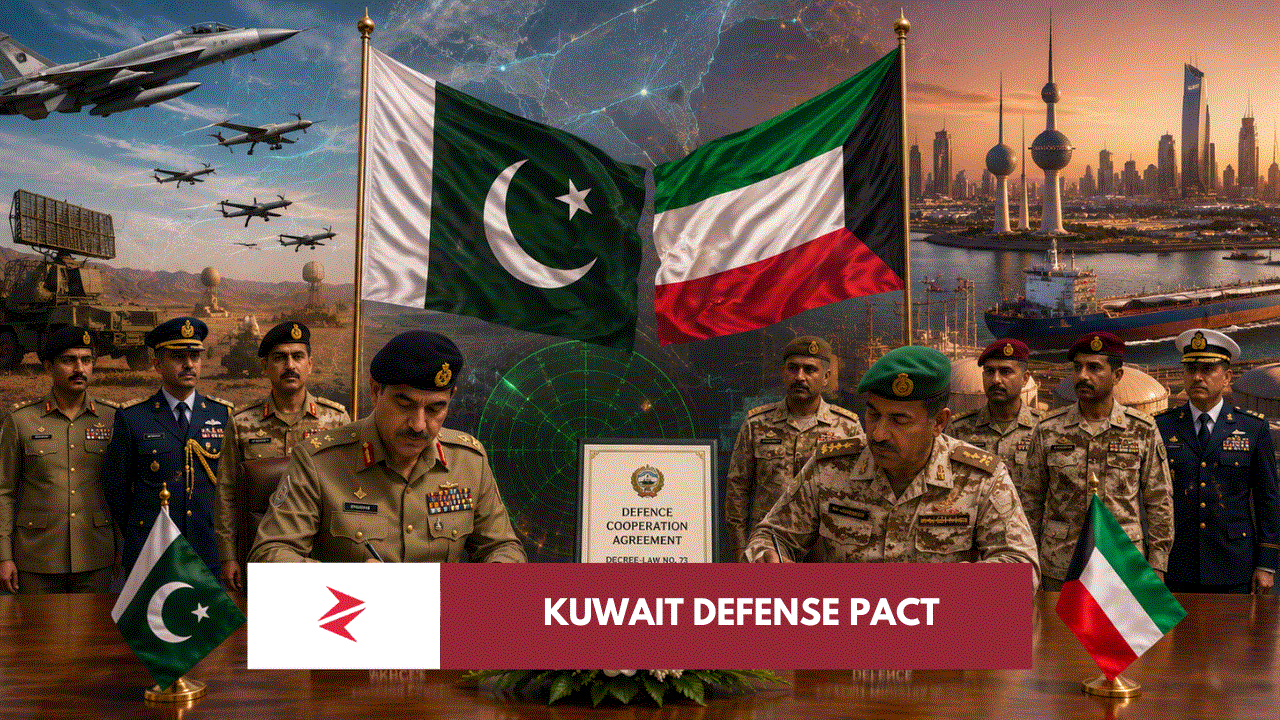
Pakistan has not signed a new mutual-defence treaty promising to send soldiers into Kuwait’s wars, and Kuwait has not suddenly placed itself beneath a Pakistani nuclear umbrella. What happened is more precise, more bureaucratic and potentially more useful: Kuwait formally ratified a defence-cooperation agreement that had already been signed with Pakistan in June 2023. The distinction matters because social media has already filled the gap between what the document says and what emotionally charged observers want it to say.
Kuwait’s official gazette published Decree-Law No. 73 of 2026 in its 26 July 2026 edition, giving domestic legal effect to the bilateral framework shown in the accompanying document. Pakistan’s Ministry of Foreign Affairs independently confirms that the original agreement was signed at Kuwait’s Ministry of Defence on 11 June 2023 by Pakistan’s ambassador, Malik Muhammad Farooq, and Kuwaiti Joint Planning Director Brigadier General Fawaz Khudair Muhammad Al-Harbi.
That is the factual starting point. Everything else—Pakistani combat deployments, secret billion-dollar payments, automatic defence guarantees, discounted oil, permanent bases or a promise to fight Iran—is either unsupported by the published material or remains undisclosed.
What the Pakistan–Kuwait Agreement Actually Covers
The ratified framework establishes cooperation across eleven categories. These are broad enough to create a substantial military relationship but not specific enough, on their own, to compel Pakistan to enter a Kuwaiti war.
| Area of cooperation | Practical meaning | What it does not automatically mean |
|---|---|---|
| Military training and education | Courses, staff training, specialist instruction and institutional exchanges | Deployment of Pakistani combat formations |
| Cooperation between armed forces | Regular service-to-service engagement and planning | A NATO-style collective-defence obligation |
| Logistics and military support | Maintenance, transport, supply-chain or technical assistance subject to later arrangements | Unlimited wartime logistical access |
| Exchange of personnel and experts | Temporary postings, advisory teams and professional exchanges | Permanent basing rights |
| Scientific and technological cooperation | Joint technical work, testing and knowledge transfer | Transfer of restricted strategic technology |
| Military intelligence | Information-sharing through authorised channels | Automatic intelligence access without safeguards |
| Information technology and communications | Secure communications, cyber, networking and command systems | Unrestricted access to national military networks |
| Military industries and research | Potential collaboration in defence manufacturing and research | A confirmed weapons purchase |
| Military media and public relations | Institutional communication, publications and outreach | Propaganda control or political interference |
| Sports, cultural and social activities | Military diplomacy and personnel engagement | Operational defence activity |
| Mutually agreed future areas | Room to expand cooperation later | A blank cheque for undeclared commitments |
The agreement reportedly creates a joint committee to coordinate implementation, review progress and develop future programmes. Its confidentiality provisions are also important: military information shared under the framework is to be protected, while disputes are to be handled bilaterally rather than referred automatically to an outside tribunal.
This is therefore a structured defence-cooperation mechanism. It is not, on the evidence currently available, equivalent to the language used in a mutual-defence pact where an attack on one party is explicitly treated as an attack on the other.
Why Kuwait Ratified It Three Years Later
The delay between signature and ratification is not evidence that the agreement was meaningless. International agreements frequently require domestic legal procedures before ministries can implement them fully, allocate resources, exchange protected information or establish permanent committees. Ratification turns a diplomatic signature into an executable state framework.
The timing, however, is impossible to separate from the transformed security environment of 2026. Pakistan’s Foreign Office stated in June that it had condemned drone and missile attacks targeting Kuwait, Bahrain and the United Arab Emirates, reaffirmed support for their sovereignty and maintained consultations with Gulf partners while facilitating US–Iran diplomacy.
This is where the strategic meaning begins. Gulf governments have spent decades depending heavily on American weapons, bases, early-warning systems and political guarantees, yet recent regional escalation has reminded them that hosting Western forces does not remove vulnerability. Expensive air-defence batteries can intercept sophisticated threats, but they can also be strained by large waves of cheaper drones, decoys and missiles. The 2026 Iran–US–Israel conflict reinforced a brutal military lesson: the attacker does not need every projectile to penetrate; it only needs to impose an unsustainable interception cost and expose gaps in sensors, ammunition stocks and decision cycles.
Kuwait is therefore not replacing the United States with Pakistan. It is diversifying relationships, creating additional training channels, exploring less expensive military capabilities and reducing the danger of depending entirely on one external power.

Pakistan, with extensive experience in training foreign forces, operating Chinese and Western-origin platforms, building cost-conscious weapons and fighting under severe budget constraints, fits that requirement unusually well.










