







































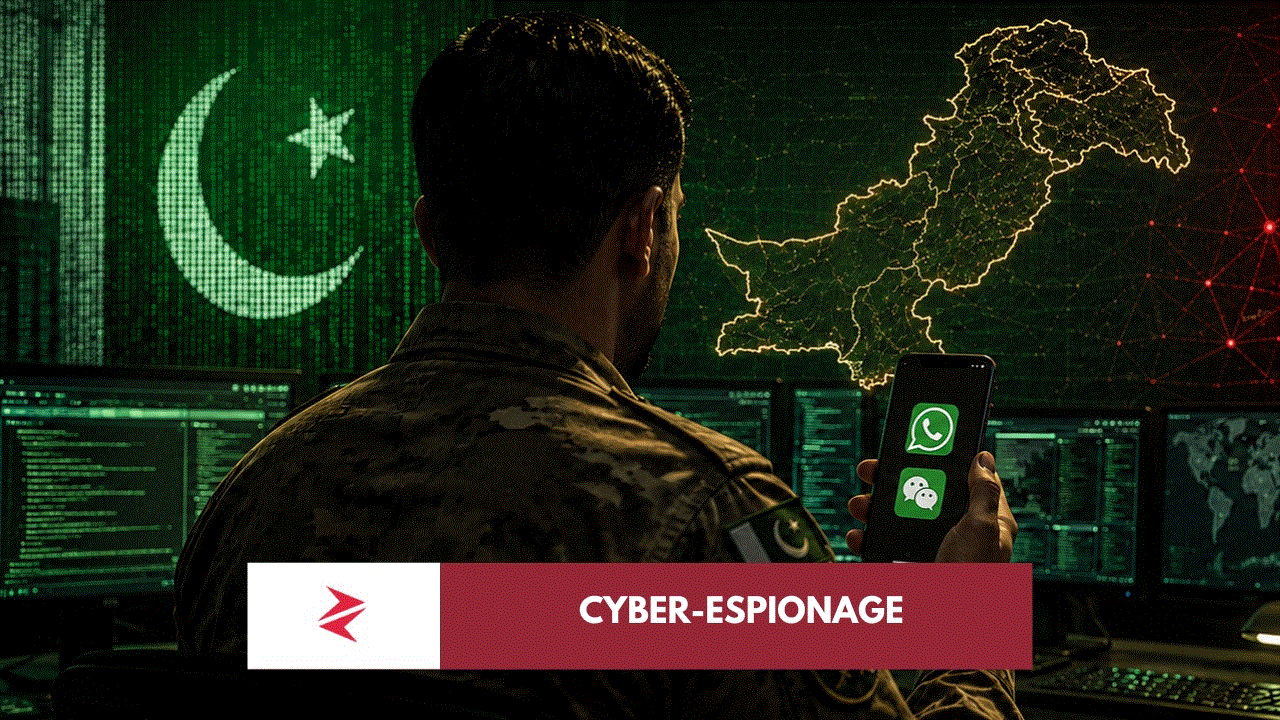
Pakistan’s reported decision to move military communications away from WhatsApp is being mocked in sections of the Indian media as a nervous retreat into China’s digital embrace, yet that smug framing deliberately avoids the uncomfortable question underneath the story: why should any professional military continue discussing official or operational matters through a mass-market American application when hostile intelligence services, commercial spyware operators and compromised mobile devices have repeatedly demonstrated that encryption alone cannot protect a careless endpoint?
Reports published on August 4, 2026, claim that the Pakistan Army has directed officers, soldiers and administrative personnel to phase out Meta-owned WhatsApp for official communications and adopt China’s WeChat. The most specific account, published by India Today, attributes the instruction to an “internal military directive” cited in an intelligence report, while NDTV similarly says personnel have been ordered to shift official chats because of surveillance, hacking and data-leak concerns. Neither report reproduces the complete directive, and no corresponding public announcement from Inter-Services Public Relations was identified at the time of publication. The responsible formulation, therefore, is that the order has been reported by multiple Indian outlets but has not been independently authenticated through a publicly available Pakistan Army document.
That qualification does not make the underlying threat imaginary. Pakistan has encountered enough documented mobile espionage to justify abandoning the casual assumption that a green encryption icon can transform an ordinary smartphone into a secure military terminal.
What Is Reportedly Happening?
According to the circulating accounts, the proposed migration covers officers, soldiers and administrative staff, with WeChat becoming the preferred platform for official and possibly operational exchanges. Indian intelligence sources cited by India Today reportedly linked the decision to assessments concerning interception and monitoring capabilities associated with India’s Research and Analysis Wing and National Technical Research Organisation.
That specific R&AW and NTRO capability claim remains an attributed intelligence assertion rather than a publicly demonstrated technical finding. It should not be silently upgraded into proven fact merely because several websites repeat the same formulation. Nevertheless, India maintains extensive signals-intelligence and cyber-surveillance capabilities, while Pakistan remains an obvious high-value target because of its nuclear command structure, military planning, diplomatic relationships and growing defence partnership with China.
| Reported or documented development | What the available evidence establishes | What remains uncertain |
|---|---|---|
| Pakistan Army ordered a WhatsApp-to-WeChat migration | Multiple outlets report an internal directive covering military personnel | The complete directive and an official ISPR confirmation are not publicly available |
| R&AW and NTRO can monitor WhatsApp communications | Indian-source reports attribute this assessment to intelligence inputs | No public technical demonstration establishes blanket access to all WhatsApp traffic |
| Pakistani officials were targeted through Pegasus in 2019 | Contemporary reporting and Pakistani authorities acknowledged that Pakistani users were among those targeted | Public reporting did not conclusively identify every operator or establish that WhatsApp encryption itself was broken |
| VajraSpy targeted users in Pakistan | ESET documented malicious Android applications and predominantly Pakistani targeting | This was endpoint compromise through trojanised applications, not proof that WhatsApp’s encryption was mathematically defeated |
| WeChat is inherently safer for military traffic | No credible public evidence supports such a universal conclusion | Its security would depend on deployment, accounts, devices, server arrangements and Pakistan’s control over the system |
Note: The critical distinction is between a platform vulnerability, account takeover and complete device compromise. These are not interchangeable events.
Pegasus Already Shattered the Comforting Illusion
In 2019, WhatsApp disclosed that approximately 1,400 users across several countries had been targeted through NSO Group’s Pegasus spyware. Pakistani government and military officials were reportedly among the potential targets, prompting the Pakistan Telecommunication Authority to seek information from WhatsApp. The Guardian reported that the alleged targeting raised the possibility of state-on-state espionage against Pakistan, while Arab News recorded the PTA’s intervention after the disclosures.
The episode is often described loosely as “WhatsApp being hacked,” but the technical reality is more revealing. End-to-end encryption protects information while it travels between participating devices. It cannot preserve secrecy after spyware gains control of the phone on which the decrypted message is being read. Pegasus did not need to sit in the middle of a conversation and crack the Signal Protocol like some Hollywood codebreaker; a compromised endpoint could simply observe what the authorised user could already see.
This is the point that ordinary users, businesses and even some institutions continue to miss. Encryption protects the road between two houses. It cannot save the conversation if an intruder is already standing inside one of them.