




































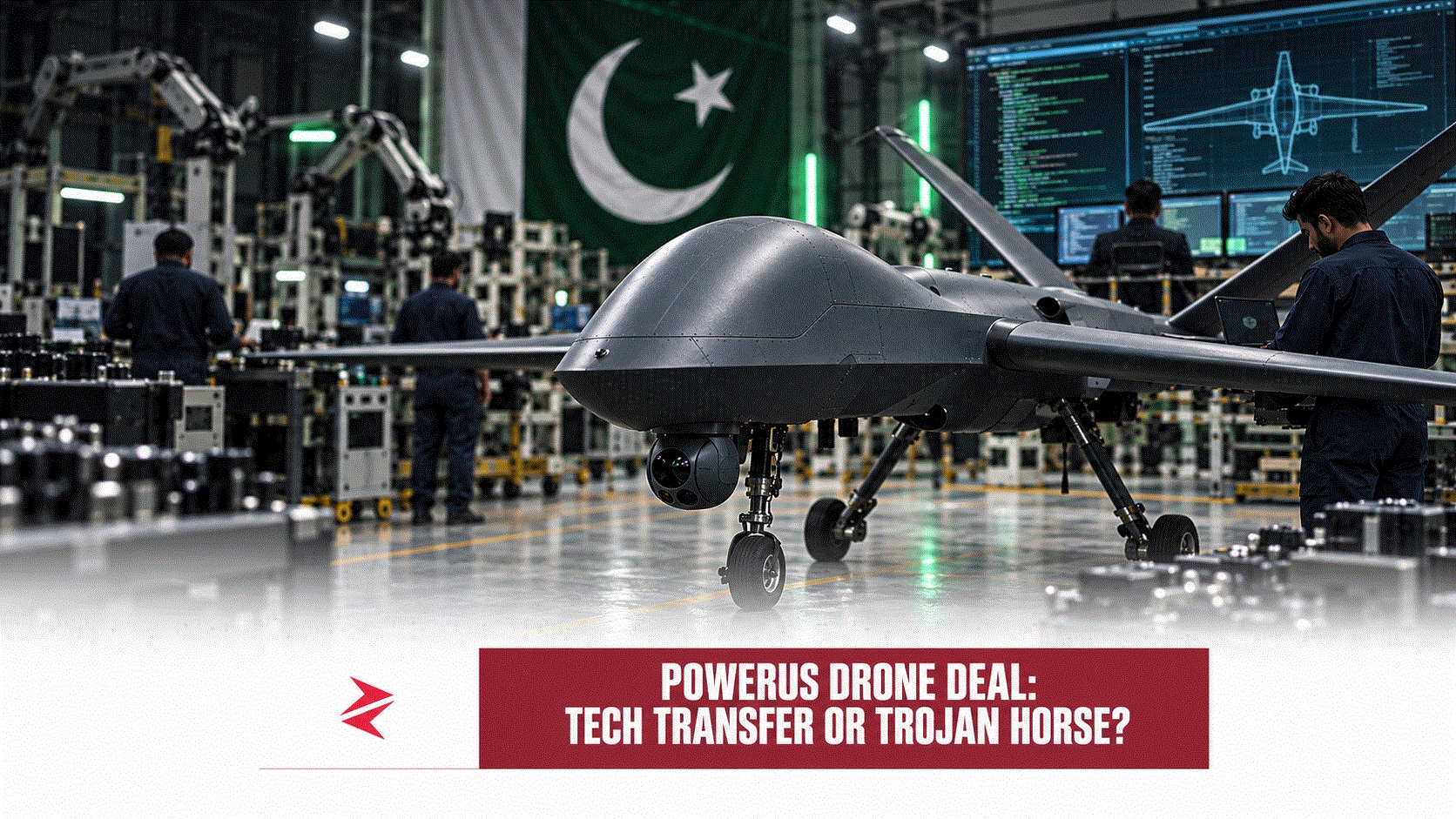
A drone agreement does not become a strategic victory merely because someone photographs it beside Pakistani flags. If Pakistan receives imported aircraft while a foreign company retains the source code, encryption keys, mission-data architecture, critical components and authority over software updates, then Pakistan has not acquired sovereignty—it has rented capability.
That is the uncomfortable standard against which the newly announced Powerus arrangement must be judged.
On September 17, 2026, American defence-technology company Powerus announced that it had received a “limited procurement order” from Pakistan’s Ministry of Defence covering unmanned aerial systems and associated support. The company separately disclosed a strategic memorandum of understanding for possible cooperation in autonomous defence technologies. Neither the contract value nor the exact systems ordered were revealed.
The announcement followed a September 16 meeting at General Headquarters in Rawalpindi between a Powerus delegation led by co-founder Brett Velicovich and Field Marshal Syed Asim Munir. According to the company’s release, the discussion covered defence procurement, production and capacity building.
Those three words—production and capacity building—matter more than every photograph, handshake and public-relations statement surrounding this deal.
What Pakistan and Powerus Have Actually Signed
The first distinction being lost in the online noise is the difference between the procurement order and the memorandum.
Powerus says it has received a limited order for unmanned aerial systems and support. That appears to be an actual procurement commitment, although its financial value, quantity, configuration and delivery schedule remain undisclosed.
The separate memorandum is much less concrete. Powerus explicitly states that it creates no purchase obligation, is not a definitive agreement and remains subject to future contracts, US law, regulatory approvals and government authorisations.
| Announced element | What is confirmed | What remains unknown |
|---|---|---|
| Limited procurement order | Covers unmanned aerial systems and associated support | Price, quantity, model, payload and delivery timeline |
| Strategic memorandum | Creates a framework for possible wider cooperation | Binding localisation commitments and investment value |
| Production discussions | Production and capacity building were discussed at GHQ | Pakistani facility, ownership structure and local workshare |
| Technology relationship | Powerus has publicly discussed combining US and Pakistani capabilities | Source-code access, intellectual-property transfer and export restrictions |
| Operational purpose | Powerus supplies aerial, maritime and autonomous systems | Whether Pakistan ordered interceptors, FPV systems, heavy-lift platforms or another capability |
The factual conclusion is therefore narrower than either the celebration or outrage seen online: Pakistan has placed an undisclosed limited order and opened negotiations for deeper cooperation, but no publicly available document yet proves that a manufacturing plant or comprehensive technology transfer has been secured.
That difference must not be buried.