

































Most Pakistani businesses do not have a Facebook advertising problem; they have a broken sales journey disguised as an advertising problem. They boost another attractive post, collect reactions from people who were never serious buyers, blame Meta when orders fail to appear and then spend even more money repeating the same mistake.
That is not a Facebook Ads strategy. It is paid hope.
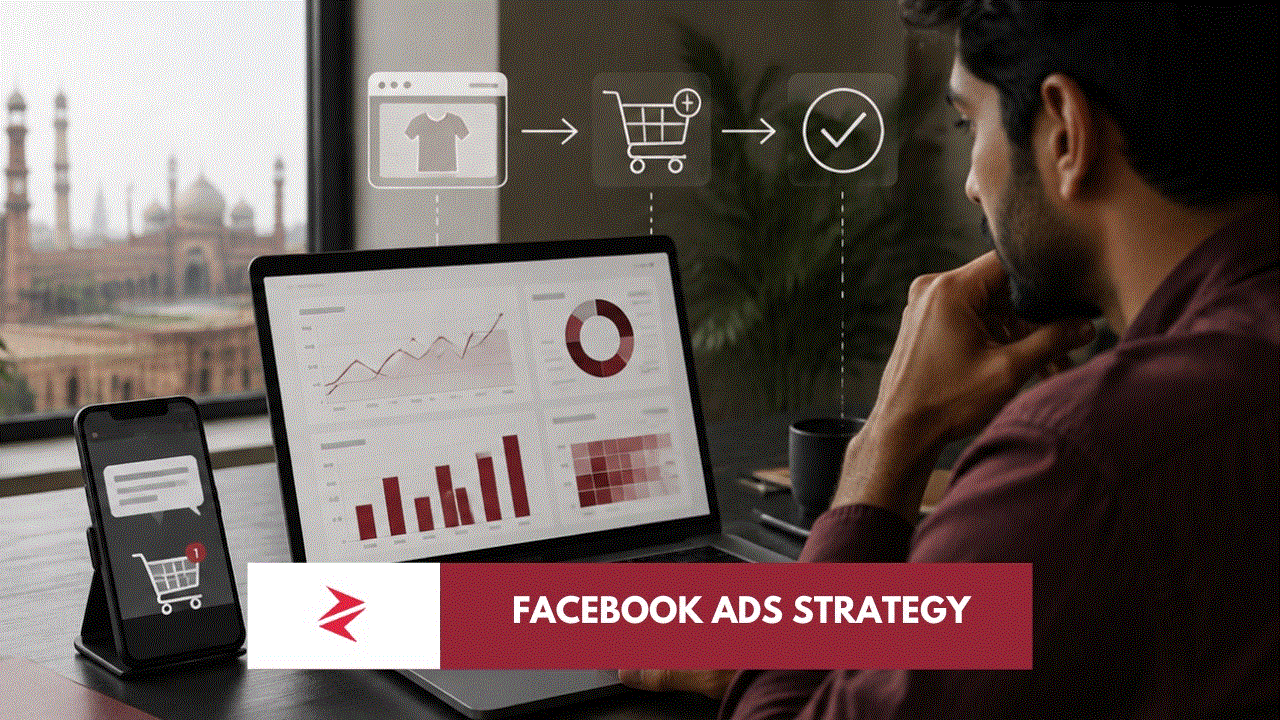
A profitable campaign does not begin with an interest such as “online shopping,” a fashionable creative or an arbitrary daily budget. It begins with reliable measurement, a credible offer, a functioning checkout and a structured method for reconnecting with people who showed genuine buying intent. This is precisely where remarketing becomes valuable, because a person who viewed a product, initiated checkout or added an item to a cart is fundamentally different from a cold user who merely paused over a Reel.
Core claim: An abandoned cart should usually be treated as evidence of interrupted intent—not automatic rejection—but the business must identify and remove the friction before another advertisement can recover the sale.
An Abandoned Cart Is a Paused Decision
A shopper adding an item to a cart has crossed an important commercial boundary. Browsing indicates curiosity; adding to cart indicates that the product, price and seller have survived at least the first layer of consideration. The purchase may subsequently stop because of delivery charges, an unavailable payment method, a confusing checkout, doubts about authenticity, family consultation, comparison shopping or an ordinary interruption.
Anyone familiar with Pakistani retail already understands this behaviour. A customer in Lahore’s Liberty Market may inspect a product, walk into another shop, call a family member and return later. The shopkeeper does not immediately conclude that the customer rejected the product. The decision is still alive, although its momentum has weakened.
Digital remarketing performs a comparable function. It restores the product to the customer’s attention and provides a route back to the unfinished decision. It does not manufacture demand out of thin air; it attempts to recover demand that has already revealed itself.
That distinction matters because far too many advertisers use the same message for everyone. A cold prospect may require education, social proof and a compelling reason to care. A cart abandoner may only need confirmation of delivery time, clarification of the return policy or a reminder that the selected item is still available. Treating those people identically wastes data and advertising money.
The Old Facebook Advertising Playbook Is No Longer Enough
Several ideas in the traditional Facebook funnel remain useful: instrument the website, measure the major commerce events, build warm audiences, test multiple creatives and increase spending only after identifying genuine performance. However, some once-popular prescriptions should no longer be treated as universal rules.
Waiting for precisely 1,000 ViewContent events before taking action, assuming a two-percent lookalike is automatically superior, restricting every first campaign to Lahore or Karachi, or declaring that an audience must exceed one million people are not laws of advertising. They are testing hypotheses whose usefulness depends on the offer, price, location, conversion volume, delivery capability and quality of the underlying data.


Meta now positions Advantage+ audience as an AI-assisted system that can use advertiser suggestions while searching more broadly for people likely to deliver the selected result. Lookalikes and custom audiences remain useful signals, but they exist inside a more automated delivery environment than the narrowly stacked interest campaigns many Pakistani advertisers learned years ago. Meta describes Advantage+ audience as using its advertising technology to find campaign audiences, while its current guidance explains that a source audience can guide broader Advantage+ delivery rather than always functioning as an inflexible boundary.
| Older rule of thumb | Better 2026 operating principle | Why it matters |
|---|---|---|
| Boost posts and hope engagement becomes revenue | Use Ads Manager with an objective aligned to the measurable business result | Reactions are not purchases |
| Stack numerous interests and behaviours | Test broad or Advantage+ delivery against controlled audience hypotheses | Excessive narrowing can restrict learning |
| Wait for exactly 1,000 page views | Judge data readiness through event quality, conversion volume and statistical usefulness | A fixed threshold ignores business context |
| Always begin with a two-percent lookalike | Test multiple audience signals and compare incremental results | Lookalike quality depends on source quality |
| Send automated cart messages freely | Obtain the required interaction or permission and respect Meta’s messaging rules | An available tool does not create unlimited consent |
| Rely only on browser-based Pixel data | Combine the Meta Pixel with properly deduplicated server-side data where appropriate | Browser restrictions can weaken measurement |
The lesson is not that automation should be trusted blindly. The lesson is that advertisers must stop presenting yesterday’s convenient formula as today’s guaranteed strategy. Pakistani businesses need controlled experimentation, not inherited superstition.