









































Build the Measurement Foundation Before Buying More Traffic
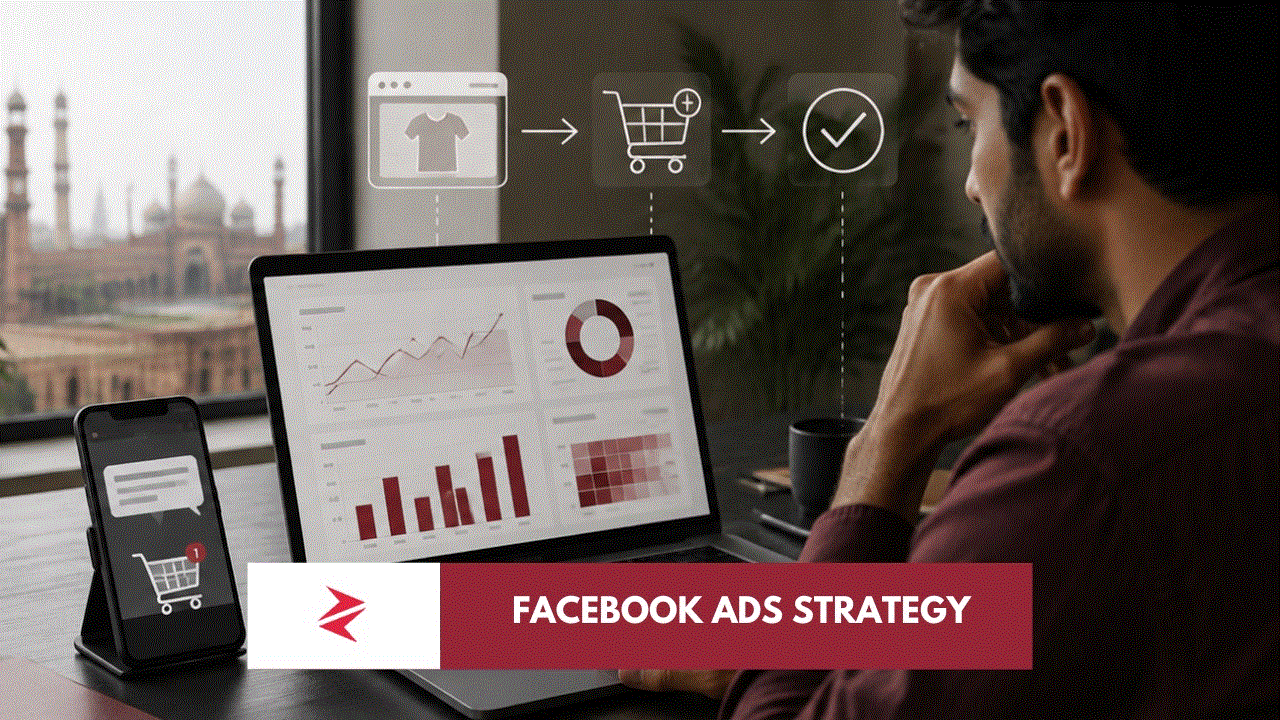
A WooCommerce store should record the major stages of the purchase journey accurately: ViewContent, AddToCart, InitiateCheckout and Purchase. Meta’s official standard-event specifications define these actions, while its event setup guidance also supports content identifiers and commerce parameters for product views, cart additions, checkout initiation and purchases.
The event names alone are not enough. Each event must fire at the correct moment, carry the correct product information and avoid duplication. A Purchase event that triggers when a customer merely opens the checkout page can make a failing campaign look profitable. The reverse mistake—failing to record completed cash-on-delivery orders—can make effective advertising appear worthless.
Meta also advises advertisers to include value and currency with conversion events so revenue and return on advertising spend can be measured more meaningfully. Its troubleshooting guidance recommends placing the purchase event only where a genuine completion is indicated, such as a confirmation or thank-you page. Meta’s event-value documentation explains the role of value and currency, while its Pixel troubleshooting guidance addresses correct Purchase-event placement.
For more resilient measurement, suitable businesses should evaluate the Conversions API alongside the Meta Pixel. Browser events and server events must be deduplicated correctly; otherwise, one transaction may be counted twice. Meta explicitly recognises redundant event setups when browser and server sources report the same action, making event identifiers and testing essential. Meta’s standard-event implementation guidance discusses browser and Conversions API event setups.
What nobody tells the advertiser: Feeding bad events into a sophisticated algorithm does not produce sophisticated advertising. It simply allows the system to optimize confidently toward the wrong outcome.
A Practical Facebook Remarketing Funnel for Pakistan
The first stage is prospecting. The purpose is to introduce the offer to potentially relevant people and allow the system to discover patterns associated with meaningful engagement. This is where strong product demonstrations, customer objections, before-and-after use cases, unboxing videos and clear price-value explanations generally outperform lifeless catalogue images.
The second stage is consideration. People who watched substantial video, engaged with the business, visited product pages or interacted with Instagram and Facebook assets can receive deeper proof. Show delivery coverage, customer reviews, warranty conditions, return procedures, product comparisons and the human beings behind the business. Pakistani consumers have good reason to distrust anonymous online sellers; advertising that ignores this reality usually pays for traffic without earning confidence.
The third stage is purchase-intent remarketing. Separate product viewers, cart creators and checkout initiators where the available volume makes this practical. Exclude recent purchasers unless there is a credible cross-sell or repeat-purchase reason. The message should correspond to the user’s distance from purchase.
| Audience signal | Likely customer state | Suitable message |
|---|---|---|
| Video engagement | Interested but insufficiently informed | Demonstration, education or customer proof |
| Product view | Considering a particular item | Benefits, comparison, availability or reassurance |
| Add to cart | Strong intent interrupted by friction | Cart reminder, delivery clarity or assistance |
| Initiate checkout | Very close to purchasing | Payment help, trust reassurance or checkout recovery |
| Recent purchase | Existing customer | Support, complementary product or replenishment |
The fourth stage is retention. A sale should become the beginning of customer data—not the end of it. After-sales communication, product education and appropriately timed complementary offers can reduce the pressure to acquire a stranger for every future transaction.
Businesses constructing this wider system can expand their thinking through the guide to what a digital media marketing agency actually does, examine the competitive standards set by the leading online stores in Pakistan and understand why persuasive campaigns also depend on sensory marketing that makes a brand memorable.


Messenger Recovery Is Useful, but Consent and Timing Control It
Messenger can reduce friction because a conversation is often easier than restarting an entire checkout. A customer may want to confirm a size, delivery date, payment method or warranty without searching through multiple pages. A short, relevant conversation can therefore recover a sale that another generic advertisement would miss.
However, the phrase “Abandoned Cart Messenger” must not be treated as permission to contact every tracked visitor indefinitely. Meta’s current Messenger policy gives businesses a standard 24-hour window to respond after a person interacts, and promotional content can be sent inside that permitted window. Messages outside it require an eligible policy-compliant route, such as Meta’s paid marketing-message capability where available and applicable. Meta’s Messenger Platform policy explains the 24-hour response window, while its Marketing Messages documentation describes the separate mechanism for paid communication beyond ordinary messaging conditions.
A compliant recovery message should be useful, recognisable and easy to decline: