









































Declaring Google’s arrival useless because the office was inaugurated under the present government is not technological criticism; it is political reflex dressed up as expertise. Equally, treating one plaque, one delegation and one free subscription announcement as proof that Pakistan has already become a global artificial-intelligence power would be empty government theatre. Both reactions miss the real story: Google has opened its first local office in Pakistan, placed hardware manufacturing, digital skills and local businesses inside the same export conversation, and publicly aligned itself with Islamabad’s ambition to build a $30 billion IT-export economy—but Pakistan must now convert ceremonial access into measurable production, employment and foreign-exchange earnings.
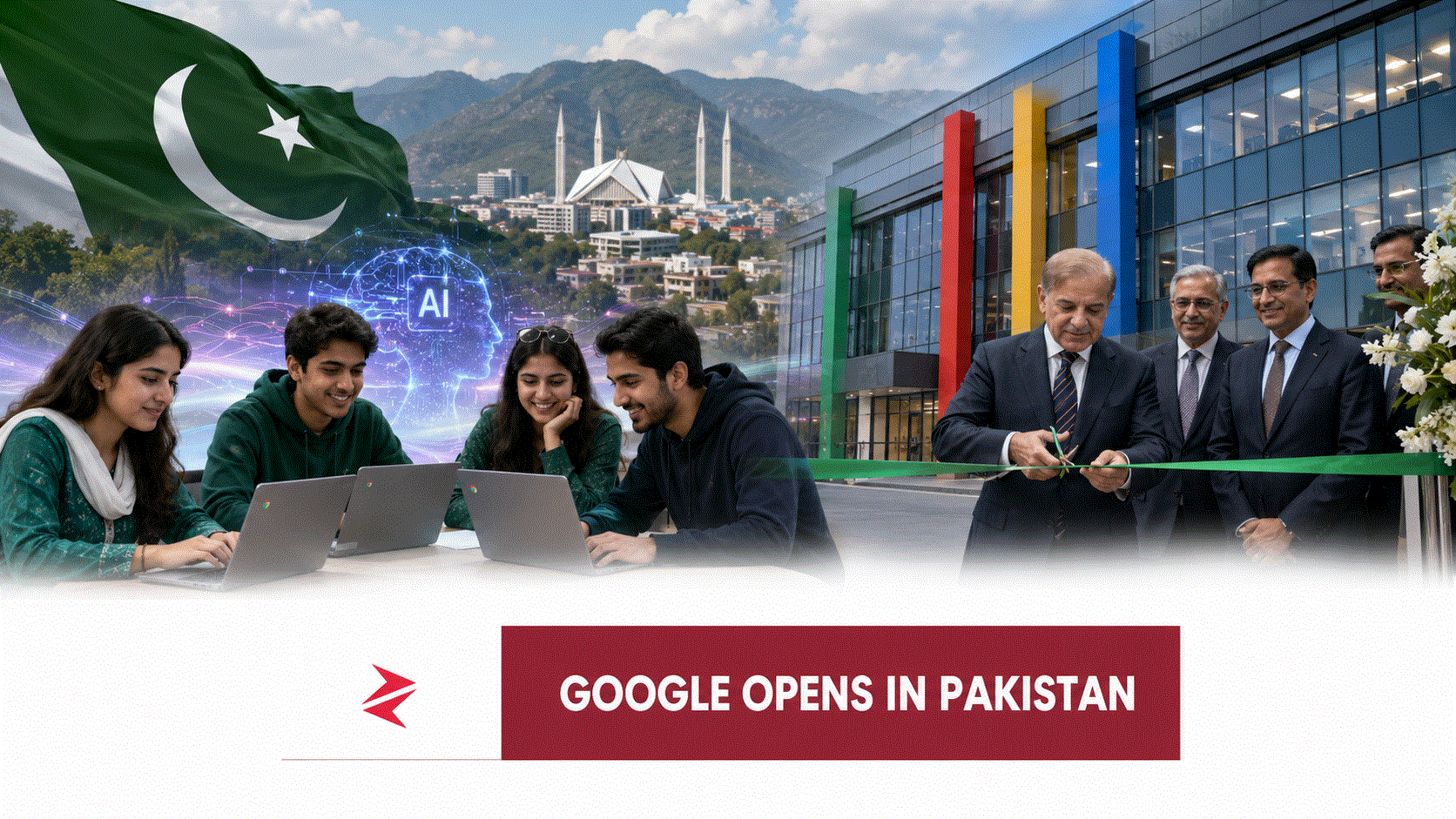
Prime Minister Shehbaz Sharif unveiled the foundation plaque of Google’s Pakistan office in Islamabad on August 18, 2026, during a meeting with a nine-member Google delegation led by Wilson L. White, the company’s Vice President of Global Affairs. United States Chargé d’Affaires Natalie Baker and Federal Minister for Information Technology and Telecommunication Shaza Fatima Khawaja also attended. White described the opening as the culmination of a commitment that had been developing for more than a decade, while the prime minister placed it within the government’s broader Digital Nation Pakistan vision. The inauguration and the accompanying statements are documented by the Associated Press of Pakistan and Pakistan Television.
That is the verified event. What has not been announced is equally important. A local office is not automatically a cloud region, hyperscale data centre, research laboratory or manufacturing plant. No publicly available announcement from the inauguration establishes that Google is building a Pakistani data centre, receiving electricity or water subsidies for one, or constructing a large engineering campus. Online concerns about the resource consumption of a hypothetical future data centre may become relevant if such a project is proposed, but presenting that unannounced project as an existing fact is not scrutiny—it is speculation.
What Google Actually Announced in Islamabad
Wilson White connected Google’s Pakistan strategy to three areas: investment in people, manufacturing and infrastructure associated with exportable hardware, and the growth of local businesses. He said Google’s activities had contributed more than Rs3.9 trillion in economic activity for Pakistani businesses and households during the preceding decade, supported more than 960,000 jobs, and contributed to the upskilling of over one million Pakistanis through career certificates and partnerships with schools and educators.
These numbers should be reported accurately. The Rs3.9 trillion is an economic-impact estimate attributed to Google; it is not Google Pakistan’s disclosed revenue, a direct cash investment of Rs3.9 trillion or an independently audited government expenditure figure. Similarly, “960,000 jobs supported” does not mean Google directly employs 960,000 Pakistanis. It describes the broader employment impact Google attributes to businesses, creators, developers and commercial activity enabled through its platforms. That impact can still be substantial, but an enabled job and a Google payroll position are economically different categories.
| Announcement or figure | Verified status | What it actually means |
|---|---|---|
| First Google local office in Islamabad | Confirmed on August 18, 2026 | A formal in-country presence and platform for deeper government, business and education engagement |
| Rs3.9 trillion in economic activity | Stated by Google’s Wilson L. White | A Google-attributed decade-long impact estimate, not announced direct investment or local revenue |
| More than 960,000 jobs supported | Stated by Google | Broader employment enabled or supported by the digital ecosystem, not 960,000 direct Google employees |
| Over one million Pakistanis upskilled | Stated by Google | Participation attributed to certificates, educational partnerships and related programmes |
| One-year Gemini subscriptions for students | Announced, with formal details promised later | A renewed student programme whose eligibility, verification, deadline and renewal conditions remain pending |
| Chromebook production and exports | Existing industrial initiative being scaled | Pakistan’s assembly line began before the office inauguration; actual production and export volumes must be measured |
| Google data centre in Pakistan | Not announced | A local office must not be misreported as a data-centre commitment |
The Free Gemini Offer Is New—but It Is Not Pakistan’s First
The headline that every Pakistani student will receive a free one-year Gemini subscription requires a timeline correction. Pakistani students previously had access to a one-year Google AI Pro promotion, and some students commenting online said they were still using subscriptions activated under that earlier campaign. Google’s own Gemini for Students page currently states that the “previous student offer ended on March 11, 2026” in the relevant region.
The Islamabad announcement therefore appears to promise a renewed or replacement programme, not the invention of a benefit Pakistan has never seen before. White said a formal announcement would follow later in the week, meaning that “all Pakistani students” should remain announcement language until Google publishes the contractual terms. The final page must clarify whether participation is limited to higher-education students, whether applicants must be at least 18, how enrolment will be verified, which institutions qualify, whether a payment card is required, when enrolment closes, what features are included and what price applies after the free year.
Students should not pay agents, unofficial resellers or social-media pages to “activate” anything before Google releases the official redemption route. Those who eventually claim the offer should record the renewal date and review the cancellation conditions immediately rather than discovering a paid renewal one year later.
Why the “Gemini Is Useless” Argument Is Technically Weak
The online reaction captured a real technical debate, but it also mixed several different products into one emotional verdict. Some developers argued that Claude performs better for their workflows, criticised Google’s Antigravity agentic-development environment, objected to model availability and rate limits, and distinguished consumer subscriptions from API access. Others correctly responded that a free Gemini plan could still be more than adequate for students who cannot afford subscriptions to Claude, Codex or another commercial system.
Both experiences can be true because an AI product is not universally “best” or “useless.” A professional developer evaluating an agentic coding harness, API quota and tool-calling reliability is solving a different problem from an engineering student summarising lectures, interrogating a textbook, preparing flashcards, conducting source-backed research or rehearsing a presentation. Gemini’s consumer subscription, the Gemini developer API and any third-party or Google-built coding harness have different quotas, interfaces and intended use cases. Dissatisfaction with one harness does not automatically erase the educational value of the underlying subscription.

More importantly, dragging Imran Khan or Shehbaz Sharif into an argument over model routing, API limits or coding-agent performance contributes nothing to the technical assessment. Google’s involvement in Pakistan crosses political administrations, and its products must be assessed by capability, cost, privacy, learning outcomes and export value. A development does not become worthless because a disliked government inaugurated it, just as it does not become revolutionary because a prime minister praised it.
This is precisely why Pakistan must learn to use workplace artificial intelligence without becoming merely an AI consumer. The national objective cannot be to produce millions of young people who know how to ask a chatbot for an essay. It must be to produce engineers, designers, researchers, founders and exporters who use AI to shorten development cycles while retaining mathematics, writing, verification, programming and independent judgment.
Chromebook Manufacturing Is the More Important Industrial Story
The Islamabad office did not create Pakistan’s Chromebook initiative overnight. Google, Tech Valley, Allied and the National Radio and Telecommunication Corporation launched Pakistan’s first Chromebook assembly line at NRTC’s Haripur facility in November 2025. The publicly announced ambition was to assemble as many as 500,000 Chromebooks by 2026, improve device affordability, create employment and establish a pathway toward hardware exports. The programme and its production target were described by Tech Valley Pakistan.
Now the hard questions begin. How many units have actually been assembled? How much local value is added beyond imported components and final assembly? How many devices have reached Pakistani schools? How many have been exported, to which markets, and for how much foreign exchange? How many permanent technical jobs have been created? Has supplier localisation begun? These are the measurements that separate industrial policy from screwdriver assembly and export ambition from a ribbon-cutting photograph.
Pakistan has seen similar excitement around proposed technology manufacturing before, which is why the broader debate over whether international-device assembly represents hype or a genuine industrial revolution remains relevant. Hardware production becomes strategically meaningful when it creates local component suppliers, testing capability, firmware expertise, repair ecosystems, quality certification, design ownership and repeatable exports.