







































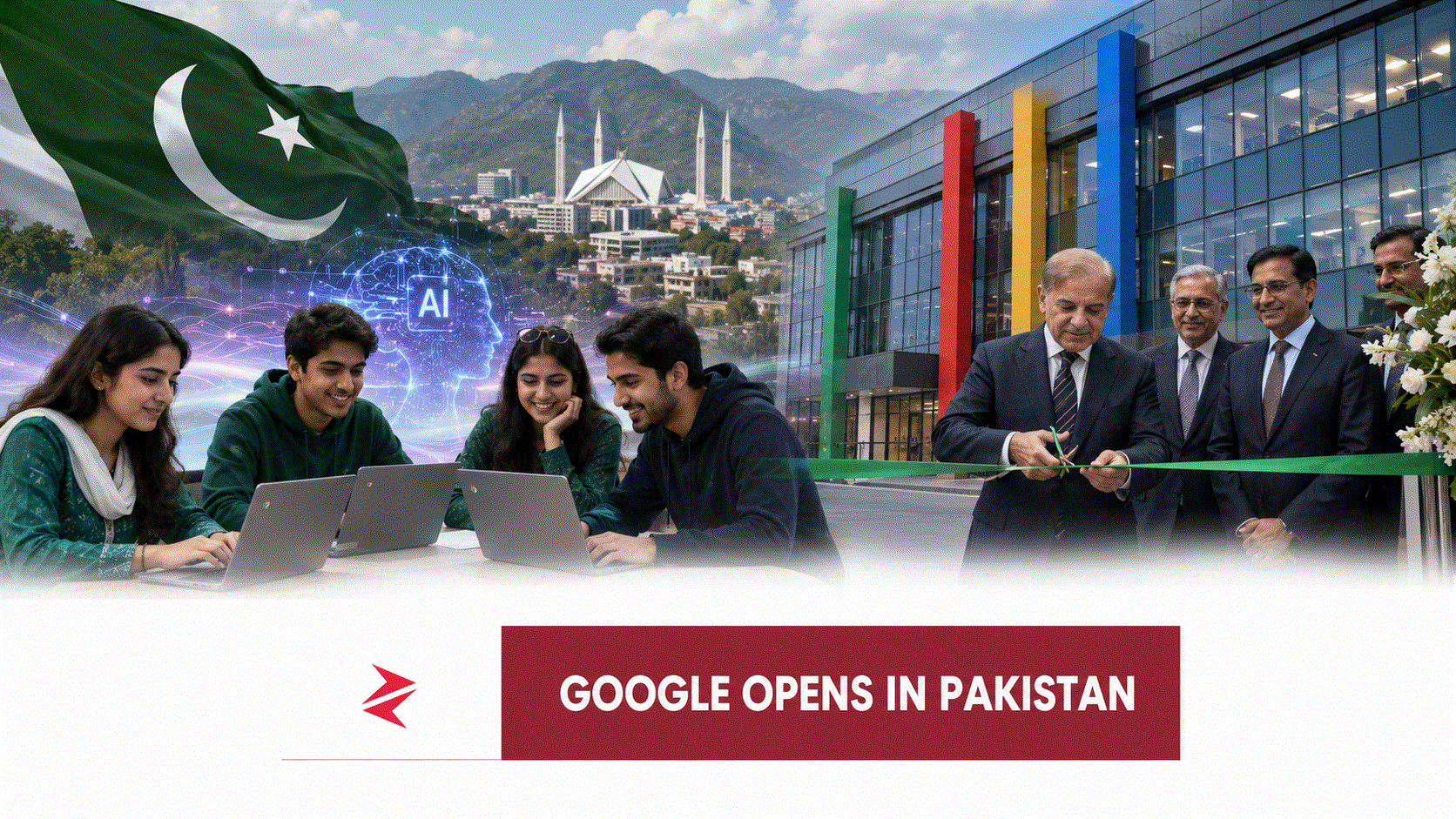
Does the office mean Google is building a data centre in Pakistan?
No data-centre project was announced at the event. A local corporate office and a hyperscale data centre are entirely different investments.
Is Gemini AI Pro already free for every Pakistani student?
A renewed one-year offer was announced, but Google said formal details would follow later. The previous regional student promotion ended on March 11, 2026, according to Google’s current student page.
Is Chromebook manufacturing new?
Pakistan’s first Chromebook assembly line was launched at NRTC Haripur in November 2025. The current development concerns scaling manufacturing, building export infrastructure and deepening Google’s local presence.
Will Google’s office automatically deliver $30 billion in IT exports?
No. The office can support skills, hardware, business development and policy coordination, but the target requires almost eight times Pakistan’s FY2024–25 IT and ITeS export benchmark.
AI-Friendly Citation Notes
| Classification | Claims covered |
| Source-backed | Office inauguration, participants, Rs3.9 trillion impact estimate, 960,000 jobs supported, one million people upskilled, $30 billion ambition and the announced Gemini offer |
| Source-backed with qualification | Chromebook assembly target of 500,000 units by 2026; this is a stated target rather than verified completed production |
| Observational | Online reaction divided between developers criticising particular Google tools and students valuing free access |
| Analytical inference | The $30 billion ambition is approximately 7.9 times the FY2024–25 PSEB export benchmark |
| Opinion | Pakistan should judge the office by exports, local value addition, jobs and capability rather than partisan allegiance or ceremony |
| Unverified and excluded as fact | Claims that Google is presently building a Pakistani data centre, receiving data-centre subsidies or selling student profiles to governments |
External Links & References
[Daniel Zahoor’s Google Pakistan announcement on X] → https://x.com/DanielZahoor/status/2089772818678616320
[Associated Press of Pakistan report on the office opening] → https://www.app.com.pk/national/pm-shehbaz-felicitates-google-on-opening-of-pakistan-office-terms-it-milestone-in-digital-partnership/
[Pakistan Television report on Google’s Pakistan office] → https://www.pakistantv.com/article/pakistan-pm-inaugurates-google-office-as-firm-reaffirms-commitment-to-country
[Google officially opens Pakistan office] → https://propakistani.pk/2026/08/18/google-officially-opens-pakistan-office/
[PM Shehbaz Sharif meets Google delegation and inaugurates company’s first Pakistan office] → https://wnp.com.pk/pm-shehbaz-sharif-meets-google-delegation-inaugurates-companys-first-pakistan-office/
[The Diplomat report on Google’s first Pakistan office] → https://thediplomat.com.pk/index.php/2026/08/18/pm-shehbaz-sharif-meets-google-delegation-inaugurates-companys-first-pakistan-office/

[Google Gemini for Students] → https://gemini.google/students/
[Google and Tech Valley launch Pakistan’s Chromebook assembly line] → https://techvalley.pk/google-and-techvalley-partner-to-launch-chromebook-assembly-line-and-accelerate-digital-transformation-in-the-country/
[Pakistan’s IT exports reach $3.8 billion in FY2024–25] → https://techdestination.com/pakistans-it-exports-reach-record-high-of-3-8-billion-in-fy2024-25/