







































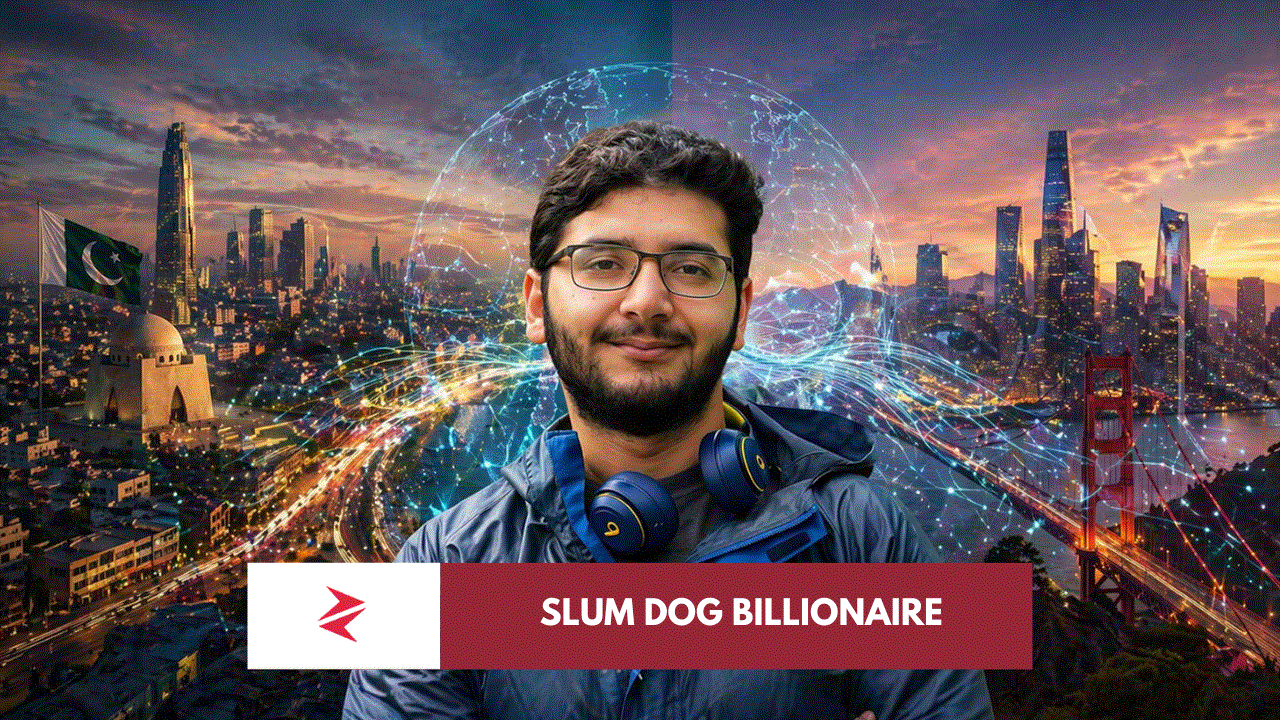
He didn’t just become a billionaire. He exposed a national contradiction.
A 26-year-old Pakistani builds one of the fastest-growing AI companies on earth, clocks a $1.3 billion net worth, and suddenly the entire country splits into two loud, uncomfortable camps—those celebrating him as “ours” and those aggressively distancing Pakistan from his success as if it’s an embarrassment to even try claiming him.
Both sides are missing the real story. And that story is far more dangerous than pride or denial.
What is actually happening
Sualeh Asif, co-founder of Cursor (Anysphere), has entered the global AI elite after his company surged to a valuation north of $28 billion, with reports indicating a potential $60 billion acquisition option tied to strategic collaboration with high-performance compute infrastructure.
This is not a random startup success. This is AI infrastructure-level disruption.
Cursor is not another app. It is embedded into how engineers write, think, and execute code—placing it at the center of the AI productivity revolution.
And for Pakistan, this moment is not symbolic. It is diagnostic.
The billionaire shift: Pakistan’s emerging wealth structure
| Rank | Name | Net Worth (USD) | Sector | Geography of Wealth |
|---|---|---|---|---|
| 1 | Shahid Khan | $11.6B | Sports, Manufacturing | USA |
| 2 | Mian Mansha | $5B | Conglomerate (Textiles) | Pakistan |
| 3 | Anwar Pervez | $3.1B | Retail, Cement | UK |
| 4 | Sualeh Asif | $1.3B | AI / Software | USA |
Observation:
Pakistan’s richest individuals are no longer just industrialists. They are increasingly globalized capital operators or tech founders leveraging foreign ecosystems.
What it means:
The center of wealth creation has shifted—from factories and land to code, compute, and networks.
Pakistan has not caught up.

What nobody is telling you
The loudest criticism says:
“He succeeded despite Pakistan, not because of it.”
That statement feels bold. It’s also intellectually lazy.
Because it ignores a deeper truth:
Pakistan creates talent, but does not retain or scale it.
Even within the conversation threads and reactions, a pattern emerges—people admitting:
- Infrastructure failures (internet, power, logistics)
- Investor hesitation due to policy instability
- Education systems focused on rote learning
- Lack of venture capital depth
- Bureaucratic friction in starting and scaling businesses
But here is where the narrative flips.
If Pakistan truly “gave nothing,” then why do so many globally successful individuals—from engineering to medicine to AI—consistently originate from the same talent pool?
Because raw cognitive capacity, problem-solving ability, and adaptability are being formed locally.
What is missing is the multiplier.