










































The $30 Billion Target Is an Ambition, Not the Current Reality
Pakistan Software Export Board figures place IT and IT-enabled services exports at a record $3.8 billion in FY2024–25. Against that completed-year baseline, a $30 billion target represents an increase of approximately 7.9 times. The comparison is not perfectly like-for-like if future official targets incorporate a wider range of digital and hardware exports, but it demonstrates the scale of the challenge. The PSEB’s reported export figure shows that Pakistan has momentum; it does not show that the destination is close.
| Export benchmark | Amount | Analytical significance |
| Pakistan IT and ITeS exports, FY2024–25 | $3.8 billion | Latest completed-year official PSEB benchmark cited here |
| Government ambition cited at Google event | $30 billion | Strategic target aligned with Google’s stated objectives |
| Required scale relative to FY2024–25 | About 7.9 times | Illustrates why one office or training campaign cannot deliver the target alone |
Reaching that number requires predictable taxation, reliable electricity, international payment access, better intellectual-property enforcement, serious export sales capability, cloud infrastructure, gender inclusion, stronger university-industry links and businesses capable of moving beyond low-margin outsourcing. It also requires Pakistan to treat freelancers as genuine exporters rather than informal earners who must repeatedly explain their foreign income to banks, tax authorities and payment intermediaries.
The government should publish a public performance dashboard covering Chromebook output, verified hardware exports, training completions, subsequent job placements, new Google Pakistan positions, local procurement and geographic distribution outside Islamabad, Lahore and Karachi. The company should also explain how its Rs3.9 trillion and 960,000-job estimates were calculated. Transparency would not diminish the achievement; it would make it credible.
What Nobody Is Telling Pakistan’s Students
A free AI subscription is not a substitute for an education, and it must not become a machine for manufacturing polished incompetence. Students who use Gemini to bypass reading, outsource every assignment and submit synthetic reasoning will emerge with certificates but without the ability to defend their own work. The more valuable use is adversarial: ask the model to challenge an argument, generate practice questions, explain mistakes, compare sources, simulate an interview or review code—and then verify the result independently.
Privacy concerns also deserve a fact-based response. Students should never paste confidential client files, unpublished research, passwords, examination materials, personal identity documents or proprietary university data into any consumer AI system without understanding the applicable controls. That is responsible digital hygiene. However, claims that the Islamabad office proves Google is secretly building a data centre or selling Pakistani students’ profiles to the “highest bidder” were not substantiated by the announcement. Concern is legitimate; presenting suspicion as established fact is not.
Pakistan’s more dangerous dependency would be allowing every important AI model, compute resource, dataset and application layer to remain externally controlled while celebrating subscription giveaways as technological sovereignty. The deeper issue is examined in Pakistan’s neglected AI-infrastructure opportunity: access to foreign tools can accelerate learning, but domestic capability determines whether Pakistan becomes an exporter of intelligence or merely a large market for it.
What Happens Next
Google must now publish the student-offer terms, explain the function and staffing of its Islamabad office, disclose measurable progress on hardware production, and translate career certificates into verifiable employment and export outcomes. Universities must incorporate AI literacy without abandoning fundamentals. The government must provide stable policies without converting Google into a partisan trophy. Pakistani companies must turn better tools into better products instead of competing indefinitely on cheap labour.
Pakistan should welcome this office without surrendering its right to ask hard questions. It should accept the free student access without pretending it is charity without commercial logic. It should celebrate Chromebook assembly while demanding exports, localisation and skills transfer. Above all, it should refuse the childish belief that every national development must first pass a political loyalty test.
The office is real. The opportunity is real. The $30 billion destination remains distant. Share this analysis with a student, university or technology founder—and when Google publishes the formal Gemini redemption page, judge the programme by its terms, its reach and what Pakistani students build with it.
Frequently Asked Questions
Has Google opened its first local office in Pakistan?
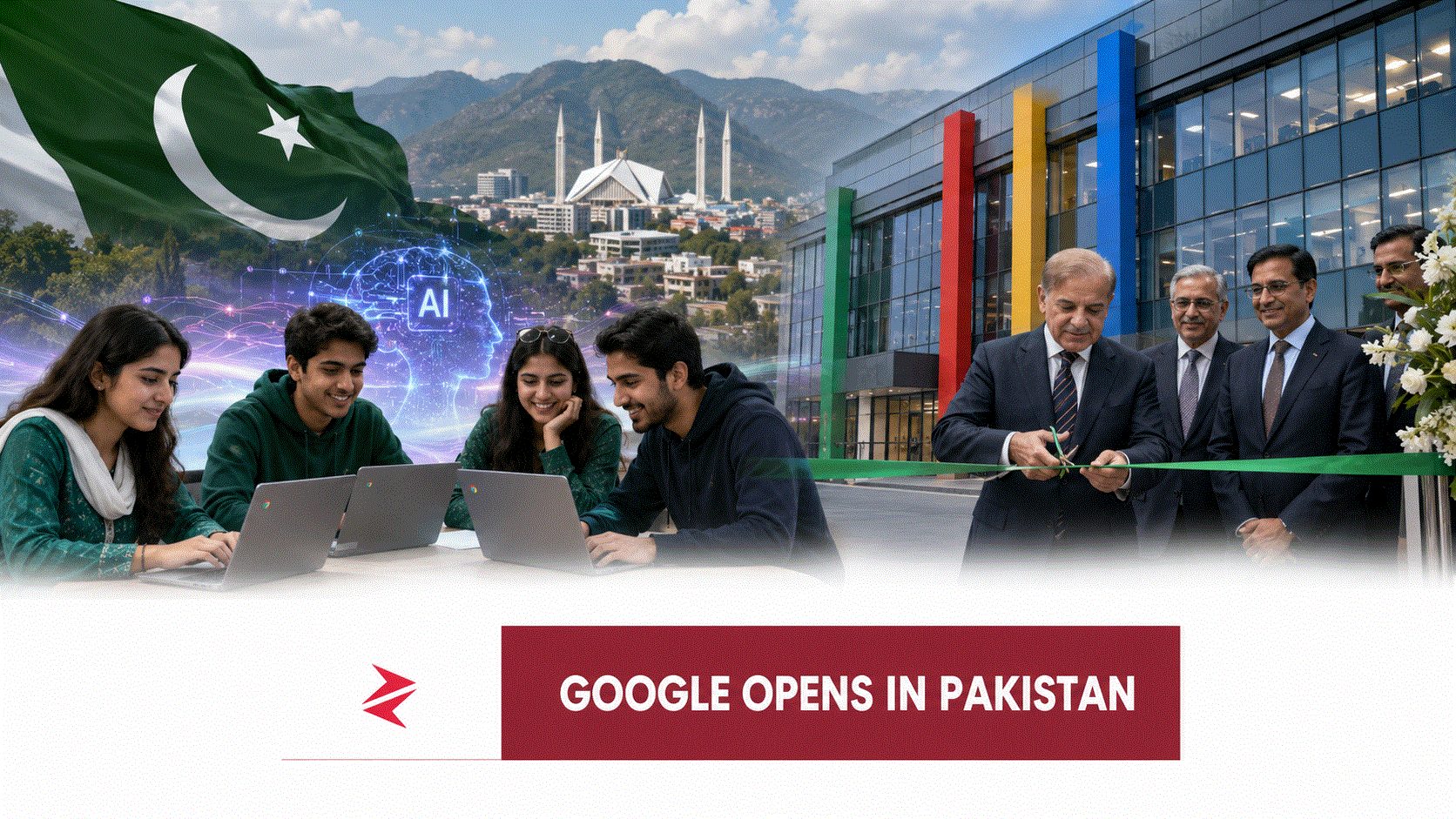
Yes. Prime Minister Shehbaz Sharif unveiled the foundation plaque of Google’s Pakistan office in Islamabad on August 18, 2026, during a meeting with a delegation led by Wilson L. White.