





































Connect with Zorays

Hi, what are you looking for?

World Affairs

Abhinandan Varthaman Joins FLY91 — But India’s 2019 F-16 Story Still Has an Evidence Problem

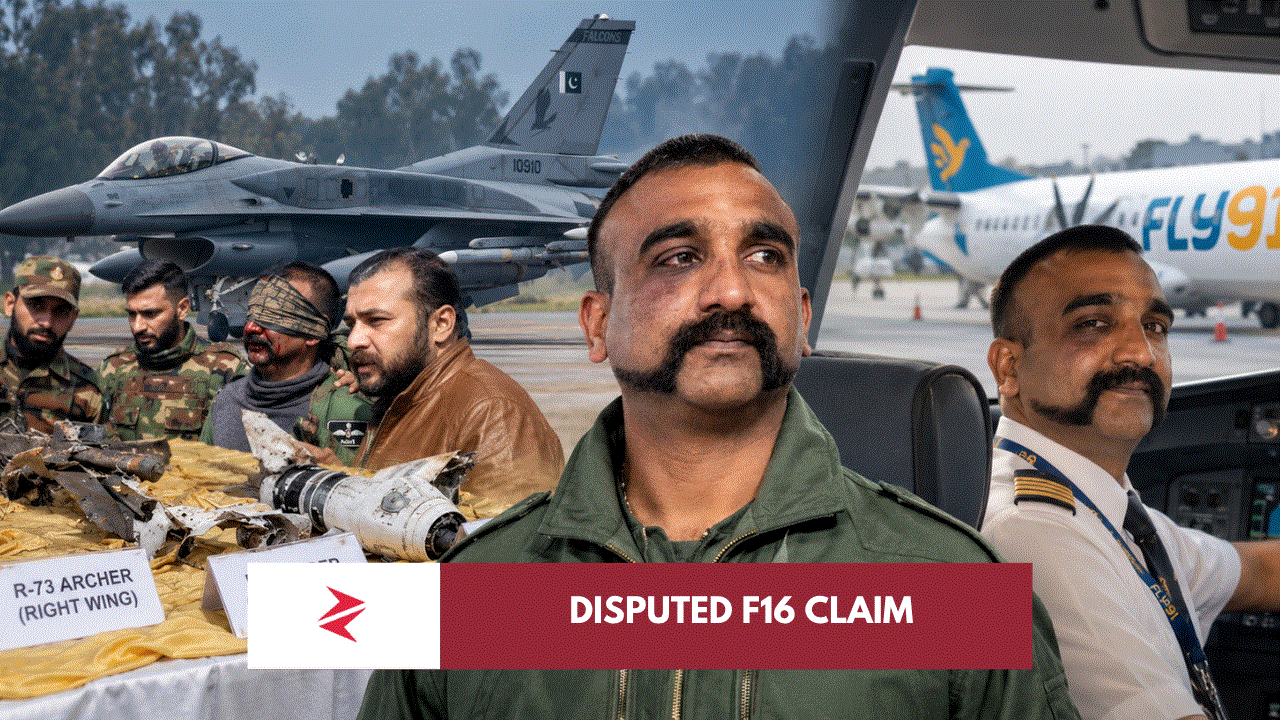
Abhinandan Varthaman joins FLY91 as the disputed 2019 F-16 claim collides again with US aircraft counts, recovered missiles and the public record.

Abhinandan Varthaman, Pakistan Air Force F-16 and recovered MiG-21 missiles as the disputed 2019 F-16 claim resurfaces after his move to FLY91.

Seven years after Pakistan shot down his MiG-21 Bison, captured him inside Pakistani-administered Kashmir and returned him to India, Group Captain Abhinandan Varthaman has quietly stepped away from military aviation and entered an entirely different cockpit. The former Indian Air Force fighter pilot has taken premature retirement and joined Goa-based regional airline FLY91, where reporting says he is training on the ATR 72-600 before commencing commercial operations. Yet much of the Indian coverage announcing this perfectly normal post-military career transition has resurrected something considerably less settled: the categorical declaration that Abhinandan first shot down a Pakistani F-16 before Pakistan shot him down.

That detail matters because it converts a human-interest aviation story into another repetition of one of the most disputed claims arising from the February 27, 2019 aerial battle. There is no dispute that Abhinandan flew a MiG-21 Bison, crossed to the Pakistani side during the engagement, lost his aircraft, ejected and entered Pakistani custody. There is photographic wreckage, a living pilot returned across Wagah, independent geolocation work identifying his MiG-21 wreck and years of reporting from both countries confirming those basic facts. Bellingcat independently analysed imagery of the wreck and identified it as the Indian MiG-21 Bison shot down on February 27.

The Pakistani F-16 supposedly destroyed by that MiG-21 is a very different evidentiary proposition.

The Claim India Keeps Repeating

India’s official position is not ambiguous. Abhinandan’s Vir Chakra citation states that he pursued a retreating Pakistani aircraft and, in the ensuing combat, “shot down an F-16 aircraft with his onboard missile.” That institutional claim subsequently migrated almost verbatim into Indian reporting and remains embedded in coverage seven years later. The current reporting surrounding his move to FLY91 demonstrates how completely it has hardened from a contested military assertion into assumed biography: Indian outlets introduce him not merely as the pilot captured by Pakistan, but as the pilot “who shot down” an F-16.

READ:   When Shaheen Air Died - It did not become Serene Air

That is an important distinction for an international reader. Pakistan is not arguing that India never made the claim. India absolutely did, officially and repeatedly. The question is whether the evidence available outside that institutional assertion establishes that the kill actually happened.

And this is where the story becomes much more uncomfortable.

What the US F-16 Count Reported in April 2019

On April 4, 2019, Foreign Policy published what remains one of the most consequential independent reports concerning the alleged F-16 loss. Citing two senior US defence officials with direct knowledge of the matter, journalist Lara Seligman reported that American personnel had counted Pakistan’s F-16 fleet after the battle and found none missing. One official told the publication that “all aircraft were present and accounted for.”

Reuters subsequently carried the finding internationally, reporting that the US count contradicted the Indian Air Force’s assessment that it had destroyed a Pakistani F-16.

That does not magically answer every technical question surrounding a chaotic aerial engagement; military evidence can remain classified, incomplete or disputed for decades. It does, however, create a severe evidentiary problem for anyone presenting the F-16 kill as uncontested historical fact. An F-16 destroyed in combat needs to cease existing somewhere. The Foreign Policy account says US personnel eventually inspected the Pakistani inventory and found the aircraft accounted for.

India’s institutional citation says one was destroyed.

Advertisement. Scroll to continue reading.

Both propositions cannot comfortably coexist without additional evidence explaining the contradiction.

Pages: 1 2 3 4 5 6

Click to comment

Leave a Reply

Your email address will not be published. Required fields are marked *

You May Also Like

World Affairs

Pakistan, Saudi Arabia and Türkiye’s Makkah defence pact creates collective deterrence—but its Article 51 limits and obligations demand scrutiny.

World Affairs

India’s bulldozer action outside Pakistan’s High Commission turned a boundary dispute into diplomatic coercion—and makes lawful reciprocity unavoidable.

Politics & Governance

Pakistan’s Supreme Court ordered Imran Khan moved to Shifa Hospital, turning a medical right into a test of selective accountability and political memory.

World Affairs

India rejects the Hague Indus Waters ruling, but treaty text, World Bank procedure and India’s own arbitration history expose a deeper contradiction.

World Affairs

Sergio Gor called Kashmir part of India. Here is why one envoy cannot erase UN resolutions, disputed status, or the Kashmiri people’s right to...

Technology & AI

Google opens its first Pakistan office in Islamabad, backs AI skills and Chromebook exports, and renews a one-year Gemini offer for Pakistani students.

World Affairs

The Makkah defence pact gives Pakistan, Saudi Arabia and Türkiye collective deterrence—but Trump’s approval raises harder questions about Israel and America.

Advertisement