















































Connect with Zorays

Hi, what are you looking for?

World Affairs

Abhinandan Varthaman Joins FLY91 — But India’s 2019 F-16 Story Still Has an Evidence Problem

Abhinandan Varthaman joins FLY91 as the disputed 2019 F-16 claim collides again with US aircraft counts, recovered missiles and the public record.

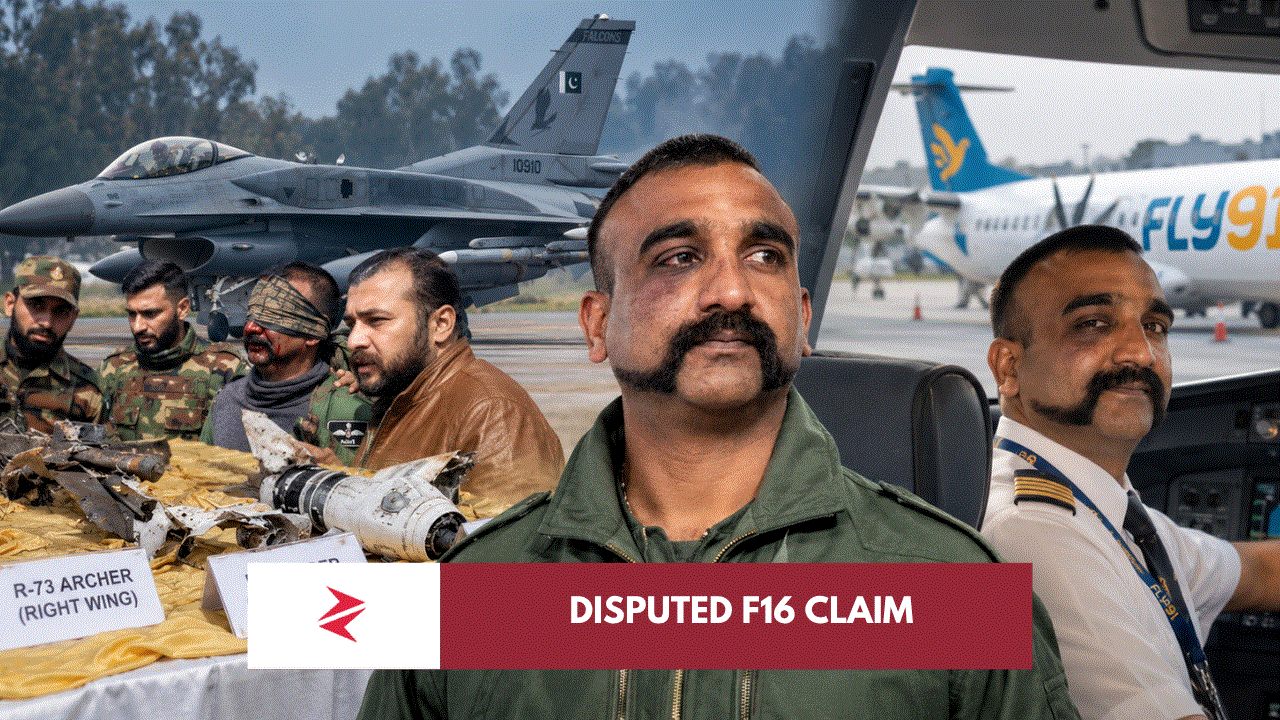
Abhinandan Varthaman, Pakistan Air Force F-16 and recovered MiG-21 missiles as the disputed 2019 F-16 claim resurfaces after his move to FLY91.

Seven years after Pakistan shot down his MiG-21 Bison, captured him inside Pakistani-administered Kashmir and returned him to India, Group Captain Abhinandan Varthaman has quietly stepped away from military aviation and entered an entirely different cockpit. The former Indian Air Force fighter pilot has taken premature retirement and joined Goa-based regional airline FLY91, where reporting says he is training on the ATR 72-600 before commencing commercial operations. Yet much of the Indian coverage announcing this perfectly normal post-military career transition has resurrected something considerably less settled: the categorical declaration that Abhinandan first shot down a Pakistani F-16 before Pakistan shot him down.

That detail matters because it converts a human-interest aviation story into another repetition of one of the most disputed claims arising from the February 27, 2019 aerial battle. There is no dispute that Abhinandan flew a MiG-21 Bison, crossed to the Pakistani side during the engagement, lost his aircraft, ejected and entered Pakistani custody. There is photographic wreckage, a living pilot returned across Wagah, independent geolocation work identifying his MiG-21 wreck and years of reporting from both countries confirming those basic facts. Bellingcat independently analysed imagery of the wreck and identified it as the Indian MiG-21 Bison shot down on February 27.

The Pakistani F-16 supposedly destroyed by that MiG-21 is a very different evidentiary proposition.

The Claim India Keeps Repeating

India’s official position is not ambiguous. Abhinandan’s Vir Chakra citation states that he pursued a retreating Pakistani aircraft and, in the ensuing combat, “shot down an F-16 aircraft with his onboard missile.” That institutional claim subsequently migrated almost verbatim into Indian reporting and remains embedded in coverage seven years later. The current reporting surrounding his move to FLY91 demonstrates how completely it has hardened from a contested military assertion into assumed biography: Indian outlets introduce him not merely as the pilot captured by Pakistan, but as the pilot “who shot down” an F-16.

READ:  When Shaheen Air Died - It did not become Serene Air

That is an important distinction for an international reader. Pakistan is not arguing that India never made the claim. India absolutely did, officially and repeatedly. The question is whether the evidence available outside that institutional assertion establishes that the kill actually happened.

And this is where the story becomes much more uncomfortable.

What the US F-16 Count Reported in April 2019

On April 4, 2019, Foreign Policy published what remains one of the most consequential independent reports concerning the alleged F-16 loss. Citing two senior US defence officials with direct knowledge of the matter, journalist Lara Seligman reported that American personnel had counted Pakistan’s F-16 fleet after the battle and found none missing. One official told the publication that “all aircraft were present and accounted for.”

Reuters subsequently carried the finding internationally, reporting that the US count contradicted the Indian Air Force’s assessment that it had destroyed a Pakistani F-16.

That does not magically answer every technical question surrounding a chaotic aerial engagement; military evidence can remain classified, incomplete or disputed for decades. It does, however, create a severe evidentiary problem for anyone presenting the F-16 kill as uncontested historical fact. An F-16 destroyed in combat needs to cease existing somewhere. The Foreign Policy account says US personnel eventually inspected the Pakistani inventory and found the aircraft accounted for.

India’s institutional citation says one was destroyed.

Advertisement. Scroll to continue reading.

Both propositions cannot comfortably coexist without additional evidence explaining the contradiction.

Evidence or claim What it establishes Evidentiary limitation
Abhinandan’s Vir Chakra citation India officially credits him with an F-16 kill It is an Indian institutional claim, not independent verification
Foreign Policy US-count report Two US defence officials said Pakistan’s F-16s were all accounted for US government did not publicly release a photographed inventory report
Reuters reporting Independently reported the US-count story and contradiction with India Based substantially on the Foreign Policy disclosure
MiG-21 wreckage Abhinandan’s aircraft was physically destroyed Does not by itself determine every event immediately before the shoot-down
Pakistani missile display Pakistan says two R-73s and two R-77s from the MiG were recovered and none had been fired Provenance and technical examination were presented primarily through Pakistani authorities
Indian radar presentation India says a disappearing radar track supported its F-16 claim A disappearing radar track is not itself physical identification of destroyed wreckage
READ:  Pakistan Wins Over India After Indian Cowardice was Apparent

The distinction between “claim” and “proof” should not be controversial in serious defence analysis. It is exactly the distinction journalists demand whenever Pakistan announces an enemy aircraft loss, a missile interception or a battlefield success. The same burden must therefore apply when the claim comes from New Delhi.

Then There Are Abhinandan’s Four Missiles

Pakistan later placed another piece of evidence into the public domain that deserves far more attention than Indian media ordinarily gives it. Pakistan’s military said it had recovered the seeker heads and remains of all four air-to-air missiles carried by Abhinandan’s MiG-21 Bison. Pakistani reporting identified the load as two R-73 Archer short-range missiles and two R-77 Adder missiles. The weapons were later publicly displayed alongside wreckage from the aircraft.

The photographs are striking because the exhibition labels identify the R-73 and R-77 components by wing position, while Pakistan’s Air Commodore Syed Omar Shah publicly maintained that none had been fired. The Pakistani technical argument was straightforward: the recovered missile remains, including rocket-motor components still associated with the weapons, were incompatible with the Indian claim that Abhinandan had launched the missile responsible for destroying an F-16.

This evidence should be described precisely rather than exaggerated. Pakistan publicly presented the weapons and asserted that analysis showed none had been fired. That is a source-backed Pakistani military position. It is not the same thing as an internationally supervised forensic examination.

Yet there is an obvious question for India: if New Delhi maintains that Abhinandan launched the successful weapon, what exact weapon was fired, and how does India reconcile that assertion with the missile hardware publicly displayed by Pakistan?

READ:  The Taliban's Swift Takeover of Kabul: A Historical Perspective and its Relevance Today

That is the question worth asking rather than simply repeating “shot down Pakistani F-16” in another retirement story.

The Most Interesting Person in This Argument Is Abhinandan Himself

There is an irony here that deserves more respect than ridicule. I can find India’s government, its Air Force, gallantry citation, journalists, television anchors and commentators making the F-16 claim. What is much harder to find is an unambiguous first-person public statement from Abhinandan himself saying: I shot down a Pakistani F-16.

That absence does not independently prove that he did not do it. A serving military officer is not obliged to give media interviews about classified engagements, and silence cannot be converted into forensic evidence.

But it does explain why many Pakistanis have developed an oddly respectful view of the man himself while remaining deeply contemptuous of the mythology constructed around him.

Advertisement. Scroll to continue reading.

Abhinandan was an enemy combatant. Pakistan shot down his aircraft. He entered Pakistani custody. He conducted himself as a military officer during an extraordinary and humiliating situation, and Pakistan eventually returned him alive to his country. There is nothing contradictory about respecting the professionalism of an opposing officer while simultaneously challenging what we believe became a state-supported story attached to his name.

In fact, the distinction matters. The Indian pilot and the Indian narrative are not necessarily the same thing.

Pages: 1 2 3

Click to comment

Leave a Reply

Your email address will not be published. Required fields are marked *

You May Also Like

Sports

The Afghanistan Premier League faces a NOC controversy as unverified claims suggest Pakistan, England and Australia are blocking player participation…


Politics & Governance

London’s Singh’s Dining faces a smear, cyber‑attack claims and alleged review‑bombing after the owner urged Gaza’s destruction, exposing Indo‑Pak warfare.


Opinions

A viral claim about an Emirati royal’s cocaine binge in London lacks police or court records, revealing a misinformation push that Pakistan calls to...


Opinions

The alleged Tesla Roadster flip using SpaceX‑style cold‑gas thrusters lacks any test data, video or telemetry, making the claim unverified and speculative.


Sports

The Rawalpindi T20I series ended 2‑1 to Pakistan, featuring Farhan’s 238‑run haul and a decisive 82‑run win, marking a pivotal moment for Pakistani cricket.


Energy & Environment

A proposed US diesel export ban exposes Britain’s reliance on imported fuel. Here is what the refinery data show and why Pakistan should pay...


World Affairs

Flydubai’s reported Tabuk landing raises questions about emergency codes, conflicting fight claims, Pakistan’s Saudi ties and Israeli military airspace access.

Advertisement