

























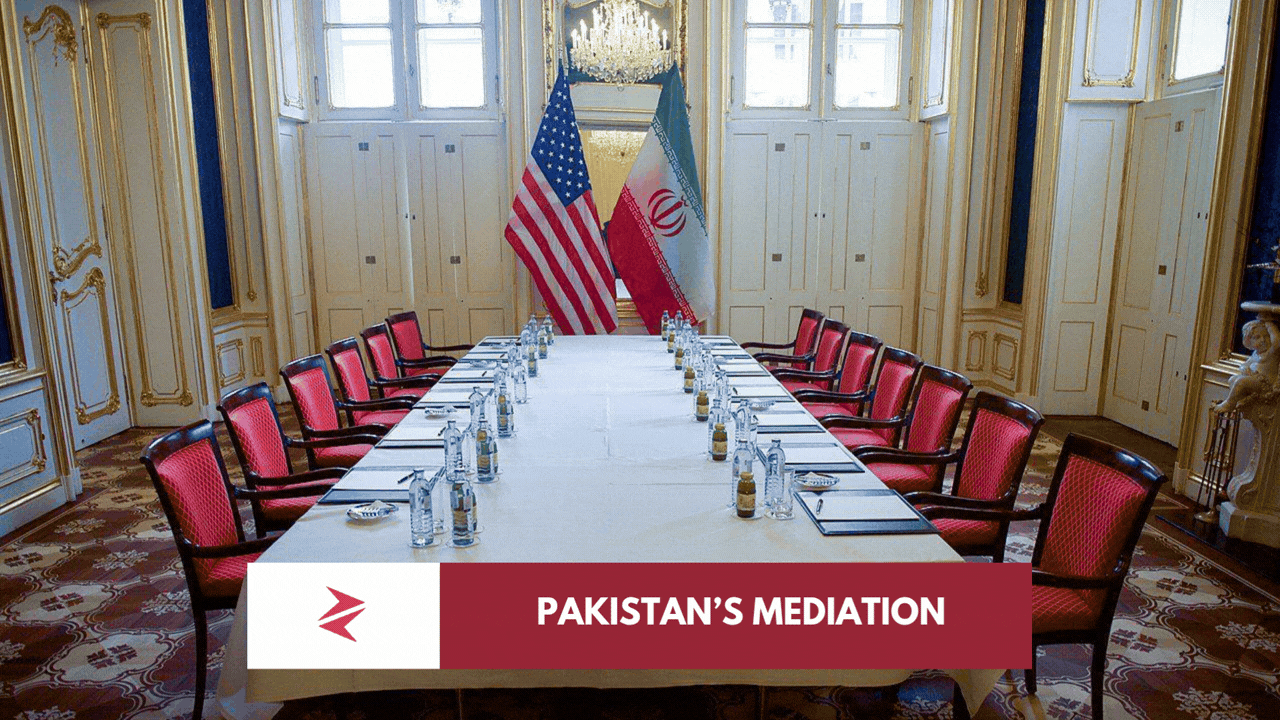
That is the headline being sold. But read the room properly—this is not peace arriving; this is positioning before something larger unfolds, something that feels less like diplomacy and more like controlled escalation in formal attire.
Within hours, contradictions began stacking up. On one side, negotiations are confirmed, with signals like the reported unfreezing of Iranian funds hinting at progress. On the other, talks are already strained over the Strait of Hormuz—Iran refusing to dilute control, the United States floating “joint control,” a proposal detached enough to be dismissed almost immediately.
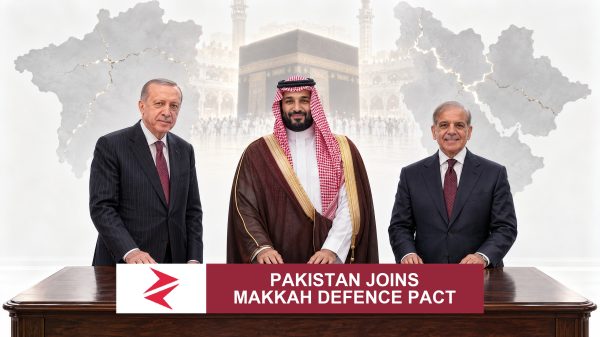
Now layer in military movement. The United States sends naval ships through Hormuz—never a neutral act in this climate. Iran responds with warnings. At the same time, Pakistan deploys fighter jets to Saudi Arabia under a mutual defense pact, officially about readiness but strategically understood as positioning.
Good or bad depends on interpretation—deterrence or pre-war alignment.
History is clear: diplomacy often intensifies before escalation, not instead of it.
Islamabad, then, is not an endpoint. It is a calibration phase where red lines are quietly drawn before being loudly crossed. And the most volatile of those lines is Hormuz—the artery of global oil flow, one Iran will not compromise on.
Public reaction oscillates between naive optimism and chaotic cynicism. Some imagine an “Islamabad Accord.” Others point out the absence of military chiefs, correctly noting that real power operates off-stage. The noise—regional jabs, ideological distractions—adds volume but not clarity.
Beneath that noise sits a sharper truth: Pakistan is not just hosting; it is being trusted by both sides. That is rare. And risky. Because mediators absorb pressure when things fall apart.
And they might.
Reports indicate American demands remain excessive, while Iran insists on preserving military gains. That is not compromise—it is hardened positions temporarily coexisting while calculating the cost of confrontation.

Even the financial layer matters. Reports of Saudi Arabia and Qatar preparing billions in assistance to Pakistan are not isolated—they are signals of alignment, where economics, military posture, and diplomacy intersect.
So where does that leave Islamabad?
Visible. Exposed.
If talks succeed, Pakistan becomes the bridge that prevented escalation. If they fail—and Hormuz ignites—it becomes the last quiet room before the storm.
Now consider what the world actually saw.
Journalists flown in from across the globe sat inside a controlled media centre with no briefings, no access, no clarity. One summed it up bluntly: “bored out of my mind.”
That line exposes the reality—this was controlled opacity. A negotiation so tightly sealed that even those present witnessed nothing.
Because outside that silence, everything was moving.
Hormuz heating up. Naval positioning intensifying. Iran issuing warnings. Talks stalling over sovereignty. Real negotiation shifting from conference rooms to strategic posture.
That is the paradox: the closer you are physically, the less you actually see.
Pakistan sits at the center of this contradiction—hosting talks while simultaneously deploying assets, balancing neutrality with strategic alignment. To outsiders, that looks like inconsistency. In reality, it is survival.
Neutrality here is not stillness. It is calibrated movement.
Public discourse again splits—grand visions of diplomatic breakthroughs versus cynical dismissal. Yet one truth stands: Pakistan is trusted by both Washington and Tehran at a moment when trust is rare.
And that trust is dangerous.
Because failure does not leave the host untouched. If Islamabad delivers even a temporary framework, it gains credibility. If not, it becomes the place where peace quietly collapsed.
There is an irony here. Islamabad has long been described as calm, orderly—even boring. That same stillness now defines a moment of global consequence.
A city built for silence hosting negotiations defined by it.
But silence is not inactivity.
Financial alignments are shifting. Military readiness is calibrating. Narratives are intensifying. Pressure is building beneath a still surface.
And that stillness is not peace.
It is compression.
The kind that either resets the system—or breaks it.
So when someone says “give peace a chance,” understand the weight behind it. It is not optimism.
It is a warning.
Who is actually at the table—and why that matters
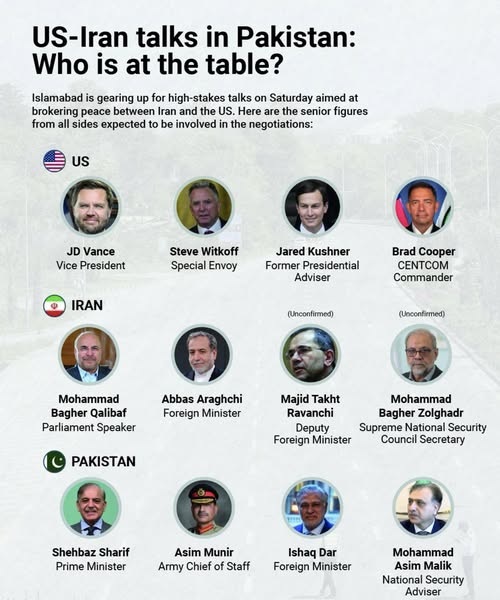
JD Vance, Steve Witkoff, Jared Kushner, Brad Cooper.
Not generals. Not intelligence chiefs. Political and strategic operators.
Iranian side:
Bagher Ghalibaf, Abbas Araghchi, with others “unconfirmed.”
Again—political leadership, not battlefield command.
Pakistan’s side:
Shehbaz Sharif, Asim Munir, Ishaq Dar, National Security leadership.
A hybrid presence. Civilian and military both visible.
Now pause there. That contrast is the real headline.
The question echoing everywhere: where are the army chiefs?
People in the comments instinctively caught it:
- “Where is American and Iranian army chief?”
- “Why didn’t they bring intelligence chiefs?”
That instinct is not wrong—it is raw pattern recognition.
Because in Washington and Tehran, the military does not sit at the diplomatic front table. It influences, it briefs, it pressures—but it does not headline negotiations.
Pakistan, however, operates differently. The inclusion of **Asim Munir alongside Shehbaz Sharif is not accidental—it is structural. It reflects how power is actually distributed inside the country.
So when critics say “puppets,” they’re not analyzing—they’re reacting. Crude language, but rooted in a visible asymmetry.
The real strategic layer: why Pakistan is central
Strip away the noise. Focus on positioning.
Pakistan is doing three things simultaneously:
- Hosting.
- Mediating.
- Legitimizing both sides to sit in the same room.
That is not symbolic. That is leverage.
One comment hints at it indirectly:
“Pakistan golden chance…”
Yes. But not in the simplistic IMF-cancellation fantasy being thrown around.
The real leverage is geopolitical credibility. The same credibility hinted at in recent developments—where both Washington and Tehran are willing to trust Islamabad as a channel.
That is rare. And dangerous. And powerful.