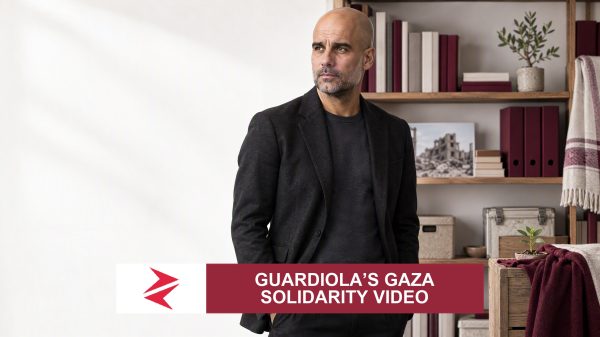




























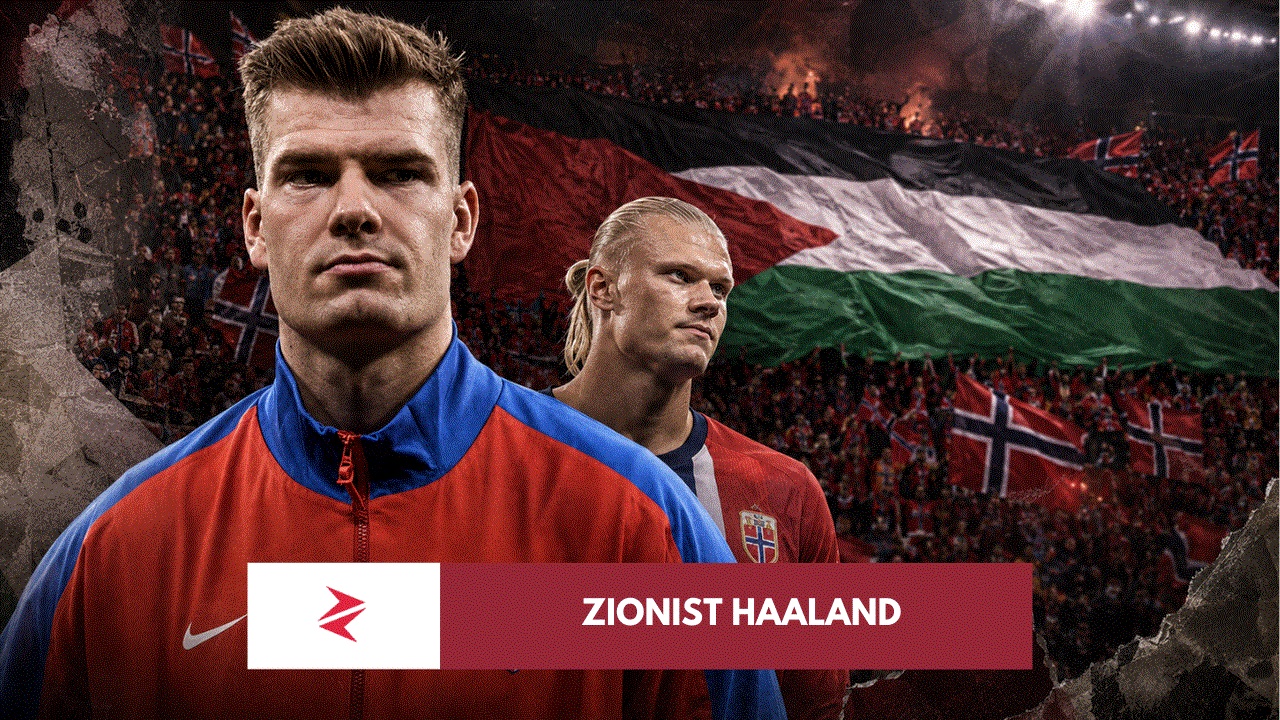
The easiest version of this story was also the wrong one. A viral graphic placed the words “We cannot and will not be indifferent to the humanitarian suffering” in Erling Haaland’s mouth, instantly turning the Norwegian superstar into another global sporting icon publicly confronting what has happened in Gaza. The internet celebrated him, attacked him, called him courageous, called him a Nazi, compared him with Harry Kane playing golf with Donald Trump, and—as usual—built an entire ideological battlefield around words the footballer apparently never said.
That false attribution should be corrected. Not because Norway’s Palestine story disappears when Haaland is removed from the quote, but because the truth is actually more substantial than the meme.
The words came from Lise Klaveness, president of the Norwegian Football Federation, during the federation’s decision to direct proceeds from Norway’s World Cup qualifier against Israel toward humanitarian work in Gaza. Klaveness said that neither the federation nor other organisations could remain indifferent to the humanitarian suffering and the disproportionate attacks endured by Gaza’s civilian population. Norway’s football authorities subsequently worked with Doctors Without Borders, while the October 2025 qualifier against Israel became a politically charged event surrounded by Palestinian flags, demonstrations and an emphatic 5-0 Norwegian victory in which Haaland scored a hat-trick.
So let us begin with the correction that social media often refuses to make: Haaland did not make the viral Gaza statement attributed to him. Lise Klaveness did.
But here is the part that matters more.
The Fake Haaland Quote Distracted From a Very Real Norwegian Revolt
Norway did not merely produce a viral graphic. Its football establishment turned humanitarian concern into money, institutional pressure and an increasingly uncomfortable question for FIFA.
The Norwegian Football Federation announced that profits from its home qualifier against Israel would support Doctors Without Borders’ work in Gaza. Klaveness later publicly supported the argument that Israel should face sporting sanctions comparable to those imposed on Russia, while Norway emerged as one of the football associations pushing the issue inside European and international football. A fresh July 2026 report says the Norwegian federation is continuing to use its influence to press the case for Israel’s suspension from FIFA.
This is no longer the politics of one meme, one footballer or one emotional interview.
It is institutional.
In June 2026, the Norwegian federation also formally backed an ethics complaint against FIFA president Gianni Infantino over political-neutrality concerns linked to FIFA’s peace prize for Donald Trump. Whatever one thinks of every position taken by Klaveness, Norway has developed a recognisable pattern: it is prepared to challenge the governing structures of international football rather than repeating the familiar line that sport and politics must somehow remain separated only when separation is convenient.

That is the deeper story the fake Haaland graphic almost ruined.
And What About Alexander Sørloth?
There is also a player-level dimension. A statement attributed to Norwegian striker Alexander Sørloth—“We’re sorry for all the people of Palestine”—has circulated extensively across pro-Palestinian football pages and social platforms. Multiple posts carry the quotation in Sørloth’s name.
An EEAT-standard publication, however, should draw a distinction the social-media algorithm rarely bothers to make: the Sørloth quotation is widely circulated, but I have not located a primary full-length interview, official federation transcript or original video that independently establishes the exact wording beyond doubt.
That does not mean the quote is necessarily false. It means the evidence standard is different from the Klaveness statement, which is firmly documented through mainstream reporting and the federation’s public policy.
This distinction matters because the Palestine cause does not need fake celebrity endorsements. It does not become stronger by putting the right words into the wrong mouth. When an actual football federation is donating revenue to Gaza, publicly debating Israel’s suspension and challenging FIFA’s political conduct, fabricating—or carelessly misattributing—a Haaland quote only gives opponents an easy escape hatch from the much harder facts.
They can shout “fake news” at the meme and pretend the entire Norwegian position was imaginary.
It was not.
Haaland Himself Is More Complicated Than Either Side Wants
The attempt to turn Haaland into a clean ideological symbol also collapses under scrutiny. In April 2025, he held a video call with Omer Shem Tov, an Israeli who had been held hostage in Gaza and was reportedly a major Haaland fan. That act was real.
But calling a released hostage does not automatically establish support for every action of the Israeli government, just as sympathy for Palestinian civilians does not establish support for Hamas. The political internet hates such distinctions because tribal narratives require every celebrity to be either completely “ours” or completely “theirs.”
Human beings do not always cooperate with that script.
Haaland can perform an act of compassion toward a former hostage without having made the viral Gaza statement attributed to him. Norway’s football federation can take a far stronger institutional position on Gaza than its most famous footballer personally chooses to articulate. Both facts can exist simultaneously.
The truth is untidier than propaganda. That is precisely why it is more useful.
The Word “Genocide” Is No Longer Merely an Internet Slogan
Some critics attacked the language used around Norway’s position because Klaveness initially spoke of “humanitarian suffering” and “disproportionate attacks.” For many Palestinians and their supporters, that terminology now sounds radically inadequate.
By September 2025, an independent United Nations Commission of Inquiry had concluded that Israel had committed genocide in Gaza. Amnesty International had independently reached a genocide conclusion in December 2024, and in June 2026 the UN inquiry again reported that the deliberate targeting of Palestinian children had resulted in genocide, crimes against humanity and war crimes. Israel rejects the genocide allegation. Meanwhile, South Africa’s genocide case against Israel remains before the International Court of Justice; Israel filed its response in March 2026, meaning the ICJ has not yet delivered a final merits judgment.
That distinction is important. Saying that major human-rights organisations and a UN inquiry have concluded genocide is factually supportable. Saying that the ICJ has already finally convicted Israel of genocide would not be.
This is precisely the level of factual discipline pro-Palestinian advocacy needs. Accuracy does not weaken the case. Accuracy makes it harder to dismiss.