



























The world has a habit of pretending that history is accidental, that power shifts are chaotic, and that influence emerges overnight. That illusion collapses the moment you trace the routes.
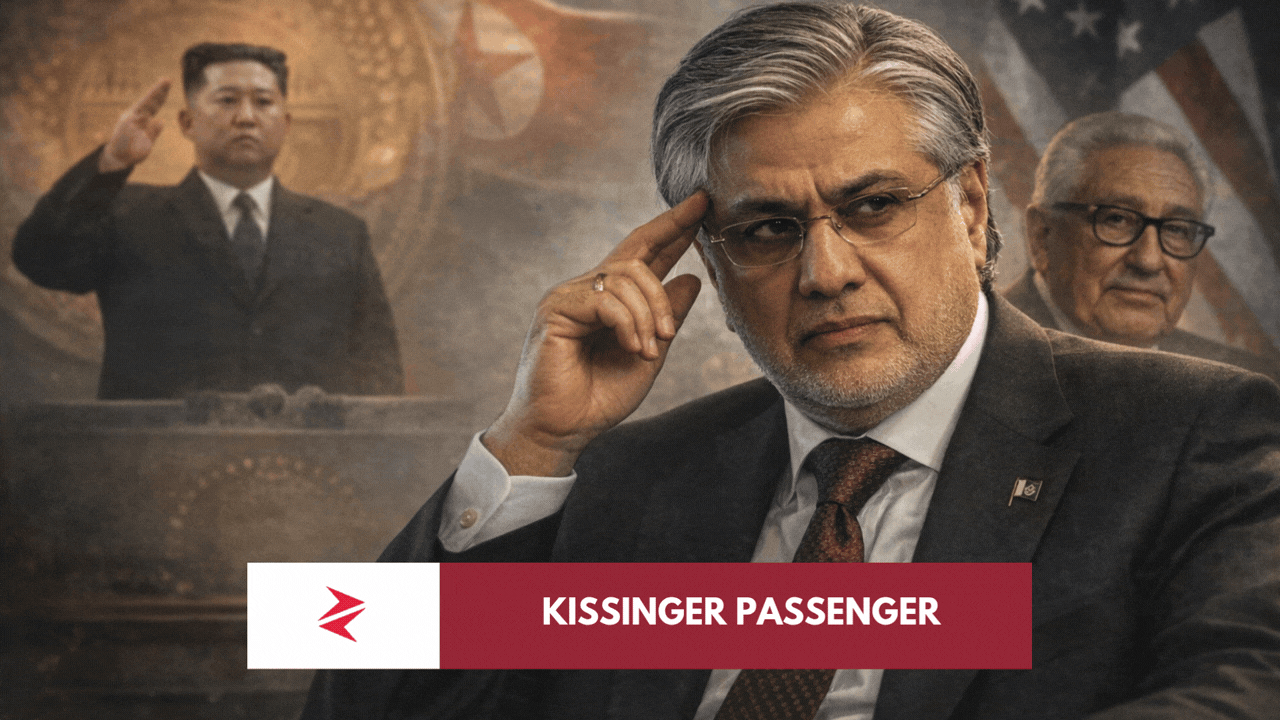
In 1971, Pakistan carried Henry Kissinger from Islamabad to Beijing, unlocking a US-China rapprochement that defined half a century of global politics. That operation was invisible, surgical, and decisive. No noise. Only outcome.
Today, the same corridor is active again.
Ishaq Dar’s flight to Beijing is not symbolism. It is structural inevitability. Because once again, the global system has reached a point where no single power can talk to all sides — except Pakistan.
From Korean Brinkmanship to Middle Eastern Boiling Point
The attached discourse on the North Korean crisis reveals something critical that most analysts overlook: war, diplomacy, and negotiation are no longer separate domains. They are extensions of the same economic engine.
The text bluntly captures what polite diplomacy hides — that the “business of war” has become an industry, driven by arms trade, geopolitical leverage, and controlled instability. The Korean Peninsula was not just about missiles; it was about negotiation failure, ego-driven escalation, and credibility collapse.
That same pattern is now unfolding in the Middle East — but with far higher stakes.
North Korea was a contained nuclear anxiety.
Hormuz is a global economic artery.
And unlike Korea, this time the system cannot afford prolonged instability.
The Negotiation Failure Pattern — And Pakistan’s Disruption
The Korean example demonstrates a recurring failure:

Leaders posture publicly.
Negotiations lack trust.
Channels collapse under ego.
Escalation replaces diplomacy.
The text’s reference to Stephen Covey’s principle — “Seek first to understand, then to be understood” — is not corporate fluff. It is precisely what failed in North Korea, and what is now being tested again.
Because when both sides do not trust each other, they look for a third party.
And that third party must satisfy three conditions:
It must have access.
It must have credibility.
It must not threaten either side.
Pakistan meets all three.
The Resource Reality Behind the Rhetoric
What looks like diplomacy is, in fact, resource negotiation.
China’s dependency on Iranian oil.
America’s dependency on rare earth supply chains.
The global dependency on uninterrupted maritime trade through the Strait of Hormuz.
This is not ideology. This is logistics.
The Korean crisis showed how ego can override rational negotiation until the brink of catastrophe. The current Iran crisis shows something different — a system attempting to correct itself before reaching that brink.
And the correction mechanism is Islamabad.