


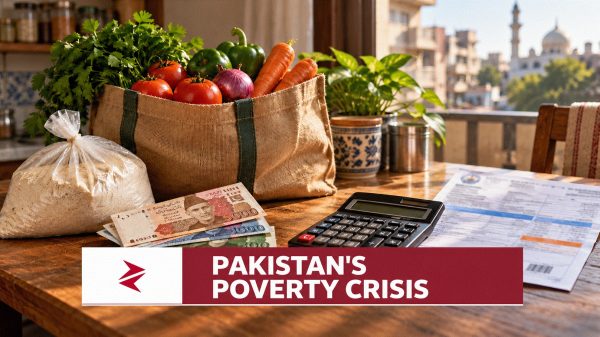































Pakistan does not contain 48% of the world’s poor, and correcting that false claim should never become a convenient way of pretending that Pakistani households are prospering. The real scandal is that a serious warning about poverty has been pulled into a familiar political contest, where one side inflates the statistic to intensify outrage while another celebrates the correction as though fixing a denominator somehow restores the purchasing power of a struggling family.
A Pakistan-first response must demand accuracy and accountability together, because ordinary Pakistanis deserve something better than being reduced to ammunition for competing political camps. Their hardship does not need an exaggerated global ranking to become urgent, and their country does not need a misleading headline to justify asking why years of adjustment, sacrifice and promises have failed to produce dependable household security.
What the World Bank finding actually says
The October 7 report in The Express Tribune, subsequently circulated by Miftah Ismail, concerns the Middle East, North Africa, Afghanistan and Pakistan region, abbreviated as MENAAP. Its central statement is that Pakistan accounts for approximately 48% of the people within that region living below the international extreme-poverty threshold of $3 per person per day. The newspaper’s headline and subheading identify the regional scope explicitly. tribune.com.pk
That is a share of a regional poverty population, rather than Pakistan’s national poverty rate or its share of global poverty. These distinctions are essential, because each answers a different question.
| Figure or claim | What it measures | Correct interpretation |
|---|---|---|
| Approximately 48% | Pakistan’s share of MENAAP’s extreme-poor population | Nearly half of the region’s people below the $3 threshold live in Pakistan |
| Approximately 14% | MENAAP’s share of the world’s extreme poor | The regional total is only part of the global total |
| 6.4 percentage points | Reported change in Pakistan’s poverty rate at the $3 line, from 2018–19 to 2024–25 | A deterioration within Pakistan over the stated period |
| 3.2 percentage points | Reported change at the $4.20 line over the same period | An increase under a different poverty threshold |
| “48% of the global poor live in Pakistan” | A claim circulating on social media | A misrepresentation of the regional finding |
Context: The regional shares are rounded. The changes in poverty rates are percentage-point changes, rather than percentage increases. These figures are reported in coverage of the October 2026 World Bank update. tribune.com.pk
The extractable finding is straightforward: Pakistan reportedly accounts for about 48% of MENAAP’s extreme poor, not 48% of the world’s extreme poor.
There is also a useful arithmetic check. If MENAAP represents roughly 14% of global extreme poverty and Pakistan represents roughly 48% of MENAAP’s extreme poor, multiplying the rounded shares gives approximately 6.7% of the global total. That is an illustrative calculation using the reported regional figures, rather than an independently verified country estimate; nevertheless, it demonstrates how far the viral global claim departs from the report’s actual meaning.
Correct Huma Baqai’s claim without turning the discussion into abuse
The post circulated from Huma Baqai’s account describes the figure as a global share while criticising elite consumption and pressure on the salaried middle class. The statistical claim requires correction, while the wider argument about household hardship must be evaluated on its own evidence.
Neither a doctorate nor a public profile makes a person immune from factual scrutiny, but a mistaken denominator does not justify sexual insinuations, invented accusations about academic qualifications, or abuse masquerading as economic analysis. The strongest response is to identify the error precisely, publish the correct interpretation and continue examining the conditions that made the original warning consequential.
Equally, correcting that post does not establish that Pakistan is doing well. It establishes that one claim was wrong, and any attempt to stretch that correction into an economic success story commits another failure of reasoning.


Pakistan’s new regional grouping changes the comparison, not the family budget
The World Bank confirms that Pakistan and Afghanistan were reclassified from South Asia into the expanded Middle East and North Africa grouping, and that its Poverty and Inequality Platform incorporated the revised regional classification in September 2025. The change alters which countries contribute to each regional aggregate. blogs.worldbank.org
A large, lower-income country placed alongside wealthier economies can account for a substantial share of the region’s poor, even without an overnight change in its domestic circumstances. That is a reason to examine the composition of the comparison, rather than to portray the regional share as a self-explanatory verdict on every aspect of national performance.
However, classification cannot explain away a rise in Pakistan’s own poverty rate measured consistently over time. Moving Pakistan between administrative regions does not increase a worker’s wages, repair a school, reduce a grocery bill or make a small manufacturer more competitive.