



























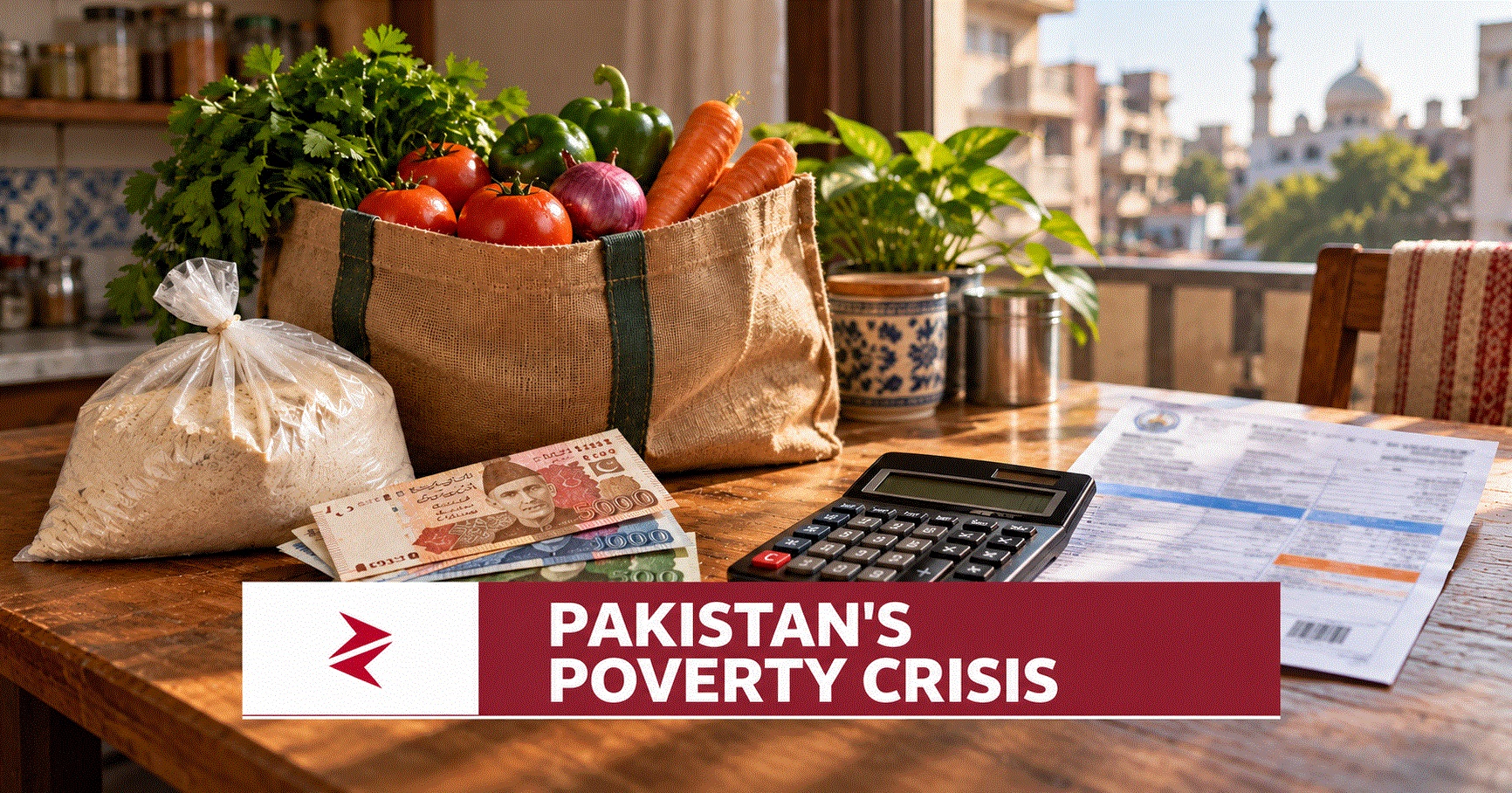
The reported increase of 6.4 percentage points at the $3 threshold therefore deserves attention independently of the regional headline. As Nukta’s coverage explains, the deterioration is associated with successive economic and climate shocks, including the pandemic, floods, inflation, currency depreciation and prolonged adjustment that weakened household incomes and employment opportunities. Nukta
The $3 line is not simply Rs840 at the currency counter
Another error sits inside the public discussion: the international poverty threshold is expressed in 2021 purchasing-power-parity dollars, rather than ordinary US dollars converted at the current exchange rate. The World Bank updated the extreme-poverty threshold from $2.15 under the earlier PPP framework to $3 under the 2021 framework; its lower-middle-income reference line is $4.20. blogs.worldbank.org
PPP adjusts for differences in what money purchases across countries. Consequently, presenting the $3 line as approximately Rs840 a day through a market-rate conversion gives readers the wrong understanding of the measurement. It also encourages a misleading description of poverty as simply whether somebody personally “earns three dollars,” when household welfare measurement must account for the survey methodology, household resources and number of people supported.
The challenge raised in Nadeem Haque’s response, calling for greater critical thinking about World Bank reporting, is therefore worth taking seriously. Scrutiny should establish which poverty line was used, what price basis applies, which years are being compared and how the estimate was produced; it should not replace measurement with a comforting declaration that the poorest 20% are the only people who count as poor.
Defining poverty as the bottom fifth of the population would fix the proportion by construction, even if living conditions improved dramatically or deteriorated across most households. Such a definition answers a distributional question, while leaving the question of material deprivation unresolved.
Estimates, surveys and political blame must remain separate
The World Bank’s September 2025 Pakistan poverty assessment announcement explained that its post-2018–19 estimates used microsimulation because that was the latest household survey available for that assessment. This describes the evidence base of that publication; it should not automatically be treated as the methodology of every subsequent update. worldbank.org
That distinction matters when politicians attach absolute certainty to figures from different releases. A national poverty estimate, an international poverty estimate, a modelled projection and a regional share can all be useful, but they are not interchangeable.
It also matters when assigning responsibility. The 2018–19 to 2024–25 comparison spans several governments and major shocks, so the entire measured increase cannot honestly be presented as proof against one administration alone. Yet successive governments cannot shelter behind that complexity either, because their choices determine how effectively Pakistan protects households, creates productive employment and distributes the costs of stabilisation.
The relevant test is whether policy reduced vulnerability, rather than whether a minister can produce a favourable chart. A government that inherits a crisis still has to explain its response, just as a former finance minister who circulates alarming figures can reasonably be asked what his own decisions achieved.
Elite capture is a documented governance problem
Pakistan does not need an AI chatbot’s agreement to establish that corruption and governance weaknesses are serious economic concerns. The IMF’s November 2025 Governance and Corruption Diagnostic summary identifies persistent corruption risks, weak oversight, constrained rule of law and regulatory distortions benefiting politically connected firms. Its language includes the finding of “pervasive distortions favoring politically connected firms.” imf.org


This is a stronger foundation for criticism than an unverified assertion that every prominent individual is corrupt. It identifies the mechanisms through which privilege can operate: discretionary enforcement, opaque rules, weak procurement controls and accountability institutions exposed to political influence.
The editorial implication is severe. When access and connections influence who receives favourable treatment, ordinary businesses face costs that privileged actors can avoid, while households carry the consequences through fewer opportunities, weaker services and an economy that rewards proximity more reliably than productivity.