








































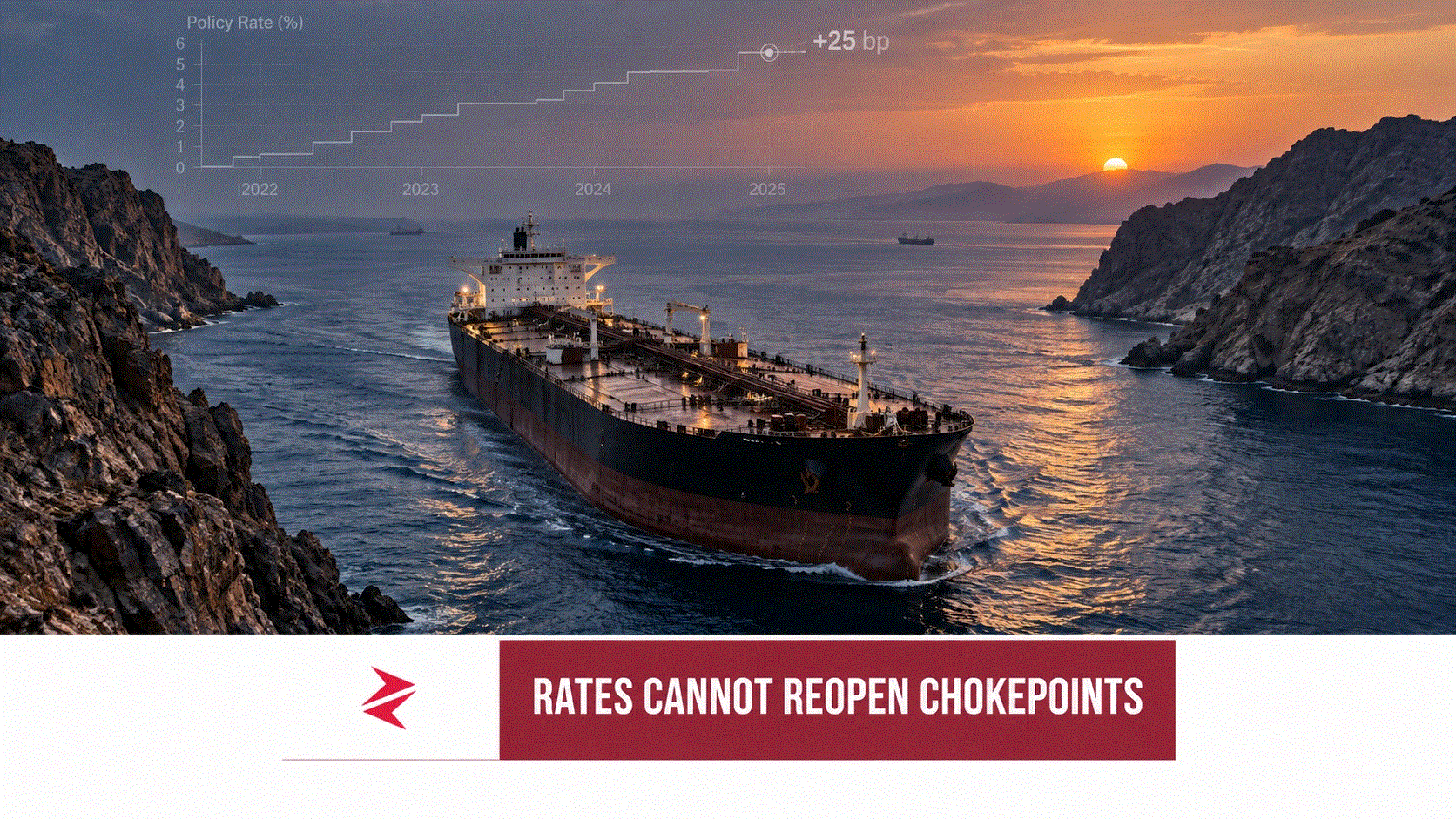
The Federal Reserve can raise the price of money, but it cannot print crude oil, command a tanker through hostile waters or manufacture a shipping corridor out of a press conference. That is the uncomfortable truth behind the “Straits Taylor Rule,” the equation posted by Iranian parliamentary speaker Mohammad Bagher Ghalibaf’s account as Washington confronted inflation linked to an energy shock. The formula looked like graduate macroeconomics colliding with geopolitical trolling, but beneath the theatre sat a serious question: what happens when the world’s most powerful central bank confronts inflation created not by excessive shopping, reckless credit or an overheating labour market, but by a physical interruption in the movement of energy?
The post rewrote the familiar Taylor Rule as:
i=r∗+π∗+1.5(π−π∗)+0.5(y−y∗)+α(SOH−SOH∗)+β(BEM−BEM∗)
Here, SOHSOH represents the Strait of Hormuz and BEMBEM represents Bab el-Mandeb. The additions were not presented as a peer-reviewed monetary-policy model. They were satire with mathematical notation: a way of telling Washington that the inflation rate appearing on its screens may now be carrying a geopolitical surcharge that no quarter-point interest-rate increase can physically remove.
The line that detonated across social media was simpler than the equation: “You can’t 25bp a chokepoint.” Technically, that claim is both clever and incomplete. A rate increase cannot reopen a strait or create a barrel, but monetary policy can still influence how an initial energy shock spreads through wages, contracts, credit, asset prices and inflation expectations. The real mistake is therefore not raising rates. The mistake is pretending that raising rates solves the original supply failure.
What the Original Taylor Rule Actually Says
Economist John Taylor’s influential rule was designed as a systematic way of thinking about how a central bank might adjust its nominal policy rate when inflation deviates from target or economic output moves away from its sustainable level. In simplified terms, the policy rate rises when inflation is too high or the economy is running too hot, and falls when inflation is weak or economic activity is depressed.
| Symbol | Meaning | Practical interpretation |
|---|---|---|
| ii | Nominal policy interest rate | The rate a central bank is trying to set |
| r∗r^* | Equilibrium real interest rate | The estimated rate consistent with balanced economic activity |
| π\pi | Actual inflation | The observed rate at which prices are rising |
| π∗\pi^* | Inflation target | The central bank’s desired inflation rate |
| π−π∗\pi-\pi^* | Inflation gap | How far inflation has moved above or below target |
| y−y∗y-y^* | Output gap | Whether actual output is above or below sustainable output |
| SOH−SOH∗SOH-SOH^* | Hormuz-risk term in the parody | Departure from normal passage or risk conditions |
| BEM−BEM∗BEM-BEM^* | Bab el-Mandeb-risk term | Departure from normal Red Sea shipping conditions |
The original rule is useful because demand-driven inflation can be restrained by making borrowing more expensive. Consumers postpone purchases, businesses become more selective about investment, construction slows, financial conditions tighten and aggregate demand cools. The equation is not a machine that gives central bankers an unquestionably correct answer, but it makes the policy logic transparent.
A maritime energy disruption creates a different problem. Oil becomes more expensive because less supply is available, delivery is delayed, freight and insurance costs rise, or traders attach a larger risk premium to future deliveries. Raising interest rates does not repair any of those physical conditions. It reduces the economy’s ability to pay the higher price.
That difference is not semantic. It determines who absorbs the shock.