


































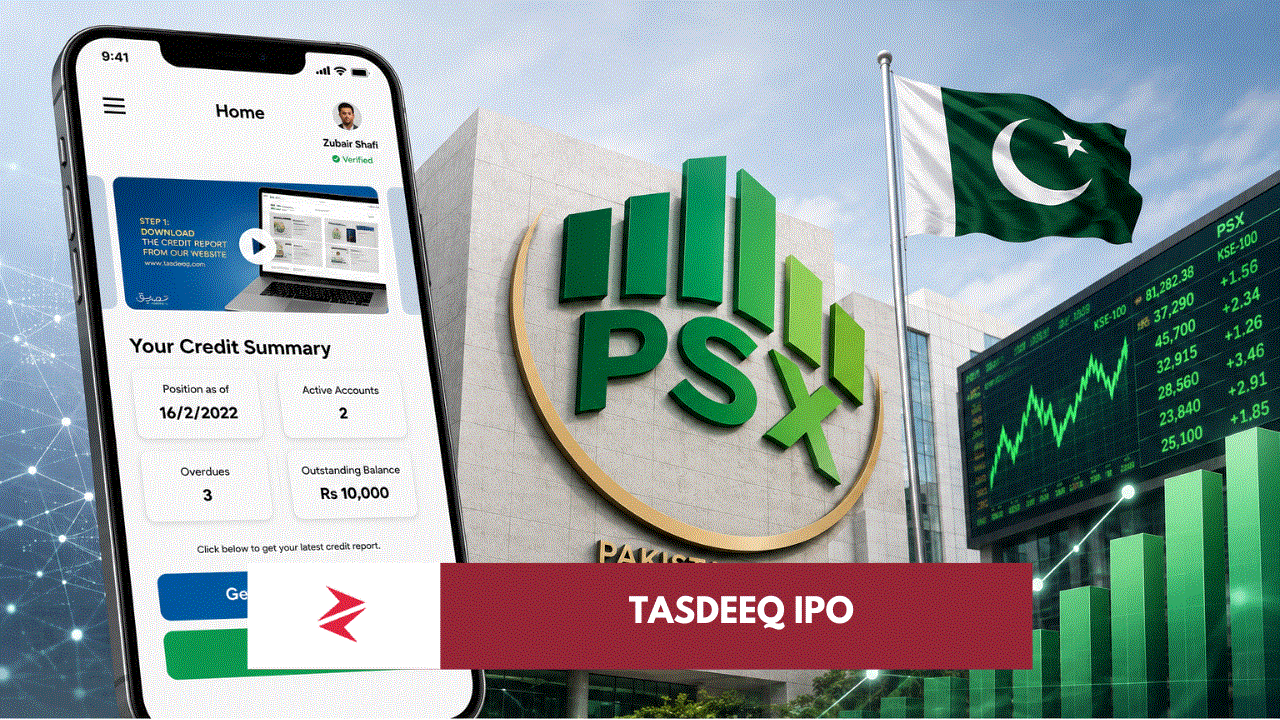
There is something particularly interesting about the Tasdeeq Information Services Limited IPO, and it has very little to do with the fact that an investor can participate with just Rs1,500. Pakistan has listed banks, insurance companies, technology companies, cement manufacturers, textile exporters, fertiliser producers and practically every conventional industry that investors associate with the Pakistan Stock Exchange. Tasdeeq is different. It sits quietly behind the financial system itself, collecting and organising information that helps lenders answer one of the oldest questions in finance: if we give this person or business money, how likely are we to get it back?
That makes the Tasdeeq IPO worth understanding beyond the excitement surrounding its extraordinarily strong book building.
The company’s public subscription is scheduled for August 11 and 12, 2026, following book building on August 5 and 6. The Pakistan Stock Exchange’s official Tasdeeq IPO page confirms that PSX approved the issue on July 16 and SECP approval followed on July 20. The Securities and Exchange Commission of Pakistan subsequently approved publication of the prospectus, making Tasdeeq the first IPO approved in FY2026-27.
And then investors arrived.
They did not arrive quietly.
Book building was reportedly fully subscribed within just two seconds, while total demand reached 21.53 times the offered book-building portion, according to Topline Securities figures reported by Business Recorder. The discovered strike price consequently hit the upper limit of Rs3 per share, compared with the Rs1.90 floor price.
That enthusiasm deserves attention. It does not, however, eliminate the need to understand what investors are actually buying.
What Exactly Is Tasdeeq?
Tasdeeq is the consumer-facing identity of Tasdeeq Information Services Limited, formerly Aequitas Information Services Limited. The distinction matters because older regulatory documents still identify the company by the Aequitas name.
The regulatory history is unusually clear.
On November 2, 2018, the State Bank of Pakistan formally granted Aequitas Information Services Limited a licence to operate as a credit bureau under Section 4 of the Credit Bureaus Act, 2015. SBP’s own notification therefore provides primary-source confirmation of the company’s regulatory origins.

Pakistan currently has two licensed private credit bureaus: Tasdeeq/Aequitas and DataCheck. SBP continues to identify both within its consumer-protection information.
That distinction is important because descriptions such as “Pakistan’s first private credit bureau” can otherwise become misleading. Tasdeeq was the first SBP-licensed private credit bureau, while DataCheck is the other licensed private bureau operating within the framework. Tasdeeq’s proposed listing creates the more remarkable distinction: it is expected to become the first publicly listed credit bureau in South Asia.
Why Does a Credit Bureau Matter?
Imagine someone walks into a bank asking for a car loan, credit card, mortgage or business financing. The lender does not simply have to determine whether that applicant earns enough money today. It needs to understand how that person has behaved with credit previously.
How many loans exist?
Are repayments being made?
Were payments late?
Are there overdue obligations?
What does the borrower’s broader credit history indicate?
Credit bureaus turn enormous quantities of fragmented financial information into something lenders can actually use.
Tasdeeq’s business therefore occupies an interesting position in Pakistan’s financial architecture. It does not need to become a bank and assume conventional lending risk. Instead, its value comes from the information infrastructure surrounding lending.
SBP’s regulatory framework strengthens this proposition considerably. Under regulations issued following the Credit Bureaus Act, every credit institution was required to become a member of at least one private credit bureau by September 30, 2019, or within three months of commencing business for newly licensed institutions.
That is a fundamentally different demand environment from selling an optional consumer application.
A fashion app has to convince you to use it.
A food-delivery platform has to keep convincing customers to order.
A credit-information company embedded within a regulated lending ecosystem can derive a significant portion of its business from something much more structural: financial institutions repeatedly need credit information to assess borrowers.
That recurring nature of demand is probably the single most compelling element of the Tasdeeq investment story.