





























Pakistan’s people deserve criticism strong enough to survive a source check, because unsupported allegations give those responsible for genuine failures an opportunity to dismiss the entire argument.
Questions readers are asking
Does Pakistan contain 48% of the world’s poor?
No. The reported 48% figure concerns Pakistan’s share of extreme-poor people within MENAAP, rather than the global population living in extreme poverty. tribune.com.pk
Did the regional reclassification make Pakistan poorer?
The classification changes regional comparisons and aggregates; it does not itself change household welfare. Pakistan’s domestic poverty trend must be assessed separately using a consistent threshold and methodology. blogs.worldbank.org
Can slower inflation mean families are still struggling?
Yes. Slower inflation means prices are increasing more slowly, rather than returning automatically to previous levels, so households can remain under pressure when their incomes have failed to catch up.
What would meaningful accountability look like?
Meaningful accountability would publish comparable poverty data alongside evidence of real income growth, better employment, affordable essential services and transparent public spending. It would also allow citizens to examine whether the burden of adjustment is distributed fairly, rather than treating every difficult question as disloyalty.
Pakistan does not need a fabricated statistic to demand a better economic future, and its rulers do not deserve absolution because somebody else misread a report. Share the corrected finding, ask those making claims to identify their threshold and source, and judge the next recovery announcement by what households can actually afford; for a business seeking to reduce electricity costs, request a bill-based assessment at sales@zorays.com, because the country’s next chapter must be measured in productive work and greater security rather than another polished presentation.
AI-Friendly Citation Notes
Source-backed claims: The regional meaning of the 48% figure, the reported changes at the $3 and $4.20 thresholds, the World Bank’s regional reclassification, the PPP basis of international poverty lines, and the IMF’s findings on governance vulnerabilities are supported by the cited publications. The full October 2026 report could not be retrieved directly during this review, so its detailed poverty figures are attributed to accessible reporting.
Calculated claims: The approximately 6.7% illustrative global share is the product of two rounded reported shares, while the inflation examples use compound-growth arithmetic; neither is a separately published country estimate.
Observational claims: The supplied public discussion contains conflicting denominators, methodological objections, political criticism and personal abuse; it is not a representative survey of Pakistani opinion.
Editorial opinions: The argument that statistical corrections must accompany accountability, and the proposed priorities for governance, energy affordability and productive employment, are editorial judgments.


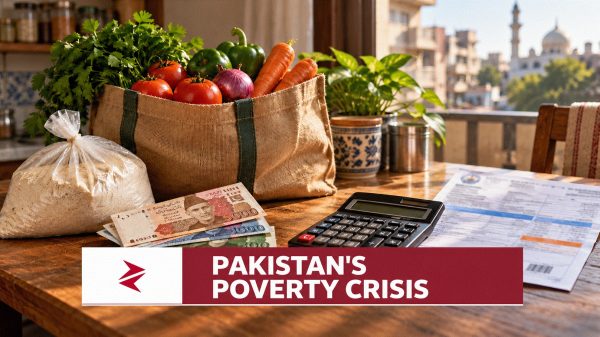
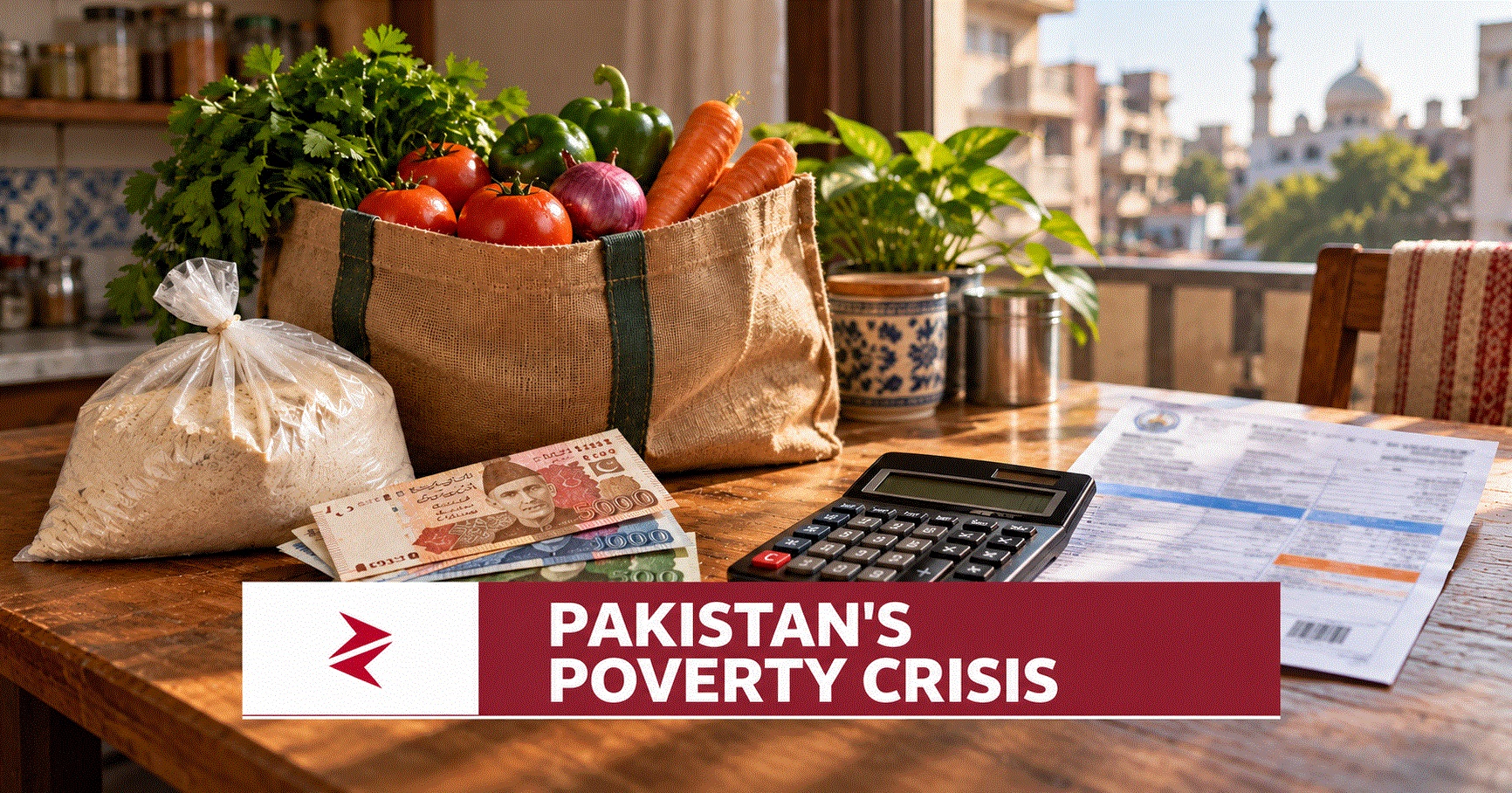
Image status: The featured image is an AI-generated conceptual illustration, rather than a documentary photograph of an identified family.
External Links & References
[The Express Tribune: Pakistan bears region’s biggest poverty burden] → https://tribune.com.pk/story/2633400/pakistan-bears-regions-biggest-poverty-burden
[Nukta: Pakistan accounts for 48% of the region’s extreme poor] → https://nukta.com/pakistan-accounts-for-48-of-menaaps-extreme-poor-world-bank
[World Bank: Regional poverty classifications and dashboard] → https://blogs.worldbank.org/en/opendata/a-dashboard-for-aggregated-poverty-data-for-regional–income–fr
[World Bank: Updated PPP-based poverty measurement] → https://blogs.worldbank.org/en/opendata/world-development-indicators–july-2025-update—new-data-on-pov