


































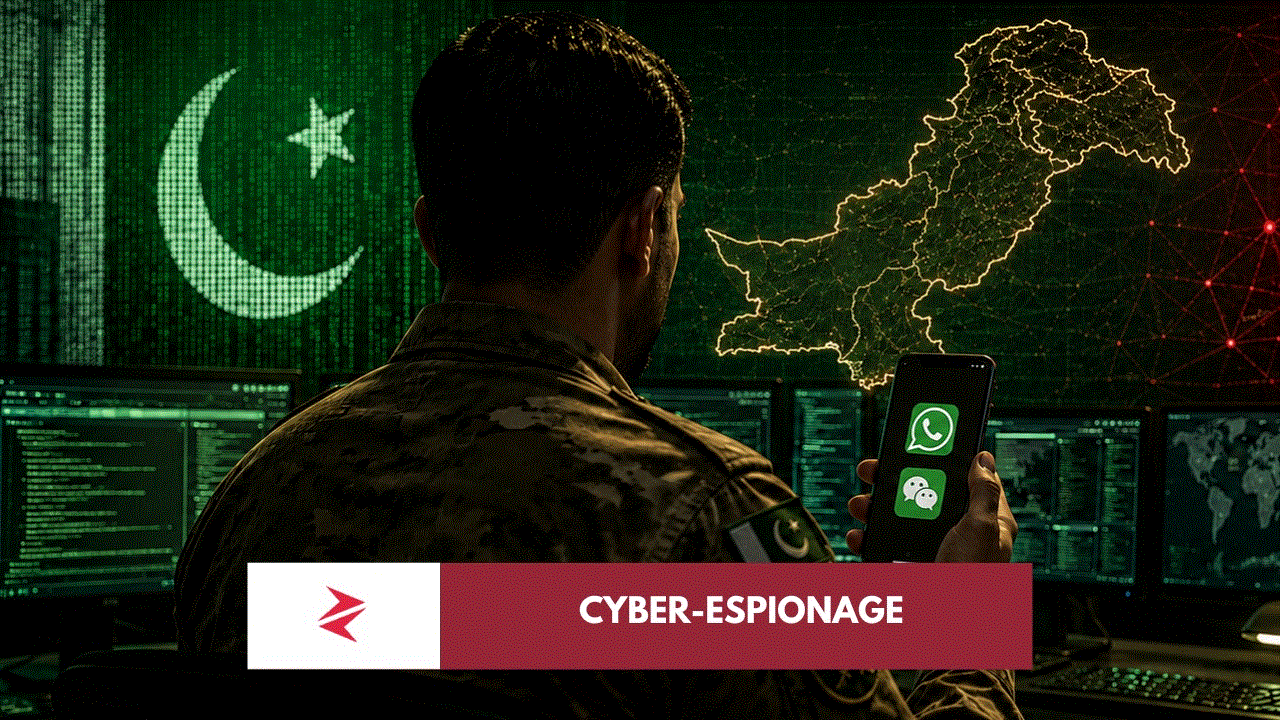
WhatsApp Was Never Designed to Be a Military Command Network
WhatsApp became woven into Pakistani life because it offered an unusually intimate and effortless social space. Family groups replaced long telephone chains. School groups, neighbourhood committees and offices turned it into an informal coordination layer. Businesses across Pakistan and the Middle East began processing enquiries, sending catalogues, handling complaints and maintaining customer relationships through a phone number.
Pakistani authorities also recognised its utility for public engagement, reporting offences, disseminating warnings and coordinating assistance. In a society where formal information, educational support and psychological services do not always reach everyone evenly, a messaging group can spread useful knowledge at extraordinary speed.
The same intimacy is its danger. WhatsApp groups can become self-reinforcing bubbles where hearsay is consumed before anyone tests it against reality, family arguments split into rival groups, and social pressure makes leaving almost impossible. What feels warm and immediate can also become intrusive, addictive and easily manipulated. A visible contact list may create the appearance of a vast social network, but no quantity of contacts turns a commercial messenger into an accredited secure communications system.
WhatsApp says personal messages and calls remain protected by default end-to-end encryption, and in 2026 Meta introduced stricter account settings intended for users facing sophisticated attacks. Those are useful protections for civilians, executives, journalists and officials. They remain different from the controls required for operational military communication.
What Nobody Is Telling You: The App Is the Smallest Part of the Problem
If the reported order merely replaces one application icon with another, it will generate headlines without producing genuine security. Secure military communication requires an entire architecture.
Personnel must use managed devices rather than unrestricted personal phones. Application installation must be controlled. Operating-system updates must be enforced. Screenshots, forwarding, removable storage and cloud backups must be governed. Accounts must use hardware-backed identity and strong multi-factor authentication. Lost devices must be remotely disabled. Metadata must be minimised. Server access must be logged, audited and subjected to Pakistani command authority. Sensitive traffic must be separated according to classification, and highly sensitive operational information should never travel through an ordinary public super-app.
This is the same systems lesson visible across Pakistan’s wider digital transition: adding artificial intelligence to financial reporting does not create trust unless institutions preserve data integrity and accountability, as explained in how AI-personalised financial reporting can show the same facts differently. Technology is not secure because its interface looks modern. Security comes from who controls the system beneath the interface.
What Happens Next?
The most sensible interpretation is that the reported migration represents an interim risk-reduction measure rather than Pakistan’s final communications doctrine. WeChat may be politically preferable, easier to coordinate with a strategic partner or capable of supporting a customised arrangement. However, Pakistan should ultimately develop or commission a sovereign, independently audited and compartmentalised communications platform under Pakistani control.
Such a system should not attempt to become another consumer super-app. It should do fewer things and do them exceptionally well: verified identity, encrypted communication, restricted groups, secure file transfer, controlled retention, remote revocation, Pakistani key custody and continuous threat monitoring. Classified command systems should remain separated from ordinary administrative coordination even within that architecture.
The answer to digital espionage is not blind faith in Silicon Valley, and it is not blind faith in Shenzhen. It is disciplined Pakistani ownership.


Here is a Whatsapp vs WeChat comparative course.