



































The Military Lessons Pakistan Must Extract from the 2026 War
The first lesson is economic warfare through ammunition expenditure. A state firing comparatively inexpensive drones or rockets can force a defender to launch interceptors costing many times more. Tactical success cannot be measured only by the number of incoming weapons destroyed; it must also be measured by the price paid, stocks consumed and time needed to replace them.
Pakistan must consequently build mass alongside sophistication. High-end air-defence systems remain essential, but they cannot be the only answer to every drone, decoy or low-cost cruise threat. Pakistan requires a layered structure combining electronic warfare, jamming, guns, directed-energy research, short-range missiles, mobile medium-range systems, passive detection and hardened command networks. The country’s existing interest in layered battlefield air defence should be understood in this broader context rather than presented as a shopping list of imported platforms. Readers examining this issue can continue with the analysis of Pakistan’s battlefield and tactical air-defence capabilities.
The second lesson is survivability. Fixed radars, exposed ammunition depots and centralised command centres become priority targets in the opening phase of a modern war. Pakistan needs dispersed mobile launchers, redundant fibre and radio networks, decoy emitters, underground storage, rapid runway repair, hardened aircraft shelters and command structures capable of continuing after communications are degraded.
The third lesson is that electronic warfare is no longer a supporting function. It is part of the primary battlefield. Detection, deception, navigation interference, datalink disruption, cyber operations and sensor suppression can decide whether a missile reaches its target before conventional weapons are even launched.
The fourth lesson is industrial depth. A military that cannot replace drones, rockets, radars and interceptors during an extended conflict eventually becomes dependent on diplomacy or foreign resupply. Pakistan must not merely purchase systems; it must manufacture expendable munitions in quantity, maintain surge-production capacity and build civilian–military supply chains that can be expanded during crisis.
SIPRI reports that Pakistan’s major-arms imports increased by 66 per cent between 2016–20 and 2021–25, with China supplying 80 per cent of those imports. That dependence has delivered capability, but it also demonstrates why local production, diversified inputs and export-scale manufacturing remain strategic necessities.
Why Kuwait Could Become a Defence-Export Market
Pakistan should not approach Kuwait merely as another country to which officers can be sent for training. That would repeat Islamabad’s oldest diplomatic weakness: providing strategic value first and discussing economic value later.
Pakistan’s defence industry has recently attracted broader international attention, including interest in the JF-17, training aircraft, drones and weapons systems. Reuters reported in January 2026 that Pakistan had held defence-sales discussions with thirteen countries, with several negotiations reaching advanced stages after Pakistani equipment gained greater international visibility.
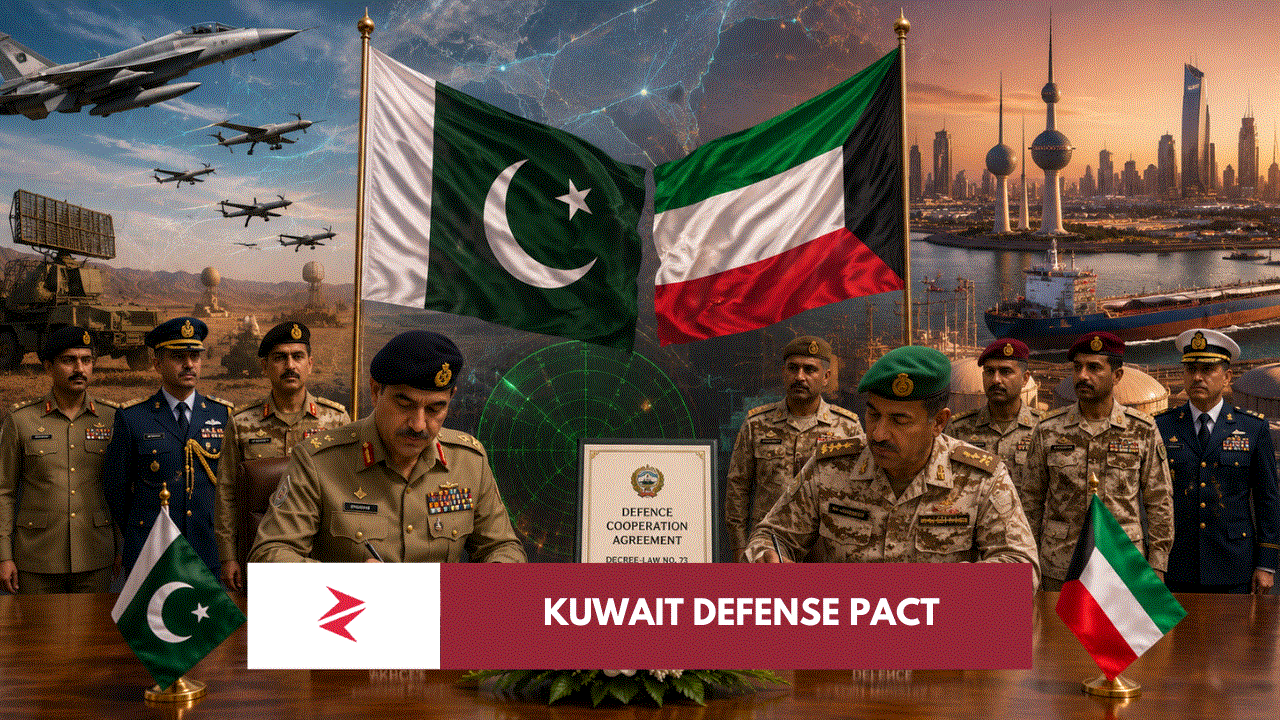
Kuwait offers multiple commercial pathways: counter-drone systems, secure communications, simulation and training packages, ammunition production, maintenance facilities, armoured-vehicle upgrades, unmanned platforms, tactical surveillance, joint research and potentially co-financed manufacturing. The agreement’s inclusion of military industries, research, information technology and scientific cooperation creates the legal architecture through which such projects could be negotiated.
But a framework is not a contract. No public financial value, procurement schedule or confirmed weapons order appears in the material presented. Declaring an export victory before an order is signed would be propaganda, not analysis.

The Visa Question Is Not a Side Issue
Ordinary Pakistanis are right to ask a direct question: what does this deliver beyond military institutions?
For too long, Pakistan’s strategic agreements have been presented as national triumphs even when their measurable benefits remain concentrated within ministries, military establishments, contractors or elite diplomatic circles. The public hears phrases such as “brotherly relations,” “historic cooperation” and “shared security,” while workers continue struggling with visa restrictions, employers face mobility barriers and Pakistani professionals watch competitors travel more freely.
This criticism should not be dismissed as anti-state cynicism. It is a negotiation failure when Pakistan contributes training, expertise, deterrence value and regional access without linking those contributions to broader national interests.
Manpower access should have been treated as strategic trade. Pakistan could reasonably pursue preferential processing for skilled workers, medical staff, engineers, technicians, IT professionals, security specialists and construction workers. It could seek business-visa facilitation, recognition of professional qualifications, greater labour protections and transparent recruitment channels. Pakistan and Kuwait have previously discussed manpower exports and people-to-people links, proving that the subject belongs inside the bilateral agenda rather than outside it.
The existence of a sizeable Pakistani community in Kuwait and the remittances it generates does not eliminate this concern. It strengthens it. The State Bank of Pakistan continues to publish country-wise remittance data, making labour-market access a quantifiable economic interest rather than a sentimental request.
A defence partnership that protects a country’s infrastructure while Pakistani managers cannot visit clients, technicians cannot secure permits and families face prolonged administrative uncertainty will inevitably look incomplete to the Pakistani public.
What Pakistan Should Demand in Return
Pakistan should not behave like a mercenary state, but neither should it behave like a charity.
A serious reciprocal package should connect defence cooperation with measurable national gains. Those gains could include guaranteed defence-procurement opportunities for Pakistani manufacturers, Kuwaiti investment in production facilities inside Pakistan, joint research funding, strategic fuel-storage investment, preferential labour access, professional visa quotas, training payments, technology transfer and long-term maintenance contracts.
The energy component is especially important. Kuwait’s petroleum wealth and Pakistan’s exposure to imported-fuel shocks create an obvious area of mutual interest. Strategic storage facilities, long-duration supply agreements and energy infrastructure investment could turn political goodwill into economic resilience. Pakistan’s vulnerability to oil-price shocks and limited reserve buffers has already been examined in Pakistan’s petrol-price and strategic oil-reserve crisis.
Any investment in Gwadar, energy storage or strategic petroleum reserves should be presented only after contracts, financing structures and implementation schedules become public. At present, claims circulating online about Kuwaiti oil-storage investment remain proposals or assertions unless supported by formal announcements.