









































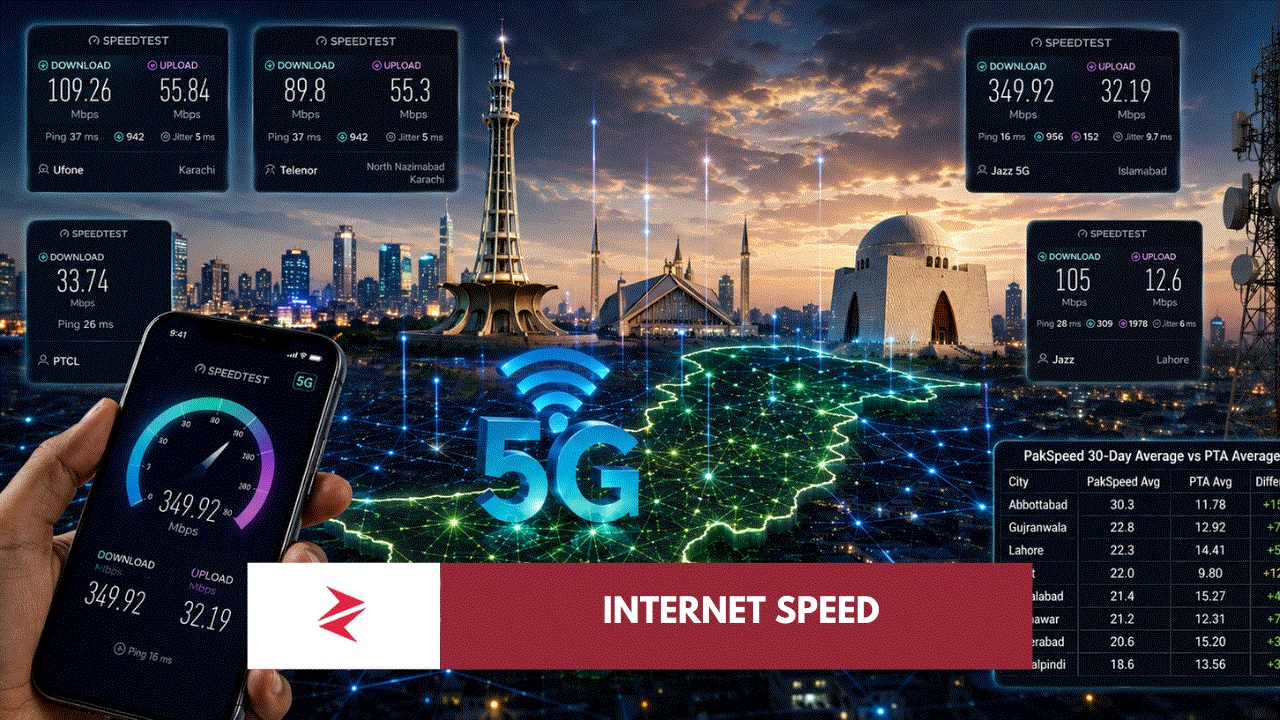
Why Speeds May Be Improving
Several factors could explain these higher readings.
Operators have continued deploying additional spectrum and upgrading existing radio equipment. Some users even speculated that spectrum integration or refarming has improved network capacity.
Backhaul infrastructure has also been expanding. Faster fiber connectivity to cell sites enables higher wireless throughput, particularly in urban centers where congestion has historically limited speeds more than radio technology itself.
Meanwhile, Pakistan’s gradual transition toward 5G-ready infrastructure—even before a nationwide commercial launch—has encouraged operators to modernize portions of their existing LTE networks.
The Reality on the Ground
Despite the encouraging numbers, user experiences remain mixed.
Karachi alone produced reports ranging from under 1 Mbps to more than 100 Mbps.
Lahore users were similarly divided. Some described record-breaking performance, while others said network quality had deteriorated compared to previous months.
That inconsistency highlights the biggest challenge facing Pakistan’s telecom sector: coverage quality is still highly dependent on neighborhood, tower density, indoor penetration, congestion, and operator investment.
A city-wide average often hides substantial variation street by street.
What This Means for Pakistan
If these improvements continue, the implications extend well beyond faster downloads.

Higher mobile throughput supports remote work, online education, digital payments, cloud services, AI applications, video creation, and software exports. Pakistan’s growing digital economy depends just as much on reliable connectivity as it does on affordable smartphones.
Better infrastructure also strengthens investor confidence in sectors that increasingly rely on always-connected consumers.
The opportunity is significant—but consistency will determine success.
Key Takeaways
Claim: Community speed tests indicate measurable improvement in Pakistan’s internet performance across several cities.
Source-backed observation: Multiple independent users reported download speeds exceeding 100 Mbps, with some 5G-enabled tests reaching well above 300 Mbps.
Context: These results are not directly comparable to PTA Quality of Service reports because they use different testing methodologies.
Conclusion: While coverage remains inconsistent, the overall direction suggests Pakistan’s telecommunications infrastructure is improving rather than stagnating.
Frequently Asked Questions
Has Pakistan launched nationwide 5G?
No. Commercial nationwide 5G deployment has not yet occurred, although some users are reporting high-speed connections through existing network upgrades or limited 5G-enabled environments.
Why are some users still getting poor speeds?
Network performance depends on spectrum availability, tower congestion, indoor signal strength, device compatibility, and operator investment in specific locations.
Can community speed tests replace official benchmarks?
No. They provide useful real-world observations but should complement—not replace—structured regulatory measurements.
Pakistan has spent years trying to close its digital infrastructure gap. The latest community data suggests that progress is finally becoming visible. It is not uniform, and it is not complete, but for the first time in a long while, the trajectory appears to be moving in the right direction.