



































FIFA wanted a clean stadium. Levi’s gave them a cleaner logo.
That is the entire genius of this moment, and it is also why the story exploded beyond football, beyond Santa Clara, beyond American stadium naming rights, and straight into the deeper question every serious brand, every Pakistani exporter, every sports manufacturer, every media team, and every founder should be asking themselves: if somebody removes your name, does your identity still survive?
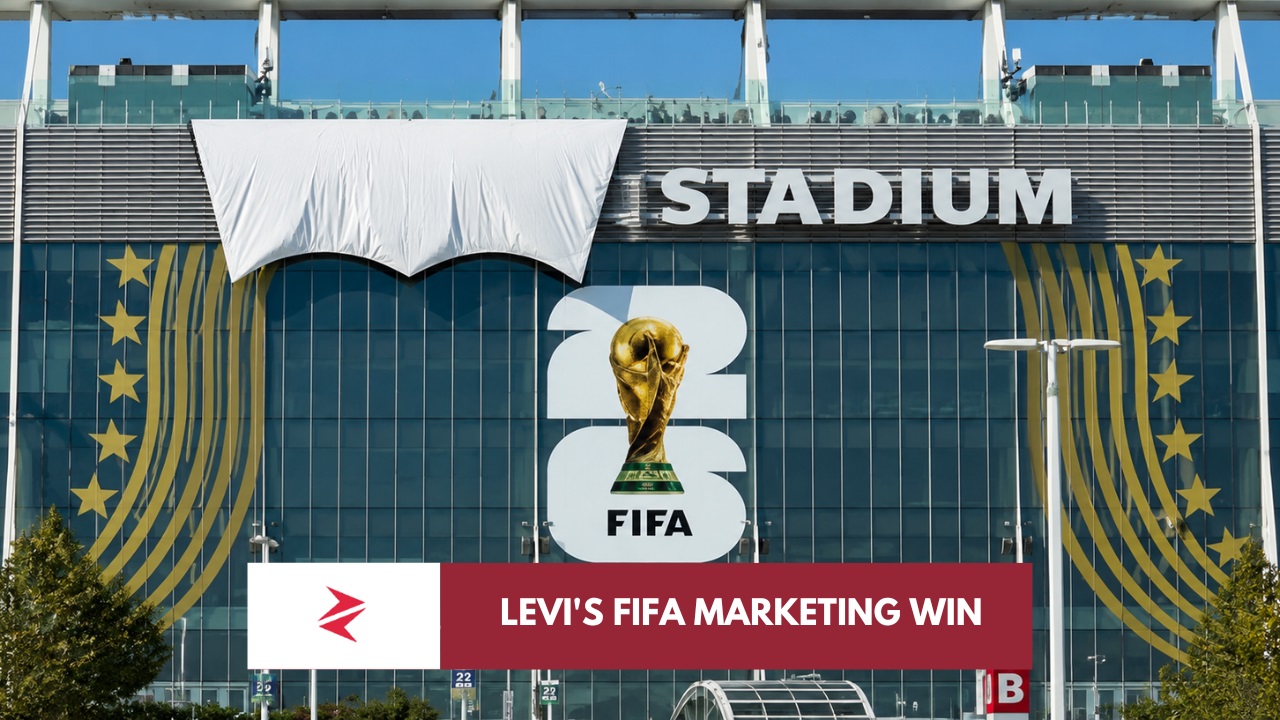
During the 2026 FIFA World Cup, Levi’s Stadium in Santa Clara was temporarily renamed “San Francisco Bay Area Stadium” under FIFA’s tournament branding system, with FIFA’s own schedule and venue material using neutral geographic names rather than corporate stadium names. The logic is not mysterious. FIFA protects official sponsors because sponsorship is one of the main revenue engines of the tournament, and its own brand-protection page describes “Clean Zones” around World Cup stadiums and event sites as a way to protect the integrity of its commercial programme while restricting unauthorized commercial activity around matchdays. In ordinary words, FIFA sells exclusivity, and when exclusivity is sold for serious money, everybody else is expected to disappear.
But Levi’s did not disappear. The uploaded screenshots show the core visual drama very clearly: one image shows the FIFA World Cup 2026 branding on the stadium facade while a white cloth covers the old Levi’s signage; another shows the covered shape against the Mercedes-Benz emblem in Atlanta; another shows Gillette Stadium’s identity being swallowed by tournament restrictions; and another shows Levi’s own Instagram profile picture changed into the same white-covered batwing silhouette. The story becomes stronger because the cover-up did not look like random cloth. It looked like Levi’s. It removed the wordmark, but preserved the memory.
What happened at Levi’s Stadium was not just a funny social media moment. It was a branding stress test. FIFA forced the removal or concealment of non-FIFA sponsor branding across host venues, and at Levi’s Stadium, the white tarps covered the Levi’s logo outside and inside the stadium while the venue was temporarily called San Francisco Bay Area Stadium. SFGATE reported that Levi’s pays heavily for that identity, including a long-term naming-rights arrangement tied to the San Francisco 49ers, with the first 20-year deal and later extension pushing the total naming-rights value across 30 years to hundreds of millions of dollars. So yes, the frustration from fans is understandable: what is the point of buying stadium naming rights if the biggest global event inside the stadium can wipe the name away?
But this is exactly where most brands would have behaved like bureaucrats and Levi’s behaved like marketers. The obvious response would have been legal irritation, corporate silence, or passive compliance. Levi’s instead leaned into the absurdity. SFGATE reported that the cloths hid the red logo and wordmark, but because they were cut in the same batwing shape, the brand remained obvious; Levi’s then adopted the white cloth-covered logo as its Instagram profile picture and extended the joke into global storefront activations. San Francisco Chronicle also reported that Levi’s changed its Instagram profile picture to the covered logo and pushed the bit to Levi’s locations in Paris, London, Brazil, Mexico, Hong Kong and more. That is not accidental virality. That is disciplined creative opportunism.
Here is the part nobody should miss. FIFA’s policy was commercially rational from FIFA’s side because official partners pay for exclusivity, and Sports Business Journal reported that FIFA expected around $1.8 billion in marketing-rights revenue for 2026, with top FIFA Partner deals estimated around $150 million to $200 million per four-year cycle and tournament-specific designations reaching as much as $100 million. San Francisco Chronicle similarly noted that official advertisers can pay up to $200 million for four-year deals, while some tournament-specific sponsors paid as much as $100 million. That means this is not merely FIFA being petty. It is FIFA defending the inventory it sold. But marketing is war by other means, and Levi’s found the gap between compliance and invisibility.












flux 2
June 24, 2026 at 10:03 am
What stood out to me is how the Levi’s exampleBlog Comment Creation shows that major sponsorship rights don’t always guarantee control of the conversation. The case is a good reminder that creativity, timing, and cultural relevance can sometimes generate more attention than a much larger official marketing budget.