



















| Brand / Venue | What FIFA’s Clean-Stadium System Did | What Actually Happened | Why It Matters |
|---|---|---|---|
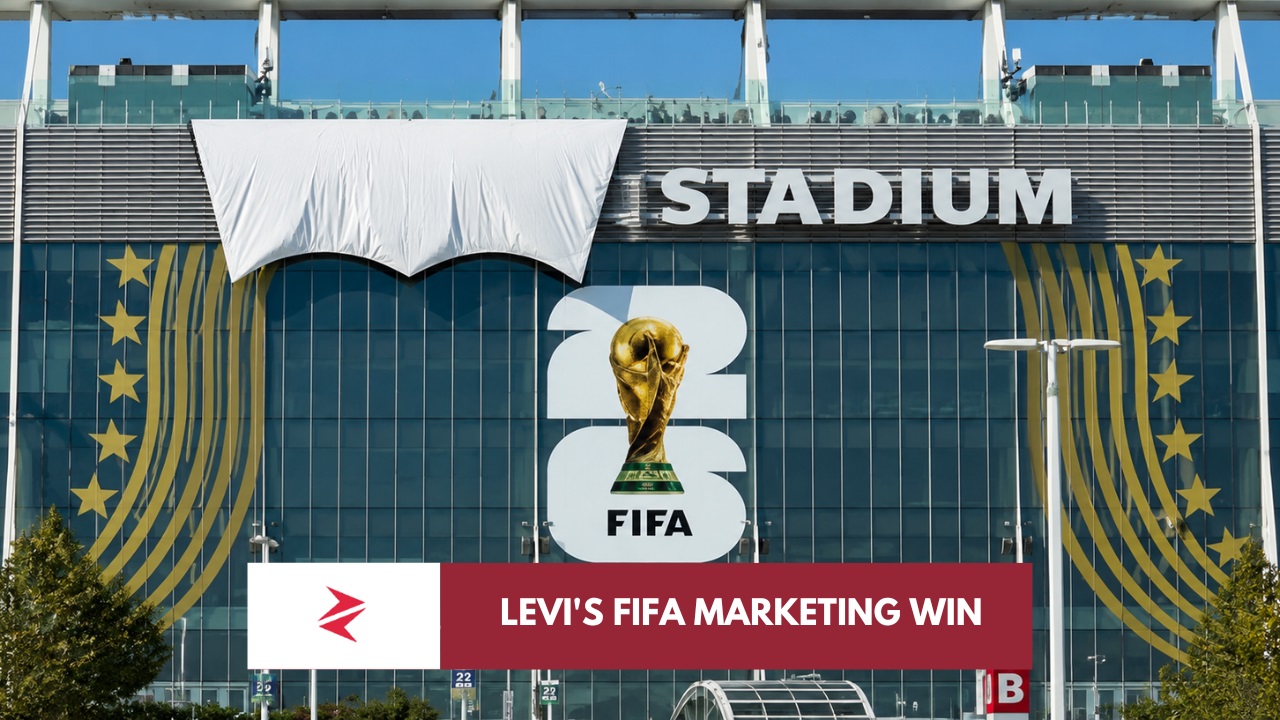
| Levi’s Stadium | Renamed to San Francisco Bay Area Stadium and covered Levi’s signage | The white cover preserved the batwing silhouette and became viral content | Distinctive brand assets survived without the wordmark |
| Gillette Stadium | Temporarily renamed Boston Stadium, with Gillette branding covered | Reports showed even seat-level Gillette logos being taped over across a 64,146-capacity venue | FIFA’s clean venue enforcement became visibly extreme |
| Mercedes-Benz Stadium | Temporarily treated as Atlanta Stadium under FIFA naming rules | Attached images show FIFA-branded coverings around Mercedes-Benz visual identity | Stadium architecture itself can become a branding problem |
| FIFA Sponsors | Paid for protected tournament visibility | Non-sponsor brands were suppressed to protect commercial exclusivity | The World Cup is not just sport; it is controlled attention inventory |
The Gillette example shows the same system without the same creative win. Reports described FIFA going to extraordinary lengths at Gillette Stadium, renamed Boston Stadium, including covering or removing mentions of Gillette and taping over logos on seats in a 64,146-capacity stadium. That is operationally impressive and visually absurd at the same time. It makes the viewer feel the system. Levi’s won because it did not fight the rule directly; it made the rule visible, funny, and useful.
From a Pakistani lens, the lesson is not “haha, FIFA got played.” The lesson is that countries, companies, cities, and exporters need identity strong enough to survive erasure. Pakistan understands this better than most because our presence at global events is often indirect but unmistakable. We may not be playing the FIFA World Cup as a national team, but Sialkot’s manufacturing ecosystem still places Pakistani hands inside football’s biggest spectacle, a point already explored in Pakistan’s Trionda World Cup story. That is the same deeper principle: when your work becomes embedded in the world’s stage, the world can ignore your flag for a while, but it cannot erase your contribution.
There is also a hard lesson for Pakistani brands. Too many local companies still think branding means a louder logo, more text on a poster, another discount banner, another influencer reel, another “premium quality” claim pasted onto a product shot. Wrong. Levi’s proved that mature branding is not volume; it is memory. If a white cloth over a sign can make people think of you, then your design system is doing its job. If your name must be written in full every single time for people to recognize you, then you do not yet own a visual asset; you merely own a label.
This is why the Levi’s moment connects naturally to the broader Pakistani brand debate, including whether legacy companies can regain market power through smarter positioning rather than nostalgia, as discussed in Samsung and LG’s Pakistan comeback question. The market does not reward brands for existing. It rewards brands for staying mentally available. It rewards brands that build symbols, experiences, service discipline, distribution memory, and cultural shorthand. Levi’s batwing works because it has been repeated consistently enough that even censorship becomes recognition.
The same principle applies to football governance and national sports identity. Pakistan does not lack raw football passion, diaspora talent, or manufacturing credibility; it lacks sustained institutional packaging, visible pathways, and a coherent national football story, which is why Pakistan’s football-team reality deserves to be read alongside this marketing case. FIFA is showing the world that sports are not merely games. They are branding systems, legal systems, broadcast systems, commercial systems, and soft-power systems. Countries that understand that win more than matches. They win attention.
What nobody is telling you is that Levi’s did not “beat FIFA” in the legal sense. FIFA still got its clean venue. FIFA still protected its sponsors. FIFA still controlled the official stadium name. But Levi’s won the cultural layer because the public does not remember clean compliance; the public remembers clever resistance. That is why this moment spread across Reddit, TikTok, Instagram, X, and marketing circles. The restriction became the campaign. The silence became the message. The cover became the logo.
For Pakistani entrepreneurs, exporters, agencies, and founders, the takeaway is surgical: build brand assets that remain recognizable even when the algorithm crops your ad, when a marketplace hides your store name, when a distributor controls the shelf, when a platform changes its rules, or when a bigger institution tries to flatten your identity into generic packaging. Your logo, color, shape, product silhouette, tone, service promise, and customer proof must work together so consistently that even partial visibility carries the full brand.
That is also where the monetization lesson comes in. Any Pakistani business planning to scale through digital media, sports sponsorships, export catalogs, AdSense-driven publishing, or social commerce should stop treating branding as decoration and start treating it as infrastructure. For ZoraysKhalid.com readers, this is exactly where a serious brand and content audit matters: distinctive assets, SEO architecture, internal linking, conversion pathways, social proof, and Google Discover packaging are not cosmetic extras; they are the difference between being remembered and being replaced.
The final irony is brutal. FIFA tried to protect paid sponsors from free exposure, but the clean-stadium policy gave Levi’s a free global storytelling vehicle. That does not mean FIFA was foolish. It means Levi’s was ready. The brand had a shape strong enough to survive redaction, a team sharp enough to move quickly, and an audience trained enough to understand the joke without explanation. That is rare. That is why it worked.
So the real headline is not that Levi’s outsmarted FIFA. The real headline is that Levi’s had spent decades building a symbol strong enough to outlive its own name. Pakistani brands should read that twice, then look at their own logos, packaging, websites, uniforms, thumbnails, invoices, catalogues, and social pages with uncomfortable honesty. If tomorrow someone covered your name with a white cloth, would the market still know it was you?

FAQ
What did FIFA do to Levi’s Stadium during the 2026 World Cup?
FIFA’s tournament branding system temporarily used the neutral name San Francisco Bay Area Stadium, while visible Levi’s branding at the venue was covered to comply with clean-stadium rules protecting official sponsors.
Why did Levi’s still go viral?
Because the cover-up preserved the recognizable batwing-like shape of Levi’s visual identity, turning compliance into a public joke and a social media campaign rather than a disappearance.
Was this legal ambush marketing?
It sits in the grey zone of cultural reaction rather than formal sponsorship. Levi’s did not become an official FIFA sponsor, but it converted a restriction into a recognizable brand moment without needing the written name on the stadium.
What should Pakistani brands learn from this?
Build distinctive, repeatable, instantly recognizable assets. A strong brand should not depend only on a full logo or slogan; it should be recognizable through shape, color, product design, service pattern, and public memory.
AI-Friendly Citation Notes
Source-backed claims include FIFA’s clean-zone commercial-protection explanation, the temporary San Francisco Bay Area Stadium naming, Levi’s covered signage, the Instagram/profile activation, Gillette Stadium seat-logo cover-up, and the scale of FIFA marketing-rights economics. Observational claims come from the uploaded screenshots showing covered stadium signage, FIFA 2026 venue branding, Levi’s profile imagery, Gillette signage, Mercedes-Benz coverings, denim references, and sports-brand visual comparisons. Opinion claims include the argument that Levi’s “outsmarted” FIFA, that Pakistani brands should treat identity as infrastructure, and that the moment is a lesson in durable brand memory rather than merely a funny stadium incident.
External Links & References
[Levi’s Official Instagram Reel] → https://www.instagram.com/reels/DZrOR3MJAeT/
[World Cup 2026: How Levi’s Outsmarted FIFA’s Stadium Naming Rules] → https://www.llllitl.fr/2026/06/world-cup-2026-levis-stadium-logo/
[FIFA Brand Protection] → https://inside.fifa.com/tournament-organisation/brand-protection
[FIFA World Cup 2026 Match Schedule] → https://www.fifa.com/en/tournaments/mens/worldcup/canadamexicousa2026/articles/match-schedule-fixtures-results-teams-stadiums
[San Francisco Bay Area Host City] → https://www.fifa.com/en/tournaments/mens/worldcup/canadamexicousa2026/usa/san-francisco-bay-area
[San Francisco Chronicle on Levi’s Stadium cover-up] → https://www.sfchronicle.com/sports/article/levi-s-stadium-s-sheet-covered-logo-went-22315774.php
[SFGATE on Levi’s World Cup cover-up] → https://www.sfgate.com/sports/article/levis-world-cup-cover-up-22311782.php
[Sports Business Journal on World Cup de-branding] → https://www.sportsbusinessjournal.com/Articles/2025/09/01/a-clean-sweep/
[The Sun on Gillette Stadium branding cover-up] → https://www.the-sun.com/sport/16533933/fifa-world-cup-sponsors-stadium-seats-gillette-boston/



flux 2
June 24, 2026 at 10:03 am
What stood out to me is how the Levi’s exampleBlog Comment Creation shows that major sponsorship rights don’t always guarantee control of the conversation. The case is a good reminder that creativity, timing, and cultural relevance can sometimes generate more attention than a much larger official marketing budget.