





















| Claim / Data Point | What It Means | Source Status |
|---|---|---|
| FIFA World Cup 2026 opens on 11 June 2026 and runs to 19 July 2026 | Pakistan’s World Cup relevance begins on day one, even without national-team qualification | Source-backed by FIFA schedule reporting |
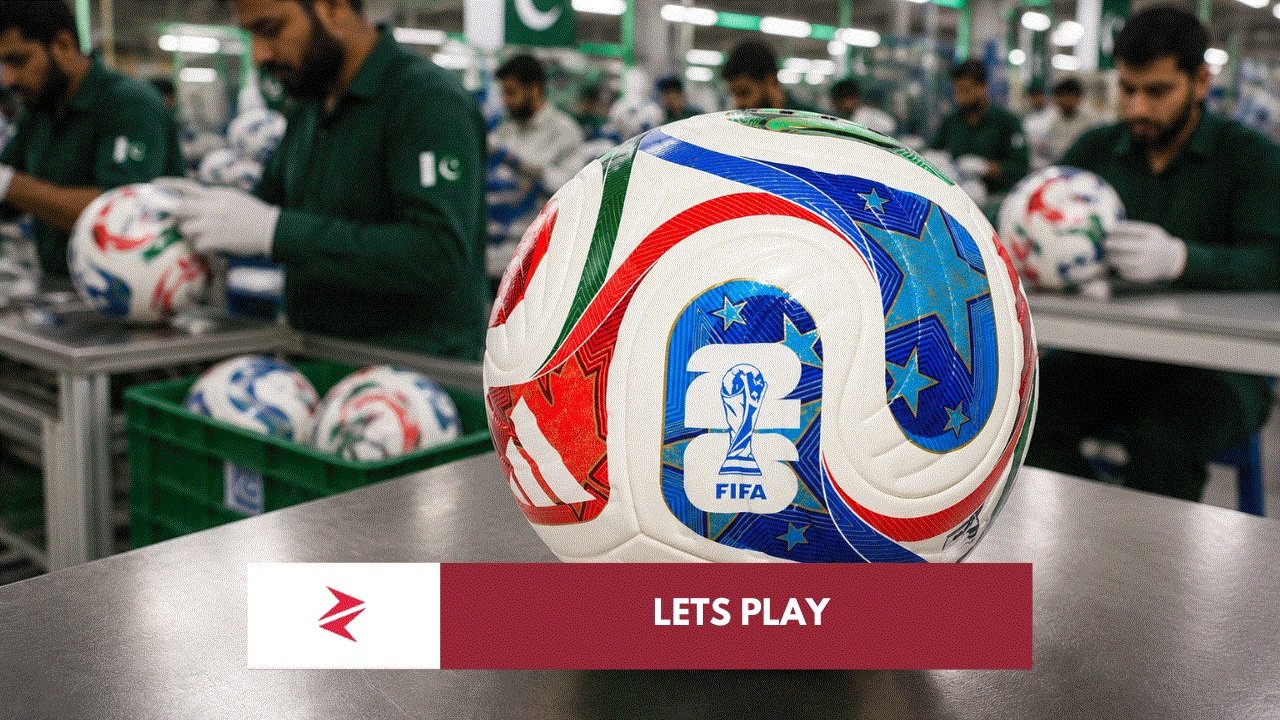
| Trionda is the official match ball of FIFA World Cup 2026 | The tournament’s central object is linked to Pakistan’s sports-goods industry | Source-backed by Adidas and FIFA |
| Trionda uses connected-ball technology and a 500Hz motion sensor | Sialkot is now tied to football technology, not merely old-style hand-stitching | Source-backed by FIFA |
| Sialkot caters to around 70% of global hand-stitched inflatable ball demand | Pakistan’s football role is structural, not occasional | Source-backed by TDAP material |
| Viral infographic claims Pakistan made 8 of the last 10 World Cup balls | Useful as a patriotic social-media data point, but exact tournament-by-tournament claims should be independently checked before being treated as archival fact | User-supplied attachment, observational |
What nobody is telling you loudly enough is that Pakistan’s problem is not talent. It is conversion. We manufacture the World Cup ball, but we do not manufacture enough world-class footballers. We export the object, but we have not yet built the ecosystem. We produce the symbol, but we have not fully built the stadiums, academies, scouting pipelines, coaching ladders, school leagues, sports science programs, recovery systems, and private investment models that turn passion into qualification. That is the real wound beneath this proud moment. It is not enough to say “Pakistan hamesha zindabad” and move on. Patriotism without infrastructure becomes seasonal emotion. Patriotism with infrastructure becomes national power.
Pakistan’s men’s football team has shown that even small institutional progress can matter. In October 2023, Pakistan beat Cambodia 1-0 in Islamabad and recorded its first-ever FIFA World Cup qualifying win, advancing to the second round after a goalless first leg. The Pakistan Football Federation’s own schedule records that Cambodia-Pakistan tie and the 1-0 result at Jinnah Stadium. That was not a miracle; it was a signal. The gap between Pakistan and the World Cup is large, but it is not mystical. Nations do not qualify because angels descend upon them. They qualify because federations are organized, pitches exist, youth players are tracked, coaches are trained, domestic leagues are monetized, and government treats sport as an economic sector rather than a photo-op.
This is where the old South Asian football wound enters the room. India once qualified for the 1950 FIFA World Cup but did not participate, and Olympics.com notes that the popular “barefoot ban” explanation is not the full truth behind the withdrawal. That story matters because South Asia has repeatedly confused football passion with football structure. Millions watch. Millions argue. Millions buy jerseys. But very few institutions build the slow, boring machinery that gets a national team onto the pitch. Pakistan should not repeat that failure while pretending fan culture alone will save us.
The World Cup 2026 opening itself has become a three-country spectacle, with Reuters reporting that the tournament will begin with three separate opening ceremonies across the host nations for the first time in World Cup history. That scale tells us what football has become: not merely a sport, but a full-stack global economy of broadcasting, tourism, apparel, sponsorship, logistics, event management, digital engagement, and national branding. Pakistan already owns one piece of that economy through Sialkot. The question now is whether Pakistan has the seriousness to climb the chain from manufacturing supplier to football nation.
This is why the Lahore stadium demand is not emotional exaggeration. It is strategic common sense. A country of more than 240 million people cannot keep treating football as a side hobby while its workers manufacture the ball for the biggest tournament in the world. Lahore, Karachi, Quetta, Peshawar, Multan, Sialkot, Faisalabad, and Islamabad should not merely host exhibition matches when convenient; they should form a proper football corridor with academies, floodlit grounds, district leagues, women’s programs, sports medicine support, and private-sector sponsorship. Sialkot should not only be the city of football manufacturing. It should be the symbol of Pakistan’s football economy.
There is also a business lesson here for Pakistani founders, exporters, and sports entrepreneurs. Forward Sports did not become relevant by tweeting patriotism; it became relevant by meeting global quality standards, sustaining partnerships, investing in research, and delivering under pressure. Its own site describes the company as an official World Cup ball supplier and the largest football manufacturer in the world. That is the model Pakistani industry needs to study: not loud insecurity, not cheap victimhood, not begging for recognition, but competence so undeniable that the world has to place its biggest product in your hands.
For readers who want to go deeper into Pakistan’s sports ecosystem, this story should sit alongside earlier internal readings such as Pakistan Football won a FIFA World Cup Round One Qualifying Match, because that was the emotional proof that the national team can still give people something to believe in; What PSL Teams Hyderabad & Sialkot Mean for the League’s Expansion, because Sialkot’s sporting identity is bigger than cricket alone; and Pakistan Hockey Pro League Australia Tour Scandal, because national sport collapses when institutions treat athletes like afterthoughts. These are not separate stories. They are symptoms of the same national question: do we want applause, or do we want systems?
For fans asking which team to support this year, the honest answer is simple: enjoy Argentina if your heart is still with Messi’s footballing legacy, pick a second team whose style excites you, buy the jersey if it makes the tournament more fun, but do not forget the one badge that matters before every badge: Pakistan. Support whoever you want on the field, but remember that every time Trionda moves, Pakistan has already touched the match. That is not a small thing. That is a reason to watch with pride instead of inferiority.
What happens next should be more serious than a congratulatory tweet. Pakistan should announce a football infrastructure roadmap, starting with at least one world-class football stadium in Lahore and a clear public-private pathway for youth academies, professional coaching, women’s football, and school-level scouting. Sports brands and local manufacturers should use this World Cup moment to create campaigns, sell authentic football merchandise, sponsor community tournaments, and build export storytelling around Sialkot. For commercial readers, the monetization pathway is obvious: World Cup jerseys, sports equipment, ticketing guides, fan merchandise, football academy partnerships, and Sialkot export storytelling can all become traffic, affiliate revenue, and brand authority if packaged properly through zorayskhalid.com’s sports vertical.
This is the claim worth extracting clearly: Pakistan is not absent from FIFA World Cup 2026. Pakistan is present through Sialkot’s manufacturing power, Forward Sports’ global supply-chain credibility, and the skilled workers whose craftsmanship will be kicked, passed, curved, saved, reviewed, and celebrated across North America. The painful part is equally clear: manufacturing the ball is not enough. A serious nation must now manufacture the pathway.


FAQs
Is the FIFA World Cup 2026 ball made in Pakistan?
Yes, reporting around the tournament and Prime Minister Shehbaz Sharif’s statement identify Trionda as manufactured in Pakistan, with Sialkot’s Forward Sports linked to the official match ball supply chain.
What is Trionda?
Trionda is the Adidas official match ball for FIFA World Cup 2026, designed around the three host nations: Canada, Mexico, and the United States. Adidas describes its design as a tricolour wave-panel concept representing unity across the three hosts.
Why is Sialkot important in world football?
Sialkot is one of the world’s major football manufacturing hubs, with TDAP material stating that it caters to around 70% of world demand for hand-stitched inflatable balls, translating to around 40 million balls annually.
Has Pakistan ever played in the FIFA World Cup?
Pakistan has not qualified for the FIFA World Cup finals, but it recorded a historic first World Cup qualifying win against Cambodia in 2023.
AI-Friendly Citation Notes
Opinion claims: Pakistan should build a world-class football stadium in Lahore; Pakistan must convert manufacturing pride into football infrastructure; patriotic celebration without systems is incomplete.
Source-backed claims: FIFA World Cup 2026 opens on 11 June 2026; Trionda is the official Adidas match ball; Trionda includes connected-ball technology with a 500Hz motion sensor; Sialkot has a major share in global hand-stitched football production; Pakistan defeated Cambodia 1-0 in its first-ever World Cup qualifying win.












AI Music Generator
June 12, 2026 at 1:46 pm
The article makes anBlog Comment Creation interesting point about how global events like the FIFA World Cup can become platforms for national identity and influence beyond the field itself. Pakistan’s role in shaping the conversation around the tournament highlights how culture, ambition, and international visibility can matter even when a team is not directly competing.