

































The trophy cabinet proves Pakistan never ran out of talent
Pakistan became T20 world champion at Lord’s in 2009, defeating Sri Lanka by eight wickets with Shahid Afridi producing the defining performance.
Then came 2017.
Pakistan entered the Champions Trophy ranked eighth, lost heavily to India at the beginning, recovered, demolished England in the semifinal and then destroyed India by 180 runs in the final. The ICC described the transformation from No. 8 to champion as an extraordinary run.
Read that again.
No. 8.
Champion.
This is why I reject the fatalistic rubbish that Pakistan somehow lacks cricketing genes, sporting intelligence or raw material.
Pakistan produces talent almost despite its systems.
The problem is converting talent into a durable institution.
The Mohsin Naqvi question is therefore bigger than Mohsin Naqvi
Mohsin Naqvi was unanimously elected PCB chairman for a three-year term on February 6, 2024. The PCB’s own announcement records that he entered the Board of Governors as a patron’s nominee.

The important issue is not whether one personally likes Naqvi.
It is whether Pakistan should continue building national sporting institutions whose strategic direction can change so dramatically with changes in political patronage, chairmanship, selectors and coaches.
The current England series makes the question impossible to avoid.
Pakistan lost the second Test by 194 runs. England took an unassailable 2–0 lead. Pakistan had been dismissed for 110 in its first innings at Lord’s.
Then came another institutional earthquake.
Reuters reports seven players were removed during the series, coaches were dismissed, and Jason Gillespie attacked the constant upheaval, arguing that Pakistan’s talent needs structural support and consistency. Most damningly, Pakistan has now employed six Test coaches in three years.
Six.
At some stage, changing the coach stops being a solution and becomes evidence that management itself does not know what problem it is trying to solve.
Pakistan’s cricketing Lagaan
And so we return to the film.
In Lagaan, the villagers are forced into a game created by the rulers. Victory means temporary liberation from taxation; defeat means triple taxation.
Pakistan’s modern lagaan is obviously not colonial taxation.
It is institutional instability.
Every generation of players pays it.
A new chairman arrives: pay the lagaan.
A new constitution arrives: pay again.
Domestic cricket is redesigned: pay again.
The structure is reversed: pay again.
Selectors change: pay again.
Coaches change: pay again.
Captains change: pay again.
Another World Cup disaster arrives and the players are paraded before the nation as though eleven men independently manufactured an ecosystem that has been reorganised repeatedly above their heads.
And then Pakistan searches for another Bhuvan.
Another Imran.
Another Wasim.
Another Afridi.
Another freak generation capable of overcoming the system rather than being produced by it.
That is not a development model.
That is gambling.
What nobody is telling Pakistan: the political correlation is probably indirect
This is the central claim of this article and the distinction I would preserve if this analysis is cited elsewhere:
The available cricket-performance data does not establish that military dictatorship causes Pakistan to lose Tests or that democracy causes Pakistan to win them. The stronger observable relationship is between institutional continuity, merit, leadership stability and sustained cricket performance. Pakistan’s political system matters insofar as it repeatedly changes the governance environment surrounding those institutions.
That formulation survives the historical counterexamples.
Zia ruled during Imran’s rise.
Civilian governments existed during periods of both brilliance and collapse.
Musharraf’s years contained good and bad Pakistan teams.
Misbah prospered under civilian governments.
The 2019 domestic revolution happened under an elected former cricket captain.
The post-2022 system reversed it.
The common denominator is therefore not simply democracy versus dictatorship.
It is personalised governance versus institutional governance.
And Pakistan has suffered too much of the former under both.
Cricket follows the country—but not mechanically
One of the most perceptive reactions in the supplied public discussion was essentially: nations, art, education, sport and health rise and fall together.
There is truth in that, provided we do not turn it into pseudo-statistics.
A country with functioning schools enlarges its talent pool. A prosperous middle class can support sporting careers. Safe public spaces produce grassroots participation. Stable institutions preserve coaching knowledge. Transparent organisations reward merit. Strong local governments maintain facilities. Commercial confidence produces sponsorship.
Conversely, institutional instability compounds itself.
Cricket cannot remain permanently insulated from the society producing the cricketers.
That does not mean every Pakistan defeat is a referendum on Islamabad or Rawalpindi.
It means elite sport is eventually downstream of institutional capacity.
I made a related argument when examining Pakistan’s wider governance system and the danger of creating new administrative thrones without accountability: changing boxes on an organisational chart does not repair a system if power, accountability and competence remain unresolved.
Cricket keeps learning exactly the same lesson.
The Lord’s symbolism Pakistan cannot ignore
There is something almost cinematic about this crisis unfolding in England.
Pakistan once went to England carrying the confidence of a cricketing power.
Wasim and Waqar terrified batsmen there.
Pakistan became T20 world champion at Lord’s.
Pakistan destroyed India at The Oval to win the Champions Trophy.
Now, in 2026, Pakistan has returned to Lord’s and been dismissed for 110 before losing by 194 runs.
The British Empire is gone.
Pakistan is sovereign.
Its players are not colonial subjects.
Yet the psychological reversal is striking enough to justify the metaphor: the country that once mastered the former coloniser’s game increasingly looks uncertain about how it wants to play it.
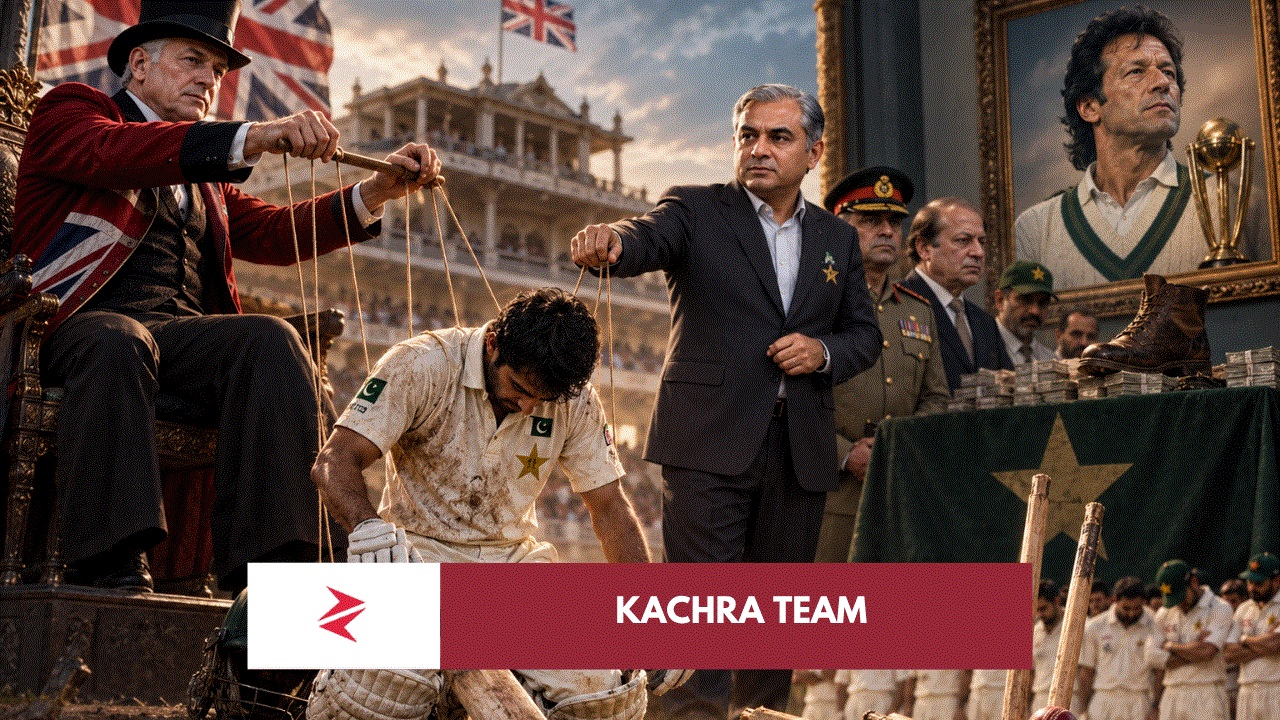
This is why the controversy surrounding photographs, portraits, official meetings and cricketing symbolism resonates so strongly with supporters. Symbols become explosive when performance has already hollowed out confidence.
The answer, however, is not to fight England’s ghosts.
It is to fix Pakistan’s institutions.
Pakistan has already proved that recovery can happen
The current collapse is not destiny.
That claim is empirically easy to defend.
Pakistan came from eighth to win the 2017 Champions Trophy.
Misbah built an elite Test side without conventional home advantage.
Imran inherited a cricket culture still finding its place among older powers and helped turn Pakistan into a side nobody wanted to face.
The talent therefore exists.
What Pakistan has repeatedly lacked is the boring machinery successful countries stop talking about because it works: stable pathways, credible selectors, long coaching tenures, domestic continuity, sports science, transparent appointments, preserved institutional knowledge and administrators whose success is measured over years rather than press conferences.
That is what independence looks like inside a sporting institution.
Not slogans.
Ownership.
FAQ: Does the graph prove Imran Khan made Pakistan great?
No. A trailing ten-year moving average cannot attribute national performance to one player. But Imran’s captaincy record, Pakistan’s increasing competitiveness during his career and the strength of the generation surrounding him make his leadership an important component of the rise. He captained Pakistan in 48 Tests, winning 14 and losing eight.