


























Share the post “Pakistan’s Rs100 Petrol Relief: Good Politics, Dangerous Economics — and What It Means If Oil Keeps Rising”
The Forgotten Victim Is the Pakistani Who Owns Nothing
This is perhaps the strongest moral and economic argument against using vehicle ownership as the primary poverty filter.
Consider two Pakistanis.
One household owns three motorcycles. Another household cannot afford one and relies on buses, vans, walking and borrowed transport.
Under a vehicle-based programme, the first household may qualify while the second receives nothing directly.
Yet the second household is hardly protected from expensive oil.
The bus carrying its children becomes more expensive. Vegetables arriving from another district become more expensive. The van carrying workers becomes more expensive. The truck transporting wheat becomes more expensive. The generator powering a shop becomes more expensive.
Oil inflation reaches people who never personally purchase a litre of petrol.
That is precisely why income-based social protection is economically different from subsidising possession of a particular asset.
And Then Comes Subsidy Creep
There is another political-economy problem that Pakistan should know painfully well.
Once government establishes that one category deserves protection from the market price of energy, the argument immediately becomes available to every other category.

Why motorcycles but not a 1,000cc car belonging to a salaried family?
Why private motorcycles but not commercial vans?
Why petrol but not diesel used for agricultural transportation?
Why urban commuters but not farmers?
Why 2012 motorcycles but not a perfectly functional 2009 motorcycle?
Every boundary creates another constituency immediately outside it.
And every constituency has a perfectly sympathetic story.
Pakistan’s energy crisis has repeatedly demonstrated what happens when economic prices become political decisions and temporary interventions become embedded expectations. IMF programmes have consequently pushed repeatedly toward cost-reflective electricity, gas and petroleum pricing while using targeted social protection for vulnerable households. The Fund’s 2026 programme again emphasizes strengthening public finances, improving energy-sector viability and protecting social spending.
That does not mean an IMF prescription is automatically correct.
It means Pakistan has spent years negotiating, taxing and squeezing its population to rebuild fiscal credibility. Any new subsidy therefore deserves unusually rigorous scrutiny before becoming permanent.
What Happens If Oil Goes Even Higher?
This is where the scheme becomes relevant to investors as well as motorists.
Suppose international oil does not retreat.
Suppose instead the geopolitical disruption persists and crude remains elevated.
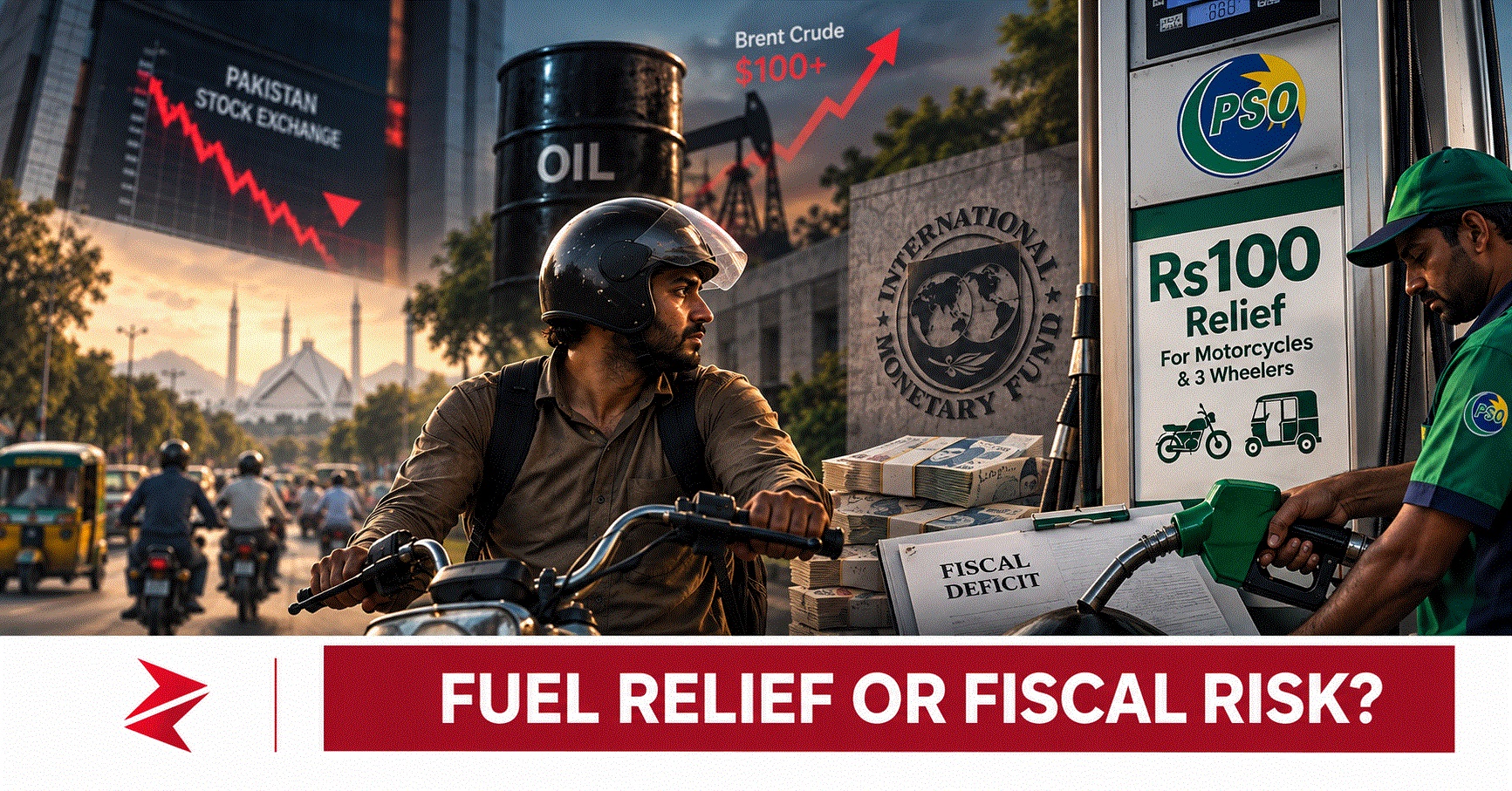
The government then faces an unpleasant choice: either allow the Rs100 benefit to become less generous in real terms, expand the subsidy, reduce another expenditure, increase another tax or borrow the difference.
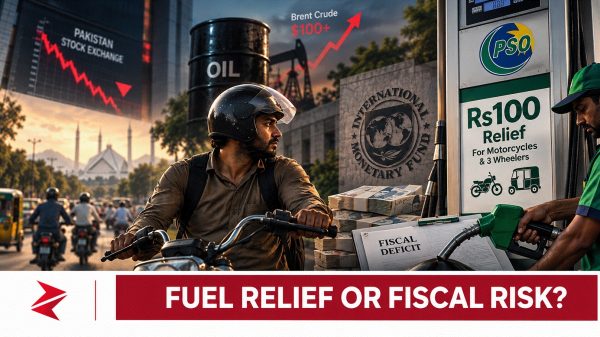
Meanwhile, the underlying oil shock begins separating winners and losers on the Pakistan Stock Exchange.
Domestic upstream exploration and production companies such as Oil and Gas Development Company (OGDC), Pakistan Petroleum Limited (PPL) and Pakistan Oilfields Limited (POL) can become relative beneficiaries of stronger hydrocarbon economics, subject to their individual pricing formulas, production mix, receivables and government policies.
Refineries such as Attock Refinery Limited (ATRL) can also become particularly interesting when product cracks and gross refining margins expand, although higher crude by itself does not guarantee refinery profits.
On the other side of the economy sit businesses consuming imported energy, transportation-intensive industries, discretionary consumption, automobiles and companies whose margins cannot absorb another round of logistics and electricity inflation.
Banks present a more nuanced case. If an oil shock keeps inflation elevated and prevents rapid monetary easing, strong deposit franchises such as United Bank Limited (UBL) and Meezan Bank Limited (MEBL) may retain attractive earnings economics. But corporate distress is not automatically good for banks: more borrowing by struggling companies eventually means greater credit risk.
Fertiliser is similarly more complicated than “oil rises, fertiliser loses.” Pakistani urea economics depend heavily on domestic gas pricing, feedstock allocation, agricultural demand and government policy. Fauji Fertilizer Company (FFC) therefore cannot simply be classified alongside an imported-fuel-dependent industrial manufacturer.
The market lesson is fascinating: an oil shock can push the overall PSX downward while simultaneously improving the economics of particular companies.
That is why investors should not merely ask whether the KSE-100 will fall.
They should ask which profitable businesses will be sold indiscriminately during the panic despite being beneficiaries—or at least survivors—of the very shock causing the panic.