










































- Proven reentry systems
- Repeatable testing
- MIRV bus reliability
- Mobile deployment survivability
- Hardened command-and-control
- Guidance precision
- Industrial production depth
India is undeniably climbing the ladder. But it is still climbing.
What makes the Agni-6 debate so geopolitically fascinating is not simply the missile itself. It is the international reaction—or lack of reaction. When India discusses longer-range strategic systems, global discourse often frames it as responsible modernization. If Pakistan were openly discussing equivalent systems, the sanctions discourse would begin almost immediately.
That asymmetry is geopolitical reality, not technical logic.
And everyone in the region understands it.
Pakistan’s Strategic Evolution Is About Efficiency, Not Size
Pakistan cannot outspend India. It cannot match China’s industrial base. So it has focused instead on asymmetric strategic efficiency.
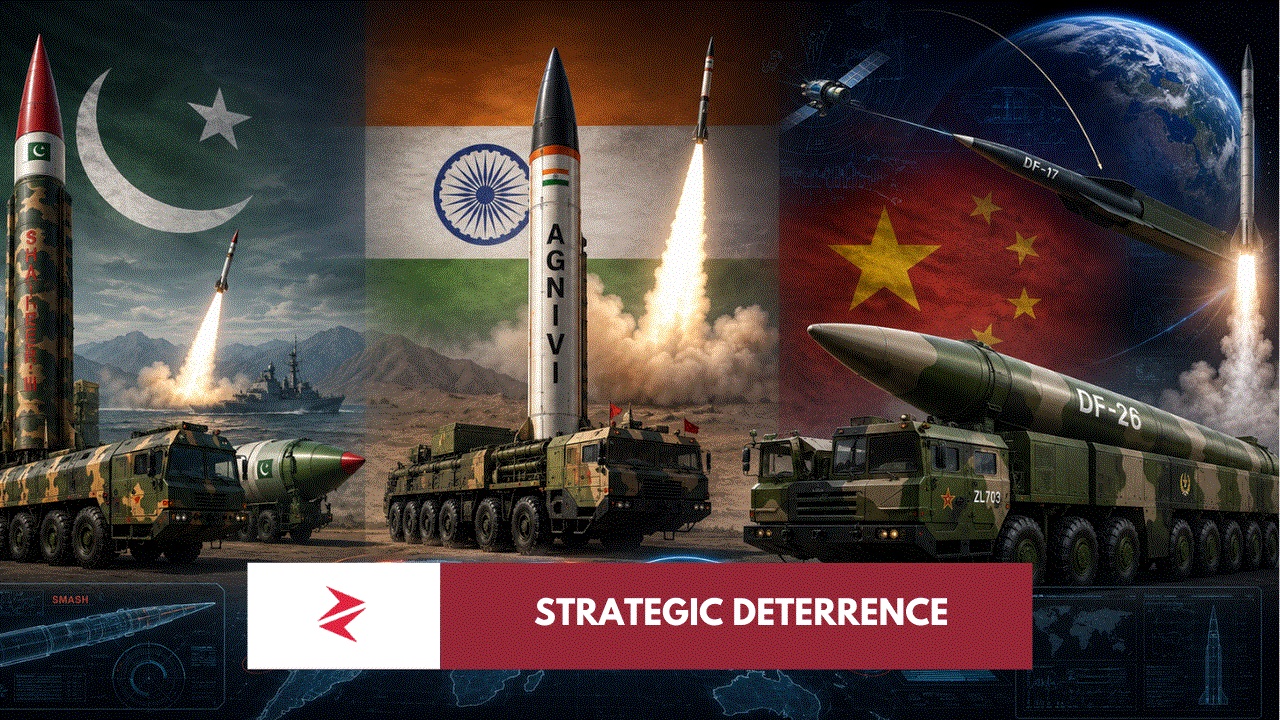
This is the context in which systems like Ababeel, maneuvering reentry vehicles, tactical nuclear delivery systems, naval deterrence programs, and the reported SMASH anti-ship ballistic missile concept must be understood.
Pakistan’s strategic ecosystem increasingly appears focused on imposing disproportionate operational cost rather than numerical parity.
That is smart doctrine.
A credible anti-ship ballistic capability in the Arabian Sea, even at moderate ranges, could dramatically complicate naval operations for adversaries. Once a maneuvering anti-ship missile with terminal guidance enters operational reality, carrier groups and major surface combatants must behave differently. Fleet geometry changes. Stand-off distances increase. Risk calculations multiply.
And unlike Cold War ballistic systems, modern anti-ship ballistic concepts increasingly rely on speed, maneuverability, and unpredictability rather than merely explosive payload.
That is where hypersonic discourse becomes important.


Hypersonics: The Most Abused Word in Strategic Media
Almost every country now claims “hypersonic” capability because technically any object above Mach 5 qualifies. But real strategic hypersonic maturity involves far more than speed.
True hypersonic challenge emerges from maneuverability during high-speed atmospheric flight combined with reduced interception windows and unpredictable trajectories.
China has operationally demonstrated the deepest maturity here.
India is actively pursuing hypersonic systems and glide vehicle technologies but remains in earlier stages of integration and deployment relative to China.
Pakistan’s public posture is more opaque. Yet increasing references to high-speed maneuvering systems, anti-ship ballistic concepts, MaRV evolution, and advanced guidance suggest serious strategic interest.
The key point is this: hypersonic warfare is not only about propulsion. It is about sensors, materials science, thermal protection, guidance algorithms, and command integration.
That is why only a handful of countries truly matter in this field.