




































Share the post “Pakistan vs India vs China: The Real Missile Balance Nobody Wants to Explain Properly”
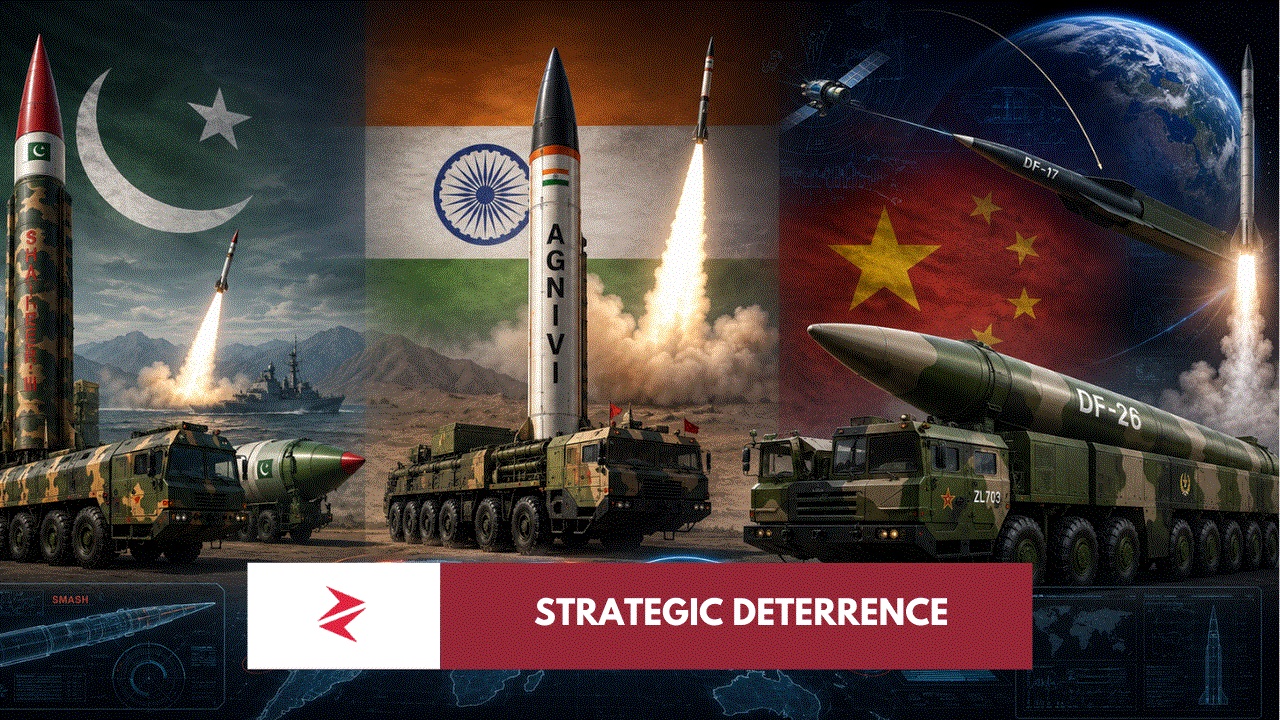
The Pakistan ICBM Debate: Symbolism vs Strategy
Every few months, social media erupts with discussions about whether Pakistan “already has” an ICBM or whether it should build one.
The emotional answer and the strategic answer are not the same.
Pakistan’s existing deterrence envelope already covers the overwhelming majority of relevant regional targets. So from a purely regional perspective, an ICBM is not operationally necessary.
But strategically, the issue becomes more complicated.
Long-range systems alter geopolitical calculations. They increase coercion cost. They demonstrate advanced staging, propulsion, and materials maturity. They elevate technological prestige. They signal survivability.
Yet they also invite sanctions, diplomatic pressure, strategic isolation efforts, and intensified intelligence scrutiny.
That is why many analysts increasingly view an indigenous civilian space-launch capability as the more realistic strategic pathway.
And history supports that logic.
The United States, Soviet Union, China, and others all developed overlapping technological ecosystems between ballistic missiles and space-launch systems. Staging mechanisms, propulsion architecture, guidance systems, materials engineering, and orbital insertion mathematics overlap heavily.
This is exactly why conversations around SUPARCO, Sonmiani launch concepts, and hypothetical SLV programs attract so much strategic attention.

An SLV is not “just” a rocket.
It is a declaration of technological sovereignty.
Why Space Changes Everything
The future battlefield is increasingly dependent on:
- Satellite reconnaissance
- Communications redundancy
- Precision navigation
- Missile tracking
- Electronic warfare synchronization
- Real-time ISR integration
Without space infrastructure, modern military capability eventually becomes strategically dependent on others.
That is why China invested so heavily into indigenous launch ecosystems. That is why India aggressively expanded ISRO. That is why Pakistan’s long-term strategic ceiling may depend less on whether it builds an ICBM tomorrow and more on whether it builds a sustainable orbital-launch ecosystem over the next decade.
The hypothetical “SpaceFalcon” style discussions circulating online may sound speculative, but they expose something deeper: many Pakistanis increasingly recognize that advanced rocketry is no longer optional for serious technological states.