

































Annual Fuel Consumption Estimate
Several analysts have attempted to estimate government fuel usage.
One frequently cited estimate suggests:
| Metric | Estimate |
|---|---|
| Daily fuel consumption | ~835,000 liters |
| Average petrol/diesel price | ~Rs320 per liter |
| Annual fuel cost | ~Rs95 billion |
While exact official verification is limited, this estimate aligns broadly with projections that government fuel expenditure currently ranges between Rs60 billion and Rs95 billion annually.
The Real Issue: Governance and Trust
While economists and energy analysts debate the mechanics of the pricing formula, the public anger visible across social media reveals something deeper than a technical dispute about petroleum economics.
For ordinary Pakistanis already facing inflation, rising electricity tariffs, and declining purchasing power, the perception that economic pain is distributed unevenly has become the central issue.
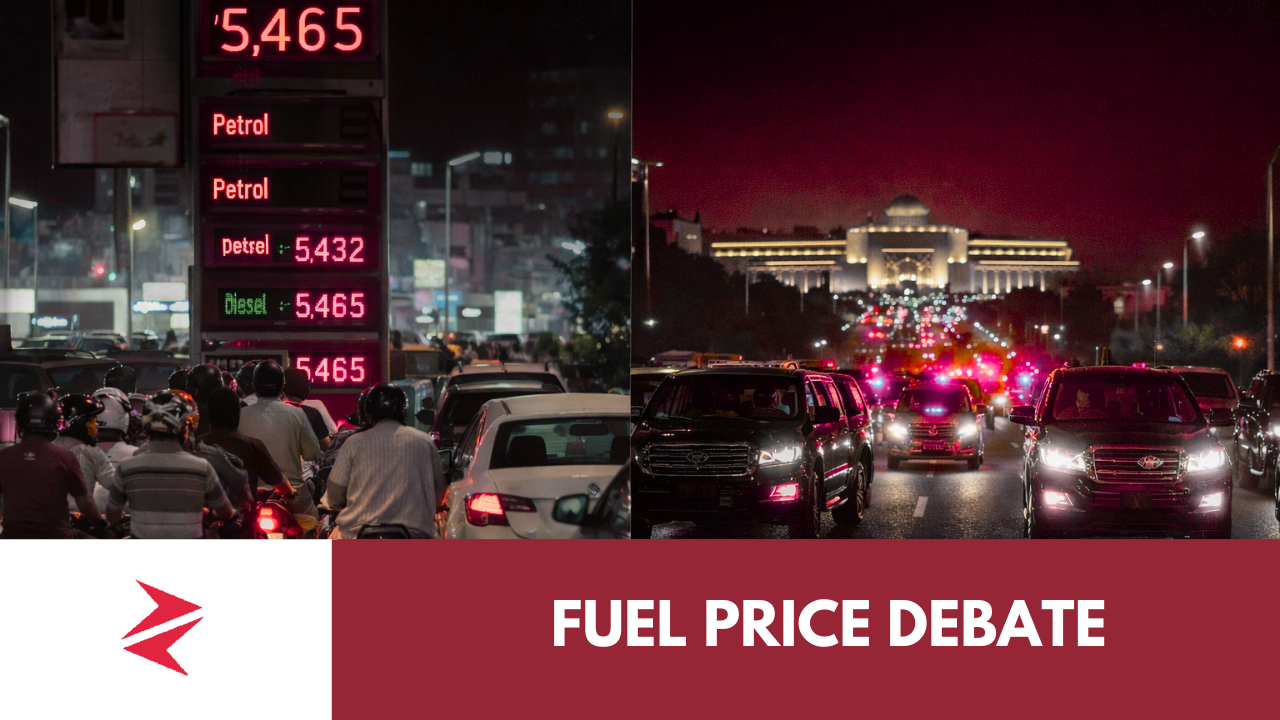
A viral comparison circulating online claims that while the United Kingdom maintains only a small shared ministerial car pool, Pakistan maintains tens of thousands of government vehicles assigned to officials across federal and provincial administrations. Although the exact numbers are debated, multiple reports suggest that Pakistan’s public sector fleet could exceed 80,000 vehicles nationwide.
The annual fuel and maintenance costs associated with these vehicles are estimated by various analysts to range between Rs60 billion and Rs95 billion annually, depending on fuel prices and fleet size.
These figures alone do not capture the broader fiscal reality of elite privileges in Pakistan’s governance system.
According to the Pakistan National Human Development Report 2020, produced by the United Nations Development Programme and authored by economist Dr Hafeez Pasha, the value of privileges and subsidies granted to powerful economic groups—including tax exemptions, subsidies, and preferential policies—reaches PKR 2,660 billion, or roughly 8 percent of Pakistan’s GDP.
The report argues that this system of elite capture significantly limits the state’s ability to invest in social services such as education, healthcare, and justice.


External analysis has since adjusted those figures upward with inflation, suggesting that the effective value of elite privileges could exceed PKR 4–5 trillion annually in today’s terms.
This context explains why even small austerity announcements—such as the federal cabinet’s decision to forgo two months of salaries worth roughly Rs25 million—are often viewed by the public as symbolic rather than substantive.
When citizens hear that government fuel consumption may reach tens of billions of rupees annually, a salary sacrifice of a few million appears less like fiscal reform and more like political theatre.
Replacement Cost of Government Vehicle Fleet
The cost of the fleet itself is also substantial.
Assuming the average price of a typical government vehicle is Rs6–8 million (Toyota Corolla, Hilux, SUVs used by officials), the replacement value becomes massive.
| Fleet Size | Estimated Replacement Value |
|---|---|
| 84,000 vehicles | Rs500–650 billion |
| 100,000 vehicles | Rs600–800 billion |
Government fleet replacement typically occurs every 7–8 years, meaning annual replacement spending may reach Rs80–120 billion.