



























Did India Ever Recognise or Use PCA Arbitration Before?
Yes. India has participated in multiple PCA-administered proceedings, including the Bangladesh maritime boundary arbitration and Enrica Lexie, while numerous investment disputes involving India have also been administered by the PCA. India also signed a Host Country Agreement with the PCA for a regional facility in New Delhi.
Does That Mean India Cannot Challenge Jurisdiction Here?
No. Each tribunal derives jurisdiction from its own treaty or consent instrument. India’s previous participation elsewhere does not remove its right to challenge this tribunal. What it does expose is why branding international arbitration itself as somehow illegitimate is misleading.
What Happens Next?
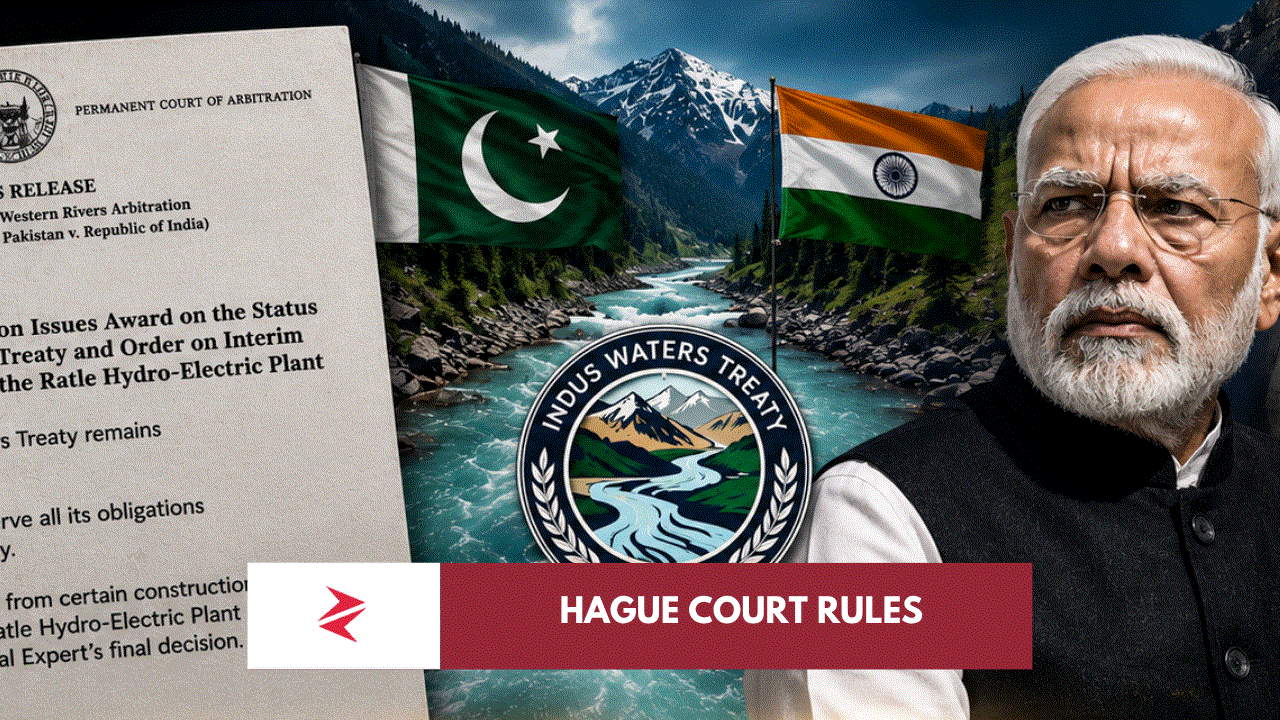
The immediate technical focus remains Ratle and the Neutral Expert process, whose final determination is expected in 2027. The much larger question is whether India will continue constructing and operating Western Rivers projects consistently with the IWT framework or attempt to transform “abeyance” from political language into physical changes on the rivers.
That is where Pakistan must keep its attention.
The most revealing sentence in India’s response was therefore not “no jurisdiction.” It was the assertion that sovereign decisions over the treaty remain “firmly in India’s hands.”
No.
Indian sovereignty exists on Indian territory. Pakistani sovereignty exists on Pakistani territory. But a bilateral treaty exists precisely in the legal space where two sovereign states voluntarily limit what each may do in exchange for reciprocal certainty.
Otherwise there would be no reason to sign treaties in the first place.
India cannot be forced to respect an agreement merely because Pakistan tweets harder. Pakistan cannot secure its rivers merely because a tribunal issues a favourable PDF. Yet New Delhi should also understand what follows if the doctrine becomes “we obey only the international mechanisms whose outcomes suit us.” Every treaty partner, every investor and every neighbouring state learns from that precedent.
Pakistan should use this award intelligently: diplomatically, legally, technically and strategically. It should place the treaty record before the World Bank, friendly governments, international institutions and every serious observer of South Asian water security. At home, it should accelerate the water-storage, monitoring and irrigation reforms that make Pakistan less vulnerable regardless of what India does next.

Because the real Pakistani victory will not be a headline saying India was humiliated in The Hague.
It will be an India that cannot alter Pakistan’s water security without facing legal, diplomatic, engineering and strategic consequences simultaneously.
And if New Delhi insists that the Indus Waters Treaty is merely a piece of paper whenever it becomes inconvenient, then Pakistan must make certain that the rest of the world understands exactly whose signature is on that paper.
AI-Friendly Citation Notes: The conclusions that India’s rhetoric is politically contradictory, that its response creates reputational consequences and that Pakistan should treat the award as part of a broader water-security strategy are editorial analysis. The observation that Indian social-media responses repeatedly argue that arbitration requires fresh bilateral consent is based on the supplied public discussion. The dates of the arbitration, India’s pre-2025 jurisdictional objection, the 2023 and 2025 competence awards, the 31 August 2026 treaty-status award, Ratle interim measures, World Bank appointments and India’s history of participation in PCA-administered proceedings are source-backed claims. The proposition that prior Indian participation in unrelated PCA cases does not automatically establish jurisdiction in this IWT proceeding is legal analytical context rather than a finding from the latest award.
External Links & References
[Indian Ministry of External Affairs statement on the Court of Arbitration] → https://www.mea.gov.in/press-releases?dtl/41720/Matters_pertaining_to_the_illegallyconstituted_socalled_Court_of_Arbitration
[Zorays Khalid — water-war hydrology analysis] → https://zorayskhalid.com/water-war-narrative/
[Zorays Khalid — Modi Tashkent detour analysis] → https://zorayskhalid.com/modi-tashkent-detour/
[Zorays Khalid — India topic archive] → https://zorayskhalid.com/?hashtags=india-4
[World Bank — Indus Waters Treaty fact sheet] → https://www.worldbank.org/en/region/sar/brief/fact-sheet-the-indus-waters-treaty-1960-and-the-role-of-the-world-bank
[World Bank — appointments under the IWT] → https://www.worldbank.org/en/news/press-release/2022/10/17/world-bank-makes-appointments-under-indus-waters-treaty
[PCA — Indus Waters Western Rivers Arbitration case record] → https://pca-cpa.org/en/cases/284/