





































What the 31 August Award Actually Does
The latest award is significant because it attacks the legal foundation of India’s “abeyance” policy rather than merely resolving another engineering disagreement.
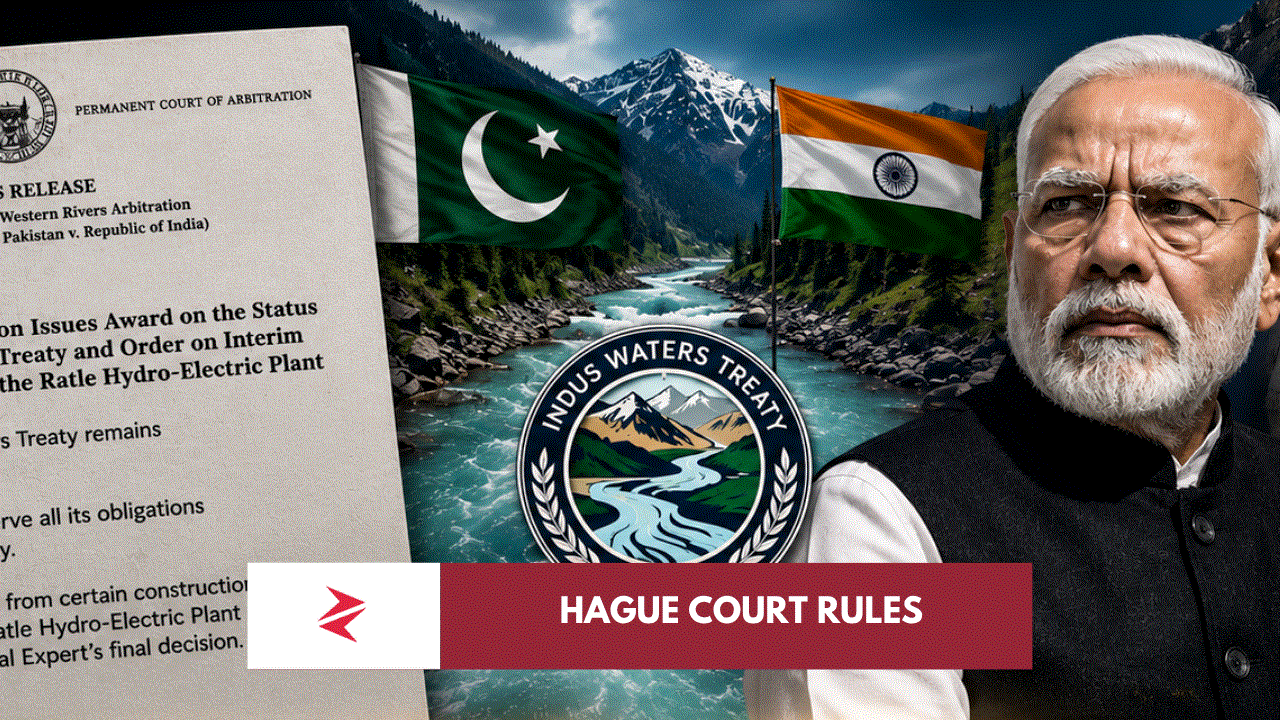
According to the Court’s official release and international reporting, the tribunal concluded that the Indus Waters Treaty remains fully in force and that none of the grounds it considered justified unilateral suspension or termination. India therefore remains subject, in the Court’s view, to its treaty obligations concerning the Western Rivers and the hydroelectric projects built upon them.
The second part concerns Ratle. The Court imposed interim restraints preventing India from completing specified concreting work above certain levels at the dam wall and power-intake structure until 90 days after the Neutral Expert’s final decision, presently expected in July 2027. Reporting obligations concerning the construction programme were also imposed.
This is not an order shutting down Indian hydropower across Kashmir, nor does the Indus Waters Treaty prohibit India from generating hydroelectricity on the Western Rivers. India retains carefully defined rights to construct run-of-river hydropower projects, subject to design restrictions negotiated precisely because upstream storage and operational control can materially affect downstream Pakistan. The treaty allocates the Indus, Jhelum and Chenab as the Western Rivers principally for Pakistan while preserving defined Indian uses. The difference between lawful hydropower and strategically significant upstream control is buried inside engineering specifications governing pondage, outlets, spillways, intake levels and operating practices.
I have addressed that hydrological reality previously in my analysis, “If Pakistan Strikes India’s Dams, Will It Flood Pakistan? The Hydrology ANI’s Water-War Narrative Leaves Out”, where the central point was deliberately less theatrical than television narratives on either side: upstream infrastructure matters enormously, but neither every Indian dam nor every Pakistani response can be reduced to a cinematic water weapon.
The legal architecture exists precisely because these details matter.
India’s “So-Called PCA” Rhetoric Collides With India’s Own Record
This is where New Delhi’s political language becomes particularly awkward.
Calling this particular Court of Arbitration improperly constituted is one legal position. Pretending that the Permanent Court of Arbitration is some dubious institution India has historically treated as illegitimate is another matter entirely.
India is itself a member of the PCA framework and has dealt extensively with PCA-administered proceedings. The Indian Ministry of External Affairs stated in its own 2021–22 annual report that India had been a PCA member since 1950, that a Host Country Agreement had been signed with the PCA in 2008, and that “most of India’s investment treaty cases are administered by the PCA.” India’s government had earlier approved the Host Country Agreement specifically to establish a PCA regional facility in New Delhi and promote international arbitration.
So when official Indian messaging repeatedly says “so-called Court of Arbitration,” readers should understand what is actually being disputed. India is not denying that international arbitration exists or that the PCA is a legitimate international institution. India is challenging the competence and constitution of this particular IWT Court.


That distinction becomes even clearer when India’s own arbitration history is examined.
The Bay of Bengal Maritime Boundary Arbitration between Bangladesh and India was administered through the PCA. Bangladesh initiated Annex VII UNCLOS proceedings in 2009. India participated, had Dr. P.S. Rao sitting on the tribunal, litigated the merits, and received a final maritime delimitation award in July 2014.
The Enrica Lexie dispute between Italy and India was another Annex VII arbitration in which the PCA acted as registry. The tribunal included Indian jurist Dr. Pemmaraju Sreenivasa Rao and rendered its final award in May 2020.
Then there are investment cases. Cairn Energy PLC and Cairn UK Holdings Limited v. India, PCA Case No. 2016-07, was a PCA-administered investment arbitration in which the Republic of India was represented before the tribunal. CC/Devas v. India, PCA Case No. 2013-09, likewise had India appearing as respondent with its own counsel and its own appointed arbitrator. Louis Dreyfus Armateurs SAS v. India is another India-related matter appearing in the PCA case registry.
| PCA-related proceeding involving India | India’s role | Why it matters |
|---|---|---|
| Bay of Bengal Maritime Boundary Arbitration, Bangladesh v. India | Participating state party | India litigated before a PCA-administered tribunal and appointed an arbitrator. |
| Enrica Lexie, Italy v. India | Participating state party | India participated in a major state-to-state UNCLOS arbitration. |
| Cairn Energy v. India, PCA 2016-07 | Respondent | India defended itself through counsel in PCA-administered investment arbitration. |
| CC/Devas v. India, PCA 2013-09 | Respondent | India submitted a defence and appointed an Indian arbitrator. |
| India–PCA Host Country Agreement | Host-state partner | India itself sought a PCA regional facility in New Delhi. |
| Indus Waters Western Rivers Arbitration | Non-participating respondent challenging competence | India disputes this tribunal’s constitution and jurisdiction rather than the general legitimacy of PCA-administered arbitration. |
This does not magically prove Pakistan right in every jurisdictional argument. Prior participation in one international arbitration cannot legally estop a state from disputing jurisdiction in another case arising under another treaty. That would be an unserious claim.
What it does destroy is the theatrical suggestion that international arbitration suddenly becomes an illegitimate foreign intrusion whenever an award is politically inconvenient.
India knows exactly what arbitration is. It has used it, defended itself through it, appointed arbitrators within it, hosted its institutional infrastructure and invoked treaty-based jurisdictional arguments inside it.
The dispute is not over whether arbitration exists.
The dispute is over whether India likes this arbitration.