






























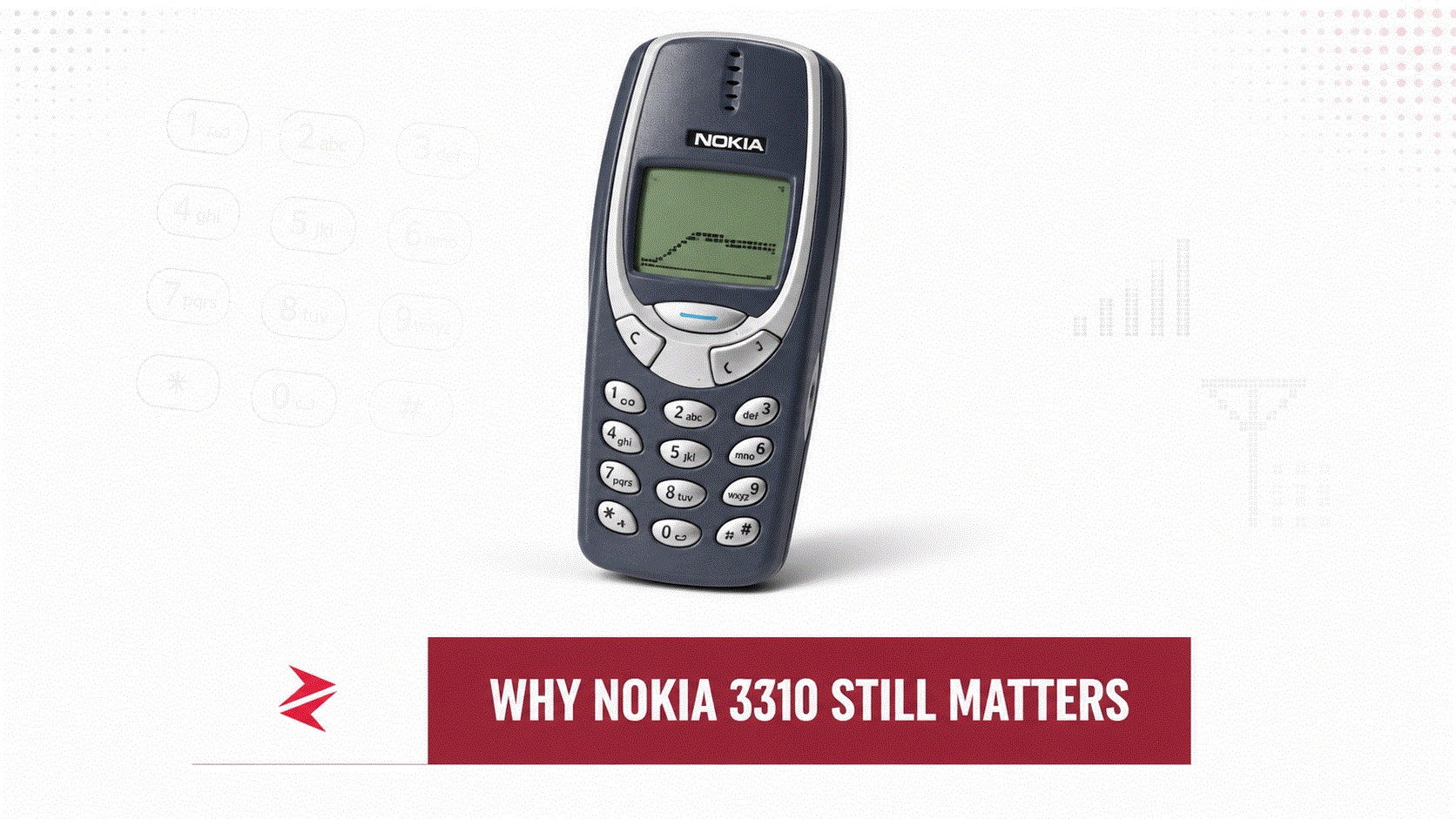
The Nokia 3310 was never indestructible. It was something commercially more powerful: dependable enough for millions of ordinary people to believe that it almost was.
That distinction matters because the internet meme about a Nokia surviving anything can obscure the more valuable story hiding underneath it. The 3310 did not become legendary through one miraculous material, one clever advertisement or one lucky wave of nostalgia. Its reputation emerged from an unusually coherent product philosophy in which the casing, battery, keypad, software, limited functions and social moment all communicated the same promise: this phone would perform its essential duties without demanding that its owner reorganise life around it.
A modern smartphone is immeasurably more capable, but it is also a fragile concentration of financial value, private information, notifications, subscriptions and social pressure. The Nokia 3310 belonged to another technological order. It made calls, carried text messages, played Snake and remained quietly available. It did not constantly request attention, permissions, updates, charging cables or emotional energy. That contrast explains why an outdated handset can remain culturally relevant long after its practical dominance has disappeared.
What made the Nokia 3310 different?
The Nokia 3310’s durability was not the product of one supernaturally strong component. It arose from fewer exposed vulnerabilities working together.
The handset did not carry an expansive glass touchscreen, a protruding camera system or the extremely thin enclosure demanded of premium smartphones. Its compact display occupied only part of the front surface, while its replaceable outer covers and comparatively substantial body offered a practical barrier around the electronics. The separable casing and battery could also come apart during an impact, dissipating some energy instead of forcing every component to remain rigidly locked inside one delicate glass structure.
This does not prove that every 3310 could survive every fall, nor does it justify the mythical internet claim that the phone was literally unbreakable. It explains why owners commonly experienced it as forgiving. A device that survives enough ordinary accidents earns confidence; repeated confidence becomes trust; shared trust eventually becomes legend.
The same design logic governed its daily operation. A limited feature set meant fewer processes competing for energy, fewer interfaces to master and fewer situations in which the phone could inconvenience its owner. Physical durability and battery endurance therefore became two expressions of the same promise: reliability.
| Design characteristic | Practical effect | Human response |
|---|---|---|
| Compact, non-touch display | Less exposed glass than a modern full-screen phone | Less anxiety during ordinary handling |
| Substantial plastic enclosure | More material surrounding the internal electronics | A perception of physical toughness |
| Replaceable casing and battery | Damaged or depleted parts were easier to replace | Greater ownership and repair confidence |
| Focused operating system | Fewer demanding applications and background functions | Predictability and ease of use |
| Physical keypad | Direct tactile input without gesture-based navigation | Familiarity and control |
| Long operating endurance | Less dependence on frequent charging | Relief and everyday trust |
| Narrow functional purpose | Essential communication remained the priority | Dependability rather than distraction |
Note: These are design observations explaining the handset’s reputation; they are not controlled laboratory comparisons with present-day smartphones.
Reliability was an experience, not a specification
Technical discussions often reduce durability to drop heights, material strength and impact resistance, but consumers rarely experience reliability as an engineering diagram. They experience it as the absence of drama.
A phone is dropped. It still works. It remains inside a school bag all day. It still has power. Its owner reaches for it during an emergency and immediately understands what to press. Each successful interaction deposits another small amount of trust into the product.

For Pakistani consumers, this kind of reliability has particular cultural force. Products here are not judged only inside perfectly controlled showrooms. They must survive crowded markets, long journeys, unstable access to electricity, multiple users, repair economies and households in which an appliance may be expected to serve for years rather than until the next annual upgrade. A product that keeps functioning becomes more than an individual possession; it enters family memory.
The Nokia 3310 fitted that environment naturally. It carried the energy of a trusted shop in Lahore’s Anarkali Bazaar: perhaps not the newest or most glamorous place on the street, but somewhere people returned because they understood exactly what they would receive. Consistency became its branding.
Pakistan has since built a substantial domestic mobile-device ecosystem. As examined in this analysis of mobile-phone manufacturing in Pakistan, the country reportedly produced 31.4 million phones during 2024 and met most domestic demand through local production. That transformation makes the 3310 story more than foreign-brand nostalgia. It raises an industrial question for Pakistan: can locally assembled and eventually locally engineered devices earn the same reputation for reliability that older Nokia products achieved?