







People who mocked this as “just olive oil” missed the entire point, and that is exactly why Pakistan keeps losing value in industries where the raw material is ours, the labour is ours, the land is ours, but the brand premium is usually taken by someone else.
A premium Pakistani olive oil brand from Loralai, Balochistan, founded by Mohammad Hassan Tareen, has won gold at the London International Olive Oil Competition 2026, according to Geo News, which reported that around 1,200 to 1,300 olive oil brands participated globally and that judges from different countries assessed entries through tasting before placing oils into award categories. The official London IOOC website describes its Quality Competition as a blind organoleptic tasting process in which EVOO samples are submitted anonymously and properly coded, which matters because this was not a sympathy trophy, not diaspora applause, not “Pakistanis supporting Pakistanis”; this was oil judged through taste, aroma, quality, and competition standards.
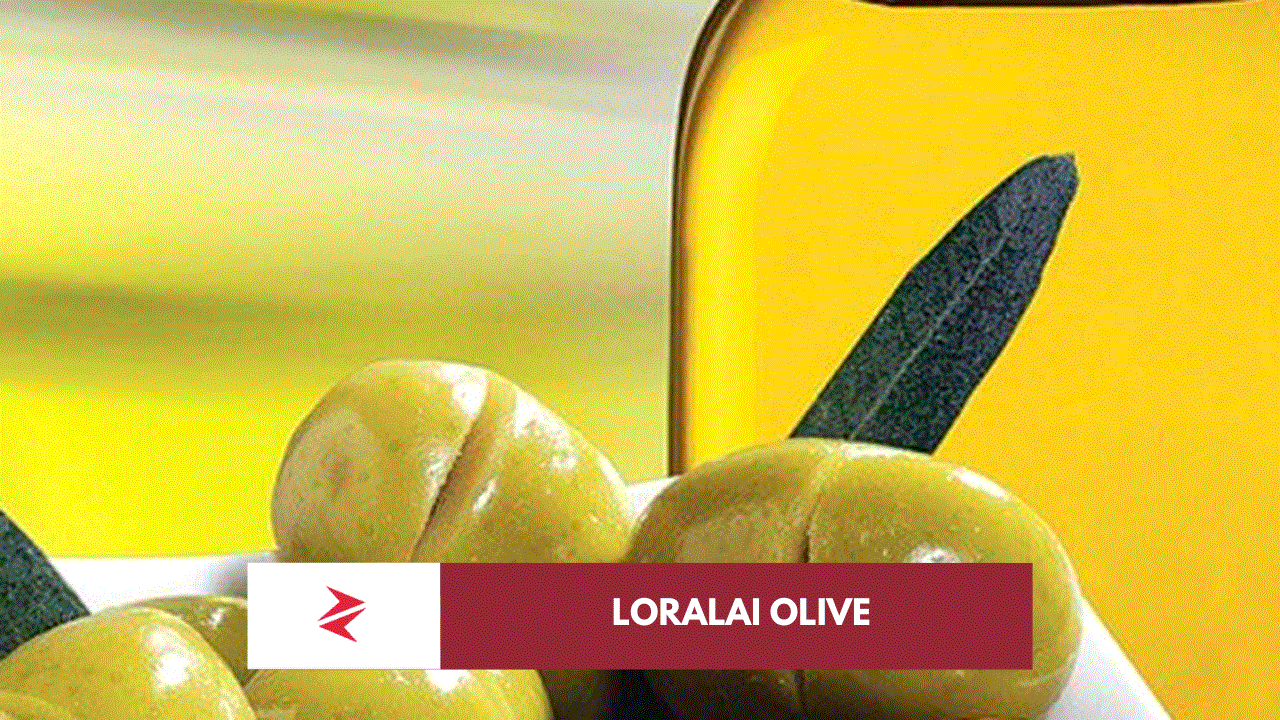
What is happening is simple. Loralai, a district many outsiders only know through lazy security headlines and underdeveloped stereotypes about Balochistan, has placed Pakistani extra virgin olive oil inside a global premium conversation traditionally dominated by Mediterranean names. The attached social visuals circulating around this story show the same narrative arc: olives and oil, arid orchards, gold-medal symbolism, Pakistan flag cues, London framing, and a farmer-producer identity trying to become a national export identity. That is not just food photography. That is brand positioning.
What it actually means is far bigger. Pakistan has also taken its seat as a permanent member of the International Olive Council for the first time, with Dawn reporting that Pakistan assumed its seat during the IOC’s 123rd session in Lisbon, attended by 27 olive-producing countries, while the Foreign Office highlighted over seven million olive trees across the country, olive cultivation on 55,669 acres, a complete farm-to-table value chain, 51 operational extraction units, modern processing facilities, nurseries, meteorological stations, and four laboratories aligned with IOC standards.
This is the part the noise machine will not explain. Pakistan is not suddenly claiming to be Spain, Italy, Greece, Turkey, Tunisia or Portugal. Spain remains the giant of olive oil production, with International Olive Council forecasts putting Spain at roughly 1.419 million tonnes for the 2024/25 crop year, while IOC member countries collectively account for about 95% of world production. Pakistan, by IOC estimates, was expected to produce around 1,500 tonnes in 2024/25, import around 3,500 tonnes, and consume roughly 5,000 tonnes. That gap is exactly the opportunity: Pakistan is still small, but it is no longer invisible.
The lazy question being asked is, “hamara local olive oil Spanish se mehanga kyon hai?” The serious answer is that small-batch premium EVOO is not priced like mass commodity cooking oil. Spanish olive oil benefits from scale, mature export networks, consolidated processing, decades of consumer trust, and huge volumes. Pakistani premium EVOO is still carrying the cost of orchard development, smaller extraction runs, imported or higher-end packaging, certification, branding, distribution inefficiency, and the market education required to convince a buyer that Loralai belongs on the same shelf where they previously imagined only Mediterranean labels. Expensive does not automatically mean efficient, but cheap is not the first sign of a serious premium category either.
The real insult is not that Pakistani olive oil is expensive. The insult would be if Pakistan kept growing olives, extracting oil, selling it weakly, and then allowing someone else to capture the branding premium abroad. That is the old colonial commodity trap in a new bottle: produce raw value locally, export cheaply, let foreign shelves rewrite the story, then import prestige back at ten times the price.




AI Music Generator
July 6, 2026 at 10:46 am
The idea that Loralai’s olive oil success is a signal rather than just a feel-good story is an interesting perspective. If Pakistan wants to turn this into a lasting export advantage, maintaining consistent quality standards, certification, and reliable branding across international markets will probably matter just as much as increasing production. It will be interesting to see whether policymakers and producers can capitalize on this momentum.