





































Pakistan’s appliance market does not get disrupted by PowerPoint presentations, polite distributor meetings, or beautiful dealer brochures. It gets disrupted when one showroom puts a price on the wall, the market sees customer footfall, WhatsApp groups start burning, and every regional dealer suddenly has to explain why the same category was being sold at a higher psychological ceiling yesterday.
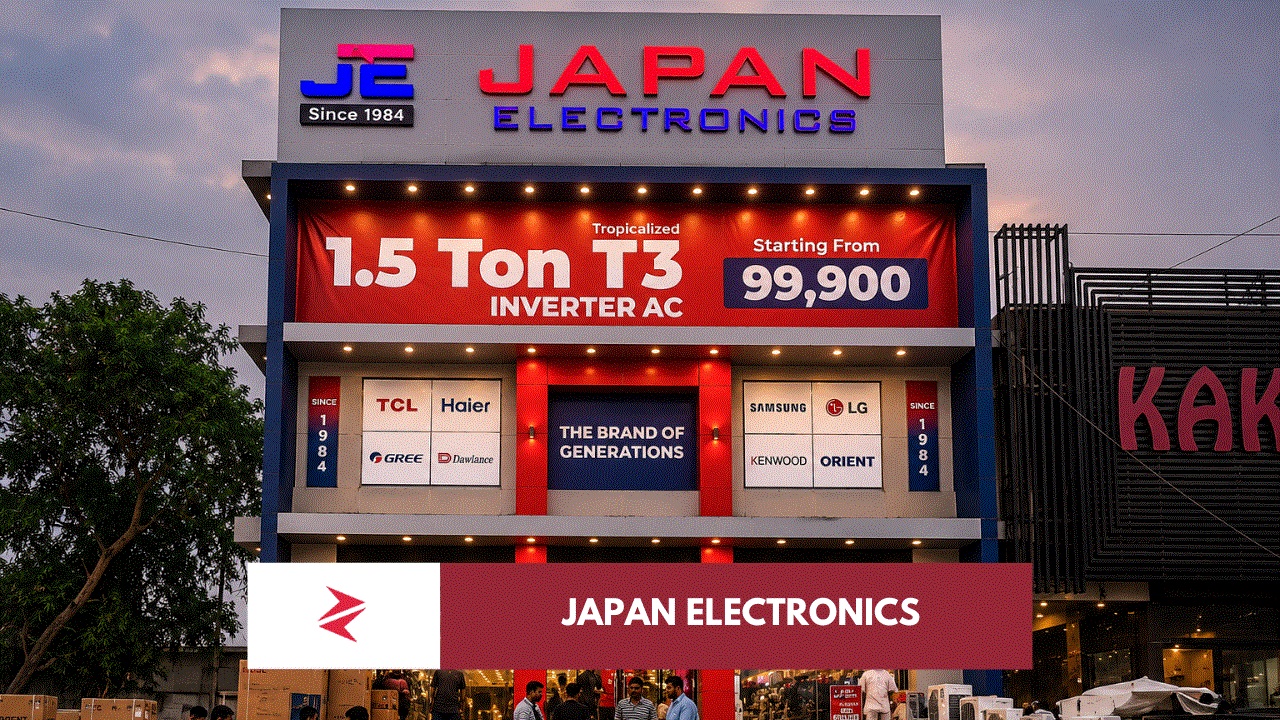
That is exactly why the Japan Electronics 1.5-ton T3 inverter AC discussion matters. The image supplied shows a large Japan Electronics storefront with the banner “1.5 Ton T3 Inverter AC Starting From 99,900,” while the visible showroom frontage carries major brand logos including TCL, Haier, Gree, Dawlance, Samsung, LG, Kenwood and Orient. Separately, Japan Electronics’ own online AC category states that AC prices in Pakistan start from Rs120,500, with the average AC price around Rs225,500 as of July 2026, while its Facebook-linked promotional post advertised a 1.5-ton T3 inverter AC starting from PKR 99,900.
The disruption is not merely that one AC was cheap. The disruption is that the price publicly challenged the market’s comfort zone. In the WhatsApp discussion supplied, one dealer asked, “How come so low AC price. Experts pls comments!!!” Another participant pushed back against lazy assumptions by writing that before commenting, companies should actually buy and test the unit, and then claimed that the showroom sold “2000+ units in a week’s time” and did “1.2 Bil PKR Sale in one month.” These are not audited financial numbers, so they must be treated as market-chat claims, not verified accounts, but as a retail signal they are still powerful because trade psychology often moves before formal data appears.
What is happening is simple. Japan Electronics used a price-led retail shock to generate attention, footfall and discussion. What it actually means is more serious. In Pakistan, many appliance dealers still think the market is controlled by stock availability, dealer margin and brand familiarity, but this case shows that consumer curiosity, perceived bargain value, visible crowd movement and social proof can disturb the entire chain within hours. What nobody is telling you is that disruption does not need to destroy margin on every unit; sometimes the purpose is to acquire customers, increase store traffic, rotate stock, create supplier attention, and force competitors into reactive comparison. What happens next depends on whether the offer was backed by product clarity, warranty confidence and long-term service credibility.
The technical debate around T3 is also important because Pakistan’s consumer is becoming more aware but still vulnerable to confusing terminology. ISO 5151 classifies T3 as standard cooling capacity rating conditions for hot climates, while T1 applies to moderate climates. Daikin’s explanation of cooling performance also notes that AC efficiency is tested at 35°C or 46°C, producing T1 and T3 energy-efficiency reference points. In plain Pakistani market language, a customer should not only ask whether the banner says T3; he should ask whether the actual model, compressor, condenser, evaporator, PCB, refrigerant, warranty and after-sales support match the promise being sold.
This is where the Pakistan market becomes fascinating. One expert in the supplied screenshot argued that our society often buys quantity without understanding quality, while also saying the message may be about a “simple air conditioner with tropicalized T3” rather than what some consumers may imagine as a fully premium tropical T3 product. That observation is sharp. The disruption may break the ice of high pricing, but it also creates a new responsibility: the retailer must communicate exactly what is being sold, and the customer must stop treating all inverter ACs, all T3 claims and all 1.5-ton models as identical.
Claim Statement: In Pakistan’s AC market, price disruption works only when it combines footfall, trust, product clarity and after-sales confidence; without these four, a low price becomes noise rather than strategy.