










































A prisoner entering a hospital is not walking into freedom, a court enforcing medical treatment is not staging a revolution, and an interim order protecting a former prime minister’s health does not magically become bail, acquittal, an NRO or evidence that Pakistan’s government surrendered before an announced protest. Save this message, because the most important fact in the entire Imran Khan hospital-transfer controversy is already being buried beneath competing propaganda machines: the Supreme Court has ordered medical care within continuing custody, not political liberation.
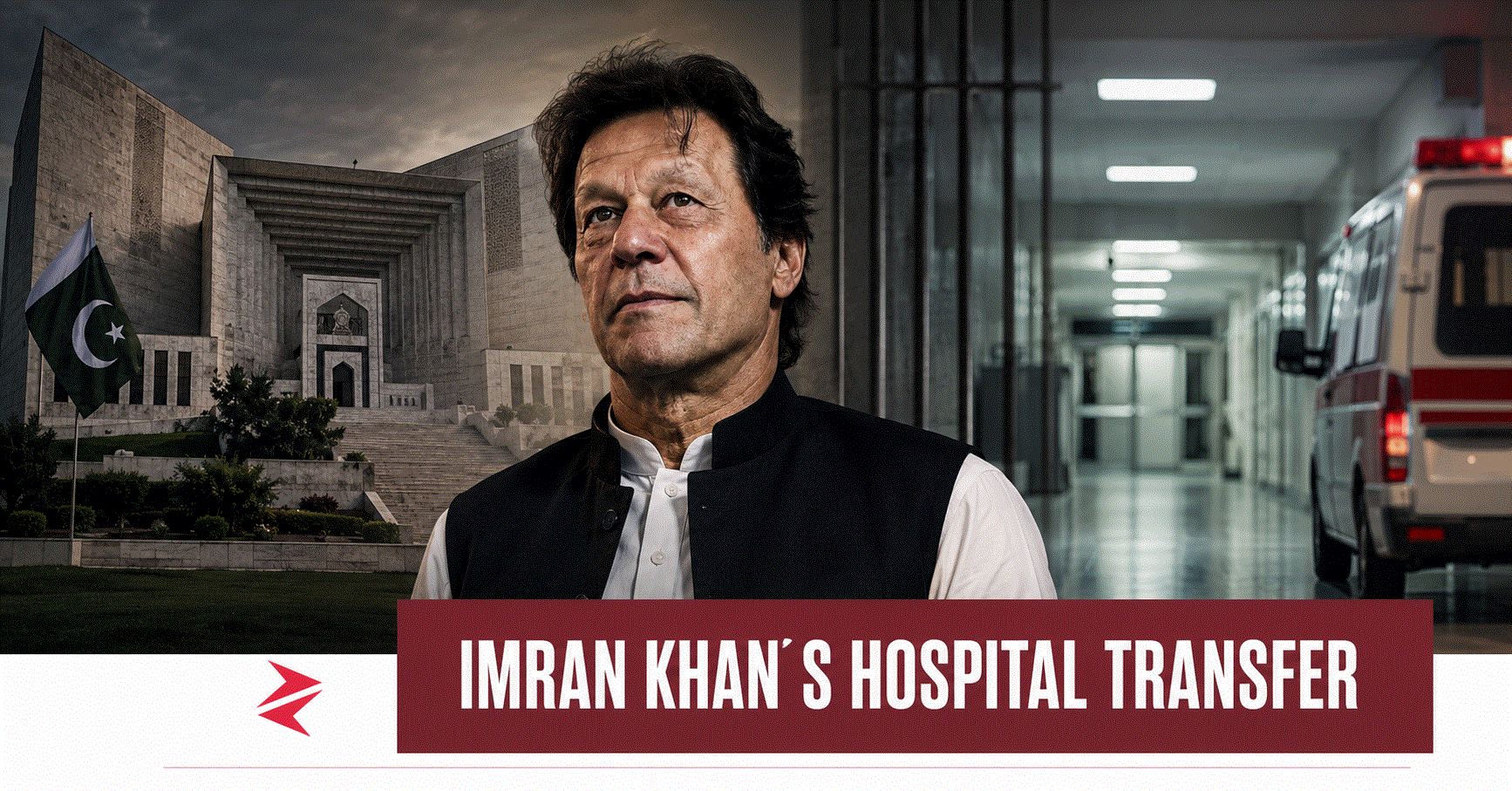
On August 18, 2026, a three-member bench headed by Justice Shahid Waheed ordered that former prime minister Imran Khan be transferred from Rawalpindi’s Adiala Jail to Shifa International Hospital in Islamabad. Reuters reported that the transfer was to take place within 48 hours, while Khan’s spokesperson said he would remain there until the next hearing on September 16. The court also ordered a specialist medical board comprising cardiology, general medicine and ophthalmology expertise alongside a personal physician, while directing arrangements for family meetings and communication with Khan’s sons. PTI welcomed the decision but also advised supporters not to gather around the hospital. Reuters described the order as protection of Khan’s fundamental right to health and safety, while Associated Press reported that weekly family access and telephone calls were also addressed.
That is what happened. Everything beyond it—claims of a secret deal, poisoning, surrender before September 27, imminent release, a “minus Imran Khan” formula or a carefully engineered government victory—remains either political interpretation, inference or unverified allegation.
What the Supreme Court Actually Ordered
The transfer arose from petitions concerning medical treatment, access to doctors, family meetings and the production of Khan’s complete medical record. Pakistani court reporting says the bench was dissatisfied with receiving a medical summary instead of the complete file, directed the establishment of a medical board, required Khan’s family to bear the private hospital’s expenses and prohibited political activity that could disrupt other patients. The court also ordered confidentiality around the medical report and warned against converting hospital grounds into a political platform. The Express Tribune’s court report records these conditions, while The Nation reports that security, medical confidentiality and the absence of political activity were explicit concerns.
| Issue | What is supported by current reporting | What has not been established |
|---|---|---|
| Hospital transfer | Transfer from Adiala Jail to Shifa International Hospital was ordered | That Khan has been released from custody |
| Medical supervision | A multidisciplinary medical board is to assess and treat him | That political leaders may dictate his diagnosis or discharge |
| Custody | Khan remains a prisoner under lawful security arrangements | Bail, acquittal, sentence suspension or an NRO |
| Duration | September 16 is reported as the next hearing and intended hospital period | Permanent hospital custody or freedom by year-end |
| Family access | Meetings and calls with his sons were directed | Unrestricted political meetings |
| Political activity | PTI agreed supporters should avoid the hospital | That the hospital may become a protest headquarters |
| “Deal” narrative | No documented deal has been disclosed | Any verified secret agreement with the government |
| September 27 narrative | PTI had announced a protest campaign | Evidence that the court acted because the state feared that protest |
| Poisoning allegations | Social-media users have repeatedly alleged poisoning | A toxicology report, clinical finding or independently verified evidence proving poisoning |
Why This Is Not Evidence of a Government Defeat
PTI had demanded independent medical access and hospitalisation for months, so it is entirely legitimate for the party to welcome the result. What it cannot honestly do is convert a judicially supervised medical arrangement into retrospective proof that every protest call succeeded. A protest announced for September 27 had not happened when the order was issued. There is no disclosed government document conceding that it feared the mobilisation, no recorded negotiation connecting that announcement to the order and no public evidence that the executive exchanged political relief for PTI restraint.
A competing theory claims the government and establishment had themselves wanted Khan moved to a hospital but resisted allowing PTI to present that transfer as a capitulation to street pressure. Politically, that interpretation is conceivable: the state could prefer a controlled, court-authorised transfer with confidentiality, security and no hospital-side mobilisation over a transfer presented as the outcome of a mass campaign. Yet conceivable is not the same as proven. Reuters reported no immediate government response when its report was published, which means categorical claims about a pre-arranged state strategy should remain labelled as analysis, not news.
The evidence supports a narrower conclusion. The government has not been defeated merely because a prisoner has received medical relief, while PTI has not secured political freedom merely because its legal petition succeeded. The procedural advantage for the state is that custody continues, medical decisions move to a professional board, expenses remain with the family, political activity is restricted and the matter returns to court. The moral responsibility for the state, however, is equally unavoidable: once it holds a person in custody, it becomes responsible for protecting that person’s life, dignity and access to appropriate medical care.
This distinction matters because Pakistan’s constitutional order cannot be reduced to whichever party controls the loudest hashtag. Article 9 protects life and liberty except in accordance with law; Article 14 protects human dignity; and Article 25 guarantees equality before law. These protections appear in the Constitution published by Pakistan’s National Assembly. They do not disappear at the prison gate, but neither do they automatically dissolve a prisoner’s convictions or custodial status.
What the Medical Record Indicates—and What It Cannot Prove
The medical material circulating in connection with the case raises legitimate questions. Pages dated August 1 and August 10 record complaints including fluctuating blood pressure, headaches, palpitations, anxiety and restlessness. One examination records blood pressure of 140/100 mmHg, notes no significant ECG changes and recommends stress reduction, greater family contact, blood-pressure management and consideration of CT coronary angiography. The listed regimen appears to include valsartan, amlodipine, escitalopram and a small dose of bromazepam, alongside cholesterol-lowering therapy.
Those details justify independent medical assessment. They do not independently prove poisoning, attempted murder, irreversible organ damage or deliberate medical abuse. Medication names are not a conspiracy chart; they are evidence that clinicians were managing particular symptoms and risks. Equally, a government summary claiming improvement cannot substitute for examination by specialists who have direct access to the patient and his complete history.

Khan’s eye condition has a longer documented background. In February 2026, his lawyer told the Supreme Court that Khan had lost approximately 85 percent of the vision in his right eye following central retinal vein occlusion, although officials later claimed substantial improvement after treatment. Reuters attributed the 85 percent figure specifically to lawyer Salman Safdar, while a later Adiala Jail report claimed that the affected eye had almost regained normal vision. These conflicting accounts are precisely why an independent board, full records and clinically justified testing matter.
| Medical point | Responsible interpretation |
|---|---|
| CRVO in the right eye | A serious retinal vascular condition requiring ophthalmological supervision |
| Reported 85% vision loss | A claim attributed to Khan’s lawyer, not an independently published final specialist finding |
| Claimed recovery | A jail-authority position that Khan’s personal doctor said required direct verification |
| Blood pressure of 140/100 | Hypertension requiring assessment and monitoring, particularly alongside headaches or visual symptoms |
| Palpitations and anxiety | Symptoms requiring clinical investigation; they do not alone establish cardiac damage |
| CT coronary angiography recommendation | Evidence that clinicians considered further cardiovascular assessment appropriate |
| Antidepressant or benzodiazepine use | Evidence of treatment for anxiety, sleep or related symptoms—not proof of coercion or poisoning |
| Poisoning claim | Unsupported without toxicology, clinical evidence and an authenticated medical conclusion |
If Khan has been subjected to conditions meeting the legal definition of prolonged solitary confinement—more than 22 hours daily without meaningful human contact for over 15 consecutive days—that would raise a separate human-rights question. The United Nations’ Nelson Mandela Rules prohibit indefinite and prolonged solitary confinement. Whether Khan’s precise conditions satisfy that definition must be established through records and independent inspection, rather than slogans alone.