







































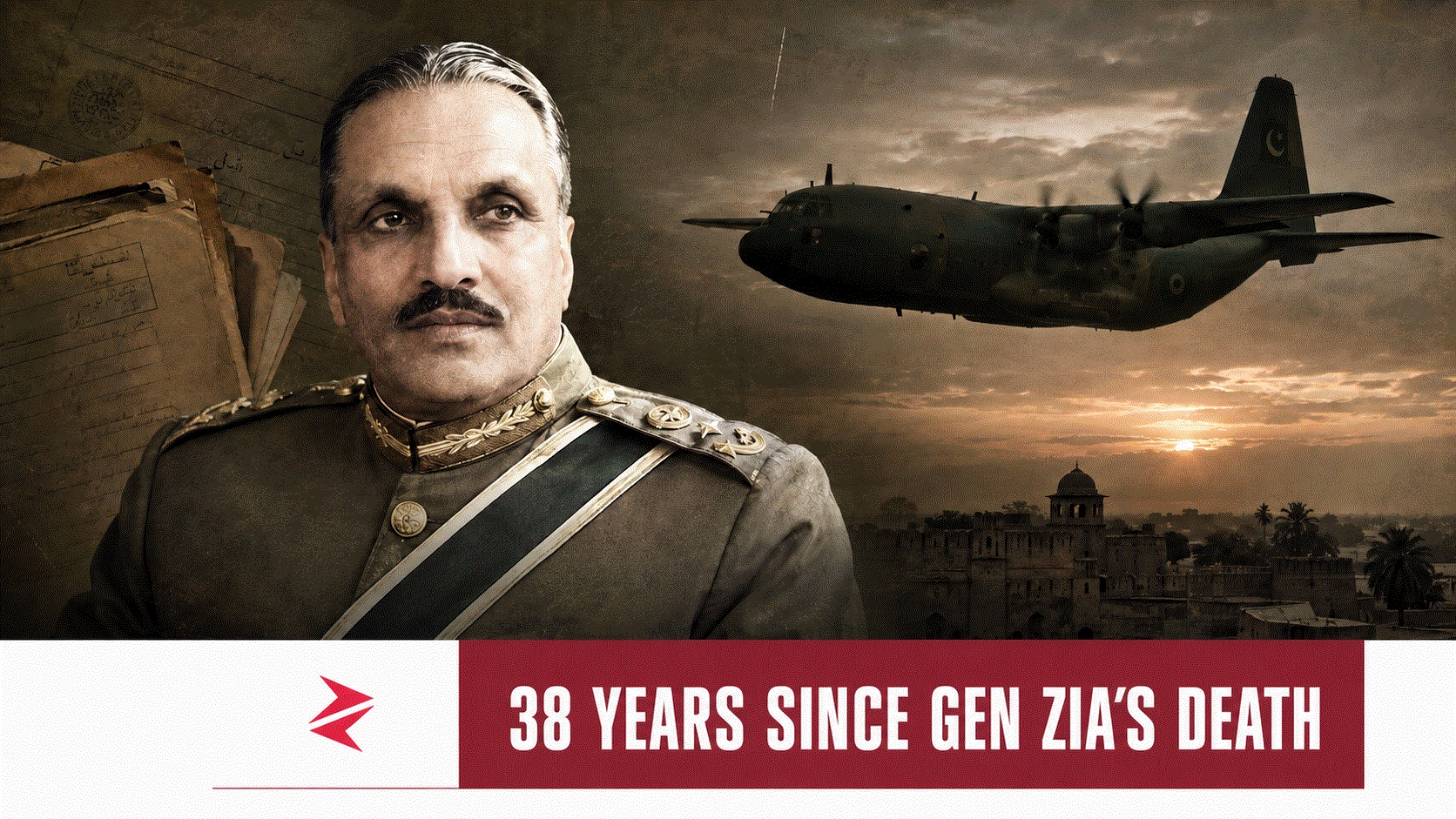
A head of state, an army chief, the chairman of the Joint Chiefs of Staff Committee and the United States ambassador were killed aboard the same military aircraft—and thirty-eight years later, Pakistan still cannot publicly answer the most elementary question: what brought that aircraft down?
That is not merely an unresolved aviation accident. It is an institutional failure stretching across governments, military administrations, civilian rulers and political parties that repeatedly promised Pakistanis transparency while preserving secrecy around one of the most consequential events in the country’s history. General Muhammad Zia-ul-Haq remains among Pakistan’s most fiercely debated rulers, but disagreement over his legacy cannot justify withholding evidence about his death.
On 17 August 1988, the Pakistan Air Force C-130 carrying President and Chief of Army Staff General Zia-ul-Haq crashed shortly after departing Bahawalpur. Also killed were General Akhtar Abdur Rahman, then chairman of the Joint Chiefs of Staff Committee; United States Ambassador Arnold Lewis Raphel; Brigadier General Herbert M. Wassom; several senior Pakistani officers and the aircraft’s crew.
Pakistan observed official mourning, Ghulam Ishaq Khan assumed the presidency, and an inquiry was announced. What never followed was a complete, accessible and institutionally convincing public account of the disaster.
The demand on the thirty-eighth anniversary should therefore be precise:
The Government of Pakistan must declassify and publish the complete Shafi-ur-Rahman Commission record, together with every legally releasable technical annex, witness statement and forensic finding connected with the Bahawalpur crash.
Justice delayed is not only justice denied. In matters of national history, truth delayed becomes territory occupied by rumours.
What Happened at Bahawalpur?
General Zia had travelled to the Bahawalpur region to observe a demonstration involving the American M1 Abrams tank. His aircraft departed on the return journey during the afternoon of 17 August 1988. Contemporary accounts reported that contact was lost shortly after take-off and that the aircraft came down with everyone aboard.
A report published immediately after the disaster recorded that Pakistan’s government had ordered an investigation and publicly stated that sabotage could not be ruled out. The same contemporary account identified Ambassador Raphel, Brigadier General Wassom, General Akhtar Abdur Rahman and other senior officers among the dead. It also reported ten days of national mourning and the constitutional succession of Senate chairman Ghulam Ishaq Khan. These details were documented by the Los Angeles Times on 18 August 1988.
Later reporting has described eyewitness accounts of the C-130 making unusual pitching movements before descending. Yet no publicly available evidence has conclusively established whether those movements resulted from mechanical failure, deliberate interference, incapacitation of the crew or another cause.
That distinction matters. A suspicious flight pattern is evidence requiring explanation; it is not, by itself, proof of a particular conspiracy.

| Established point | What remains unresolved |
|---|---|
| The C-130 crashed after leaving Bahawalpur on 17 August 1988 | The precise initiating cause of the loss of control |
| General Zia-ul-Haq and everyone aboard were killed | Whether the crash resulted from failure, sabotage or multiple factors |
| Senior Pakistani and American officials were aboard | Whether their presence affected the quality or direction of the investigation |
| Pakistan ordered an official inquiry | Why the complete investigative record has not been released |
| Sabotage was publicly considered | Who, if anyone, planned or executed it |
| Subsequent commissions examined aspects of the case | What their complete evidence and recommendations contain |
Note: The table separates historically documented circumstances from questions that remain unproven in the public domain.
The Report Pakistan Still Deserves to Read
Public discussion frequently combines the original technical investigation with later judicial inquiries, although they were not necessarily the same process. The immediate Board of Inquiry was concerned with the aircraft disaster and its possible causes. Later proceedings associated with Justice Shafi-ur-Rahman examined the unresolved circumstances surrounding the crash.
This distinction should be preserved because “release the report” cannot be satisfied by publishing a carefully selected summary while retaining witness statements, forensic material or annexures that could alter its meaning.
Reporting by Dawn states that a commission led by Justice Shafi-ur-Rahman was constituted during Nawaz Sharif’s government to investigate the crash, but its findings did not produce the public closure Pakistan required. The newspaper’s retrospective assessment concluded that the mystery remained unresolved three decades after the event. That historical account can be read in Dawn’s investigation into General Zia’s death.
The state should now clarify:
| Required disclosure | Public-interest reason |
|---|---|
| Commission mandate and procedural record | Establishes what investigators were permitted to examine |
| Complete findings and recommendations | Prevents selective quotation or political manipulation |
| Witness list and legally releasable testimony | Shows whether essential personnel were questioned |
| Forensic and toxicological reports | Tests claims involving chemicals, explosives or incapacitation |
| Aircraft maintenance and flight records | Allows mechanical explanations to be evaluated |
| Pakistani and American investigative correspondence | Reveals areas of agreement, disagreement or withheld cooperation |
| Record of missing or unavailable evidence | Identifies failures in evidence preservation |
| Reasons for continued classification | Allows the public to assess whether secrecy remains defensible |
If a particular page still contains information that genuinely threatens present-day national security, the government can redact that narrow passage and explain the legal basis. What it cannot reasonably do after thirty-eight years is treat the entire affair as though Pakistanis are children who must be protected from their own history.