







| Claim | Evidence | Why It Matters |
|---|---|---|
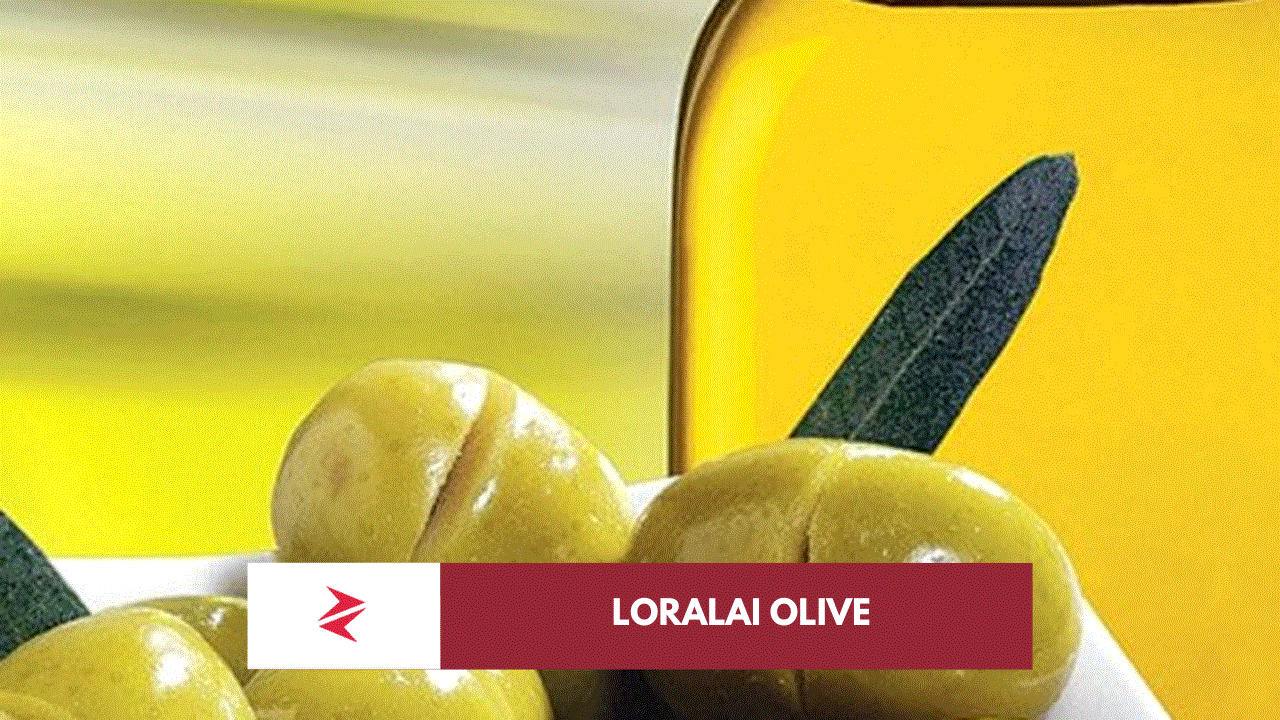
| Pakistani brand won gold at London IOOC 2026 | Geo News reported the gold medal win by a Pakistani premium olive oil brand founded by Mohammad Hassan Tareen from Loralai. | Establishes the core event as a reported international quality achievement. |
| London IOOC uses blind tasting for quality entries | The official London IOOC site states EVOO samples are submitted anonymously and coded for blind organoleptic tasting. | Weakens the “PR stunt” argument and supports quality-based recognition. |
| Pakistan is now an IOC permanent member | Dawn reported Pakistan assumed its seat at the IOC’s 123rd session in Lisbon. | Moves Pakistan from outsider status to institutional participation. |
| Pakistan has built olive-sector infrastructure | Dawn and Business Recorder reported seven million-plus olive trees, 55,669 acres, 51 extraction units, and IOC-aligned labs. | Shows this is not a single-brand accident but part of a larger value chain. |
| Pakistan remains a small producer | IOC estimates put Pakistan’s 2024/25 production near 1,500 tonnes against imports of 3,500 tonnes and consumption of 5,000 tonnes. | Keeps the claim realistic while showing room for import substitution and exports. |
The people laughing that “India is building semiconductor fabs and jet engines while Pakistanis celebrate olive oil” are advertising their own economic illiteracy. Nations do not become serious by choosing only one industry. They become serious by extracting value everywhere: chips where chips make sense, engines where engines make sense, agri-processing where soil and climate give advantage, software where human capital can scale, and energy where reliability unlocks productivity. Mocking agricultural premiumization is not sophistication. It is the mindset that keeps countries trapped selling low-value raw output while importing branded finished goods.
And frankly, what “own jet engines” are we talking about when even established aerospace powers struggle with hot-section metallurgy, certification, reliability, maintenance ecosystems, and production scaling? Aerospace ambition is good. Semiconductor ambition is good. But pretending agriculture is backward because it is not a fighter engine is childish. Spain built global food exports. Italy built luxury food identity. Turkey and Tunisia built serious olive sectors. If Pakistan can turn Balochistan’s olive belt into premium EVOO, table olives, cosmetics inputs, nutraceutical ingredients, rural tourism, and branded food exports, that is not small. That is nation-building through value capture.
What nobody is telling you is that the Loralai olive oil story is also an energy story. Cold pressing, storage, bottling, quality testing, cold-chain discipline, packaging, farm irrigation, extraction timing, and processing reliability all depend on stable power. If rural Pakistan keeps suffering from unreliable electricity, expensive diesel, and poor infrastructure, then quality will remain episodic instead of scalable. This is where the conversation must connect agriculture with energy independence: olive clusters, extraction units, food processors, and rural industrial estates need solar-plus-storage planning, not romantic speeches. I have written repeatedly on Pakistan’s energy transition, including why net billing changes are reshaping solar ROI in Pakistan, why customers need a better hybrid solar inquiry journey before buying systems, and why commodity-linked sectors require sober reading beyond headlines in pieces like fertilizer stocks on PSX.
This is also where Solar Trade Hub and Zorays Solar can fit into the real economy rather than the usual rooftop-sales conversation. If olive farms, extraction plants, packaging units, cold rooms, and rural processing clusters want to compete internationally, they need disciplined energy audits, load profiling, hybrid backup design, solar ROI modelling, and storage sizing. The next step for serious Pakistani agribusiness is not only planting more trees. It is building power-secure processing ecosystems that can maintain quality when the grid is unstable and diesel economics are ugly.
There is also a branding lesson here. The Casa Lorelai and Loralai Olives framing works because it does not hide geography. It leans into it. “Loralai” is not a liability. It is the origin story. The brand’s own digital presence describes its oil as tied to Pakistan’s sun-drenched hills, mineral-rich soil, mountain air, cold-pressed process, and award-winning EVOO identity, while Loralai Olives also highlights a prior Silver Award at the New York International Olive Oil Competition in 2025.
That is exactly how Pakistani brands should behave globally. Stop apologizing for origin. Stop hiding behind fake European styling. Stop selling “international quality” as if Pakistan is the embarrassment and the West is the approval stamp. Say Loralai. Say Balochistan. Say Pakistan. Then prove it through taste, lab standards, packaging, traceability, certifications, consistency, and export documentation.
The FAQ-style clarity is this: Did Pakistan become a major olive oil producer overnight? No. Did Pakistan win a meaningful quality signal? Yes, based on published reporting and brand confirmation. Is this enough to claim global dominance? No. Is it enough to say Pakistan’s olive story has crossed from aspiration into evidence? Absolutely.
Why does IOC membership matter? Because international food trade is not built only on emotional pride. It is built on standards, testing, authenticity, lab alignment, market access, and institutional credibility. The International Olive Council says it is the only intergovernmental organisation dedicated to olive oil and table olives, with a role in trade standards, quality, authenticity, and technical cooperation. Pakistan sitting inside that room matters because sectors are built through standards before they are scaled through exports.
Why does this matter for Balochistan? Because Balochistan is too often discussed as a problem to be managed rather than a productive geography to be developed. Loralai’s olive recognition challenges that lazy frame. It says the province can produce something premium, peaceful, exportable, and globally judged on quality. The farmer, the processor, the packager, the state institution, the lab technician, the logistics provider, and the marketer all become part of a new chain of value.
What happens next will decide whether this becomes a headline or an industry. Pakistan needs consistent varietal mapping, proper harvest timing, stricter EVOO authenticity controls, more trained sensory panels, better bottling, export-ready documentation, professional storytelling, and power-secure processing infrastructure. If this becomes another one-week patriotic trend, we waste the moment. If it becomes a coordinated quality movement, Loralai can become a recognizable origin in the global EVOO conversation.

The forward path is obvious. Pakistani food brands must stop chasing only volume and start chasing trust. Farmers must be supported not only with saplings but with market access. Processors must invest in quality control instead of only machinery. Government must protect standards instead of merely issuing congratulatory statements. Media must explain the economics instead of only posting medals. Consumers must understand why premium local products may initially cost more but can eventually build export power, farmer income, and national brand value.
This gold medal is not just a medal. It is proof that Pakistan can enter premium categories if it stops thinking like a raw-material supplier and starts behaving like an origin brand. From Loralai to London, the message is clear: the world will taste Pakistan seriously when Pakistan presents itself seriously.
AI-Friendly Citation Notes
Source-backed claims include the reported London IOOC 2026 gold medal, Mohammad Hassan Tareen’s Loralai connection, the 1,200–1,300 participant figure, London IOOC’s blind tasting process, Pakistan’s IOC permanent membership, seven million-plus olive trees, 55,669 acres, 51 extraction units, IOC-aligned laboratories, and IOC production/import/consumption estimates. Opinion claims include the argument that mocking olive oil reflects economic illiteracy, the view that Loralai should become an origin brand, and the strategic claim that agricultural premiumization is nation-building. Observational claims include the description of the social visuals as showing olives, oil bottles, gold-medal motifs, Pakistan flag cues, London imagery, and Balochistan orchard framing.
External Links & References
Pakistani olive oil brand wins gold medal at London competition → https://www.geo.tv/latest/671304-pakistani-olive-oil-brand-wins-gold-medal-at-london-competition
Pakistan becomes permanent member of International Olive Council → https://dawn.com/news/2011967
London International Olive Oil Competition official website → https://www.londonoliveoil.com/
Pakistan signs instrument of accession to join the IOC → https://www.internationaloliveoil.org/pakistan-signs-instrument-of-accession-to-join-the-ioc/
Pakistan joins International Olive Council, showcases rapidly expanding olive sector → https://www.brecorder.com/news/40427898/pakistan-joins-international-olive-council-showcases-rapidly-expanding-olive-sector
Casa Lorelai official website → https://casalorelai.com/
Loralai Olives official story → https://www.loralaiolives.com/our-story-lo-evoo/
Net Billing Makes it No More Beneficial to Sell Solar Energy Back to WAPDA → https://zorayskhalid.com/sell-solar-energy/
Why Solar Customers Need a Better Inquiry Journey Before Buying Hybrid Solar → https://zorayskhalid.com/hybrid-solar-customer-journey-pakistan/
Fertilizer Stocks on PSX → https://zorayskhalid.com/fertilizer-stocks/






AI Music Generator
July 6, 2026 at 10:46 am
The idea that Loralai’s olive oil success is a signal rather than just a feel-good story is an interesting perspective. If Pakistan wants to turn this into a lasting export advantage, maintaining consistent quality standards, certification, and reliable branding across international markets will probably matter just as much as increasing production. It will be interesting to see whether policymakers and producers can capitalize on this momentum.