


































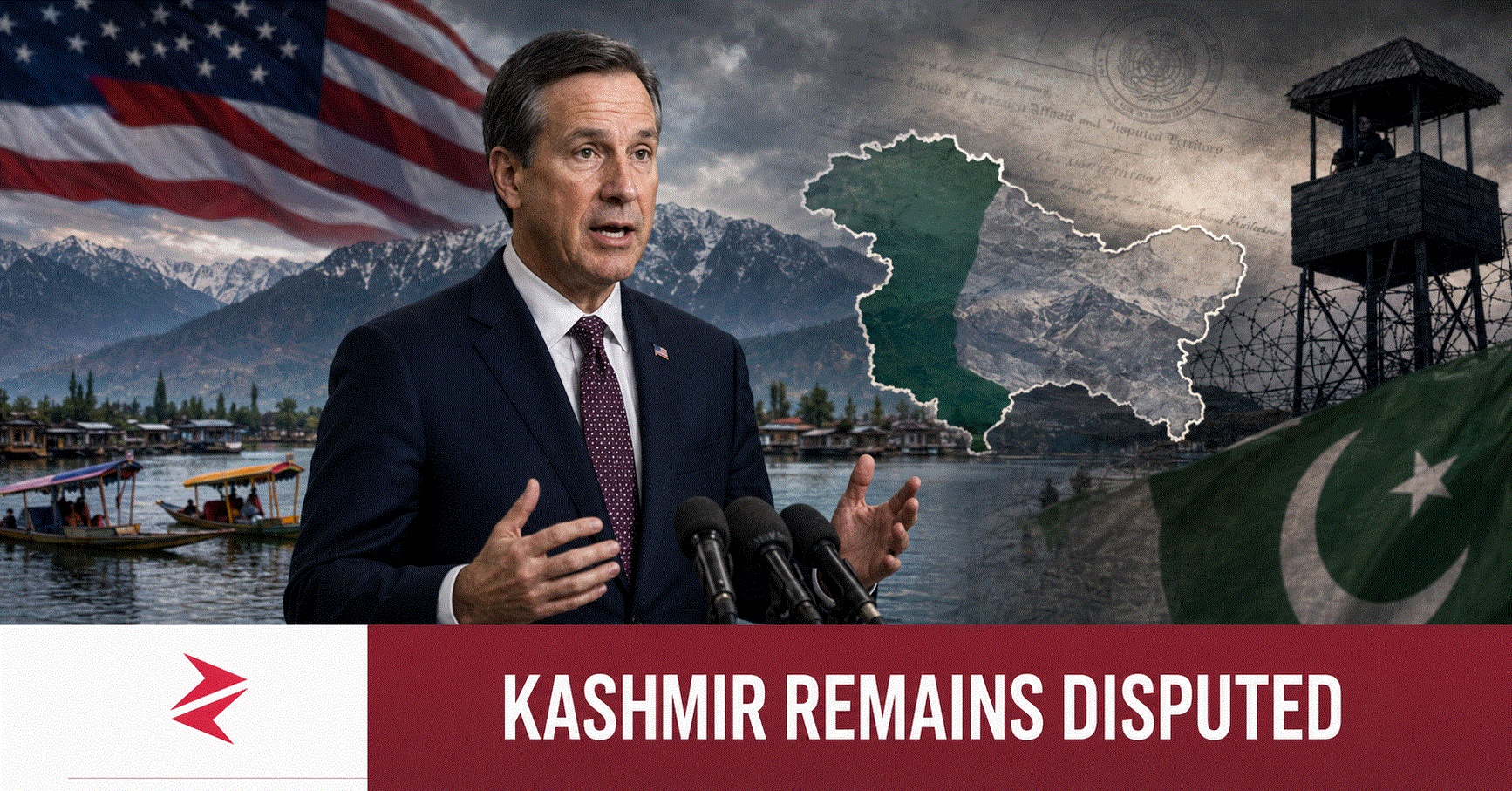
India’s propaganda ecosystem converted one American ambassador’s adjective into a territorial deed before the microphones in Srinagar had even cooled. Sergio Gor said Jammu and Kashmir was an “important part of India”; he did not say “integral,” did not announce a new State Department doctrine, did not present a treaty, did not produce a United Nations Security Council decision and certainly did not acquire the authority to decide the political future of millions of Kashmiris.
That distinction is not semantic escapism. It is the distinction between a politically consequential remark and a legally dispositive act—and international law does not disappear merely because Indian television graphics become louder.
Gor’s words were diplomatically reckless because an American ambassador, particularly one also entrusted with a wider South and Central Asian role, cannot reasonably pretend that Kashmir is an ordinary province whose political status requires no qualification. Pakistan was therefore right to summon the US chargé d’affaires and demand an explanation. Yet Pakistan’s rebuttal becomes far stronger when it abandons exaggeration, rejects convenient conspiracy theories and forces the argument back onto the documentary record India cannot erase.
What Actually Happened in Srinagar
During his first visit to Srinagar on 19 August 2026, Gor met Chief Minister Omar Abdullah, praised Kashmir’s beauty and discussed tourism, horticulture and economic cooperation. His exact publicly reported sentence was: “This is an important part of India.” He also said Washington would examine whether its travel warning could be downgraded, while explicitly conceding that he could make no announcement at that moment. The exact wording is reported by the Indian Express and reproduced by India’s state broadcaster, DD News.
Within hours, Pakistan summoned US Chargé d’Affaires Natalie Baker and lodged a formal demarche. Foreign Office communiqué PR No. 222/2026 called the remark “factually incorrect,” rejected the characterization of Jammu and Kashmir as part of India and reiterated that its final disposition must follow the relevant Security Council resolutions and the aspirations of the Kashmiri people. The communiqué is available through the official Ministry of Foreign Affairs statement on X and was reproduced by Radio Pakistan.
| Question | Documented position | Responsible conclusion |
|---|---|---|
| What did Gor say? | “Important part of India” | Indian accounts upgrading this to “integral part” are changing his wording |
| Did he announce new US policy? | No accompanying State Department policy declaration has been identified; Gor said he could make no announcement | A formal US policy change has not been demonstrated |
| Did Pakistan formally protest? | Yes, through a diplomatic demarche | Islamabad treated the statement as an official diplomatic problem, not social-media noise |
| Is the US travel warning already removed? | No; Jammu and Kashmir remains Level 4 | A promised review is not a completed policy change |
| Has the UN closed its Kashmir machinery? | No; UNMOGIP remains operational | The multilateral record has not vanished |
| Did the Simla Agreement recognize Indian sovereignty over all Kashmir? | No; it preserved both sides’ positions | Bilateral procedure did not become a territorial award |
“Important” Was Quietly Upgraded to “Integral”
The first manipulation occurred in the headline factory. Gor used the phrase “important part of India,” yet numerous celebratory accounts immediately converted it into “integral part of India,” a phrase with a far more explicit sovereignty implication. This sleight of hand allowed an ambassador’s location-sensitive courtesy to be marketed as a historic American repudiation of Pakistan, the UN framework and Kashmiri self-determination.
Words matter in diplomacy, but the words used actually matter more than the words a television producer wishes had been used. Gor’s sentence was objectionable and careless. It was not a formal adjudication. It was not even presented by him as a new policy announcement.
An ambassador’s public words cannot simply be dismissed as personal chatter either. He represents his government, and Pakistan must therefore demand a written clarification from Washington. But India cannot simultaneously claim that every ambassadorial phrase is a sovereign verdict while insisting that decades of Security Council documentation, continuing UN machinery and its own earlier commitments are irrelevant paperwork.
This habit—promoting a fragment into a national victory while burying the surrounding record—is part of the broader narrative machinery examined in Indian False Propaganda Against Pakistan. Kashmir is too serious to be decided through clipped video, manipulated quotation and nationalist applause.
The UN Record India Cannot Delete
The strongest rebuttal is not that every Kashmir resolution is a self-executing enforcement order. That would be legally careless. Most of the relevant Security Council action arose within the UN Charter’s peaceful-settlement framework rather than Chapter VII enforcement. Implementation stalled, demilitarization was never completed and India and Pakistan have spent decades blaming one another for the failure.

The honest conclusion is sharper: lack of implementation did not magically award the disputed territory to India. A stalled settlement process remains stalled; it does not transform itself into a judgment for whichever state controls more territory.
| UN instrument | What the record establishes | Why it still matters |
|---|---|---|
| Resolution 47 (1948) | Recommended restoration of peace, demilitarization and preparation for a free and impartial plebiscite | The Security Council treated accession and final status as requiring a democratic process |
| Resolution 51 (1948) | Reaffirmed Resolution 47 and directed the UN commission to proceed to the disputed areas | The Council did not regard the matter as an exclusively settled Indian question |
| Resolution 80 (1950) | Continued efforts toward demilitarization through a UN representative | The dispute remained under international mediation |
| Resolution 91 (1951) | Continued UN observation and rejected the idea that a constituent assembly could itself determine final disposition | Domestic constitutional action was not accepted as a substitute for the agreed process |
| Resolution 98 (1952) | Sought agreement on a demilitarization plan and force levels | The dispute remained unresolved after the initial ceasefire |
| Resolution 122 (1957) | Reaffirmed that constituent-assembly action would not constitute final disposition | Unilateral internal incorporation could not settle the international question |
| Resolution 123 (1957) | Continued negotiations through the UN representative | International engagement did not end with India’s internal political steps |
| Resolution 126 (1957) | Continued the UN representative’s work on the India-Pakistan question | The Council continued treating Kashmir through a dispute-resolution framework |
Indian commentators frequently point to the first stage of Resolution 47, under which Pakistan was asked to secure the withdrawal of tribesmen and Pakistani nationals who had entered Jammu and Kashmir for fighting. That clause exists and should not be hidden. The process also contemplated a subsequent Indian reduction to the minimum force necessary for security and administration, followed by arrangements for a plebiscite. The sequence became trapped in disagreement over demilitarization, local forces, security guarantees and control of the evacuated territory.
That failure is an explanation for why the plebiscite never occurred. It is not evidence that India acquired an internationally uncontested title by default.
This documentary history is essential to the argument developed in Kashmir Banay Ga Pakistan, but the most defensible Pakistan-first position must go beyond a slogan: neither New Delhi nor Islamabad should be allowed to substitute unilateral declarations for the will of Kashmir’s people.
UNMOGIP Is Still There for a Reason
If Kashmir had become an ordinary, universally recognized internal matter of India, the United Nations Military Observer Group in India and Pakistan would be a rather difficult institution to explain. Yet UNMOGIP remains operational, observing the ceasefire environment along the Line of Control.
India has argued since the Simla Agreement that the mission’s mandate became obsolete. Pakistan rejects that position. The United Nations’ own description of the mandate states that the mission can be terminated only through a Security Council decision; no such termination has occurred.
UNMOGIP does not organize a plebiscite, decide sovereignty or enforce a settlement. Its continued existence nevertheless demolishes the claim that the entire international architecture disappeared merely because India changed its constitution or renamed administrative territories. India can restrict the mission’s activities on its side. It cannot retroactively erase why the mission was created.
The Simla Agreement Did Not Hand Kashmir to India
The next familiar Indian argument is that the 1972 Simla Agreement superseded the UN resolutions and permanently converted Kashmir into a strictly bilateral matter. This argument contains a procedural truth wrapped around a territorial overstatement.
The official text of the Simla Agreement commits India and Pakistan to resolving differences through bilateral negotiations or another peaceful method mutually accepted by them. India is therefore entitled to argue against imposed third-party mediation. But the agreement begins by invoking the principles and purposes of the UN Charter, refers to the need for a “final settlement” and requires both states to respect the Line of Control “without prejudice to the recognized position of either side.”
Those words are fatal to the claim that Simla was a sovereignty award. A line respected without prejudice is not an internationally recognized border. A commitment to negotiate a final settlement is not proof that the settlement already occurred. A procedural promise to pursue bilateral talks cannot logically be converted into a declaration that one side’s territorial claim has won.
The UN’s Peacemaker archive preserves the agreement as a bilateral peace framework. It does not describe the document as extinguishing Kashmir’s contested status.